
Why AI Needs Sleep: Saving Machines from Digital Amnesia

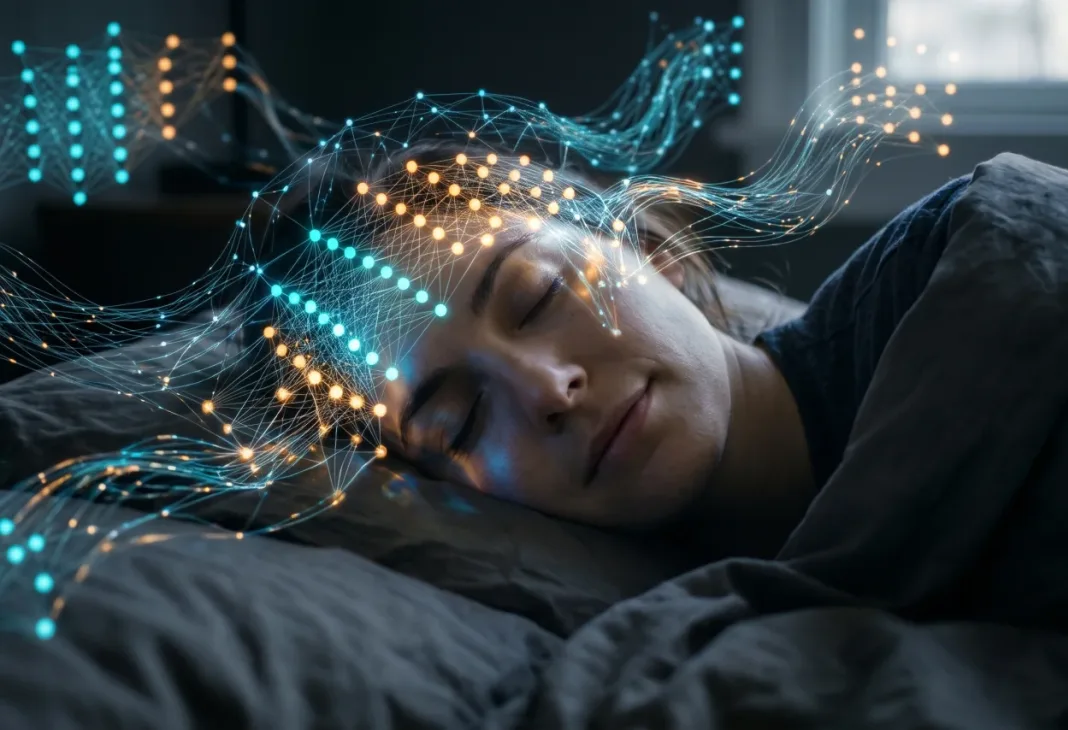
When we deprive ourselves of sleep, our cognitive architectures begin to fall apart. Every biological brain needs sleep to recharge its cells and turn daily experiences into lasting memories (Diekelmann & Born, 2010). Similarly, when an artificial neural network continues training with new data inputs, it quickly loses its previously acquired knowledge due to a problem called catastrophic forgetting (Kumaran et al., 2016; Tadros et al., 2022). In order to learn how to generalize information without overwriting their previous knowledge, AI systems need a digital version of "sleep" so they can mimic the way our brains integrate new information (Tadros et al., 2022).
Why Neural Networks Forget
Think of a computer hard drive: all your files are stored in organized folders with their own isolated paths. Artificial neural networks work in a completely different manner. They model the neocortex, the outer layer of the brain where long-term knowledge exists. Instead of each memory being separate from the next, memories are tied into one web of neuronal connections, which must gradually be adjusted over time (Kumaran et al., 2016; Diekelmann & Born, 2010).
As neuroscientist Dharshan Kumaran and colleagues (2016) explain, forcing this web to learn something new too quickly triggers a fatal flaw. If a person sees a lion at a watering hole, they will need to immediately remember, to save their life, how to react when a lion appears. However, if a computer network quickly rewrote all of its links so as to "lock in" the knowledge that lions are present, it would be rewriting the links that contained the memory of the previously learned, less-threatening animals.
This "catastrophic forgetting" is avoided by humans with the help of the hippocampus, an area in the brain that acts like a fast, temporary "notepad" for daily events. The hippocampus quickly stores the lion experience and then leaves the neocortex largely unaltered. During sleep, the hippocampus will replay these stored experiences to the neocortex, allowing for a safe, slow transfer into permanent storage (Kumaran et al., 2016; Diekelmann & Born, 2010). Since artificial intelligence lacks this notepad, it has no choice but to overwrite existing information when creating new information (Tadros et al., 2022).
The Brain's Offline Blueprint
How does the brain safely move these fragile notes into permanent storage? Neuroscientists Susanne Diekelmann and Jan Born (2010) show that the brain needs to go completely "offline" during deep, slow-wave sleep to do this.
The rhythmic patterns in the brain function like a conductor while you sleep. The sweeping slow waves work with rapid signals from the hippocampus and brief bursts of brainwaves—"sleep spindles"—which together replay the events from your day in fast-forward. This assists the neocortex in forming memories for future reference by integrating new memories into already established network structures without interfering with old memories.
Crucially, sleep does more than just hit "save." It pulls out overarching patterns from day-to-day experiences and eliminates weaker links between neurons in order to avoid overloading the neural network and, when it awakens, allows for new learning (Diekelmann & Born, 2010). This can be considered a biological model for how AI could learn, giving researchers a way to develop this concept further.
Giving the Digital Brain a Bedtime
To convert the biological form of this magic into a silicon one, researchers developed the Sleep Replay Consolidation (SRC) algorithm (Tadros et al., 2022). Instead of needing large amounts of memory to store past data, an artificial neural network goes into an offline "sleep" mode immediately after learning a new skill.
In its sleep state, the system is exposed to random background noise as opposed to receiving new information about the world. This noise triggers the network's internal connections—its "weight architecture"—to spontaneously play back previously learned patterns of neural activity.
The network's local, unsupervised Hebbian learning rules—brain-inspired self-learning rules—guide how it rearranges its digital connections, which correspond to synapses in biological systems. These rules are based on a simple principle: if two neurons are active at the same time, they wire together. Without direct human supervision, the network automatically prunes interfering pathways while strengthening pathways associated with older memories, allowing the machine to separate overlapping information and thus avoid digital amnesia (Tadros et al., 2022).
What Happens While the Machine Dreams
What this noise-driven replay accomplishes in the artificial environment is remarkable: it creates decorrelation. As a network trains on a new task during "active" learning, its parameters naturally begin to be biased toward newer data as opposed to older data. By allowing activity to flow freely through the network via random signals during offline "sleep," the system locates where old and new memory traces overlap (Tadros et al., 2022).
Unlike many methods that avoid conflicts between skills by either storing past data or freezing prior connections, this approach offers a distinct advantage. The algorithm increases representational sparseness. This is done by allocating artificial neurons into discrete clusters for specific tasks with varying levels of similarity. In doing so, it sharpens the distinction between concepts that share similarities. Similar to how biological sleep downscales noisy synaptic connections to help restore cognitive homeostasis, digital "sleep" restores a balanced distribution of weights across the network. Thus, previous knowledge can be easily revived without disturbing recently obtained knowledge (Diekelmann & Born, 2010; Tadros et al., 2022).
Conclusion: The Future of Lifelong Learning
While overcoming catastrophic forgetting in AI is difficult in itself, nature has already provided the ultimate model (Kumaran et al., 2016; Diekelmann & Born, 2010; Tadros et al., 2022). By developing a "brain-inspired sleep," researchers are eliminating the need for artificial networks to store endless amounts of raw data. This work is narrowing the long-standing gap between artificial neural networks (ANNs) and biological lifelong learning.
As AI systems become more complex and perform increasingly sequential real-world tasks, giving them a "bedtime" will no longer be simply an interesting analogy—it will be a necessity. If artificial networks can be taught to shut down, experience a form of dreaming, and rearrange their internal environments much like biological brains do, it could ultimately define the next era of artificial intelligence: saving these synthetic minds from digital amnesia (Tadros et al., 2022).
Kaynakça
- Diekelmann, S., & Born, J. (2010). The memory function of sleep. Nature Reviews Neuroscience, 11(2), 114–126. https://doi.org/10.1038/nrn2762
- Kumaran, D., Hassabis, D., & McClelland, J. L. (2016). What learning systems do intelligent agents need? Complementary learning systems theory updated. Trends in Cognitive Sciences, 20(7), 512–534. https://doi.org/10.1016/j.tics.2016.05.004
- Tadros, T., Krishnan, G. P., Ramyaa, R., & Bazhenov, M. (2022). Sleep-like unsupervised replay reduces catastrophic forgetting in artificial neural networks. Nature Communications, 13(1), Article 7742. https://doi.org/10.1038/s41467-022-34938-7