
The Ones Who Feel Like Home: What Our Cats Teach Us About Attachment

There is a particular kind of love in having a cat. It lives in the small things: a warm body curled beside you, a familiar face waiting for you, or the quiet company of someone who seems perfectly content simply to be near you. Cats have their own personalities, preferences, and ways of showing affection. Yet, without our quite noticing when it happens, they become part of what home means to us.
Why can an animal become so important to us that losing them feels like losing a part of ourselves? Psychology offers one way to understand this: attachment.
More than just a pet
We usually associate attachment with our relationships with parents, romantic partners, or children. According to attachment theory, developed by psychologist John Bowlby, close relationships provide two important things: a safe haven when we feel distressed and a secure base from which we can explore the world (Bowlby, 1982).
Think about what this looks like in everyday life. After a difficult day, you might sit beside your cat, stroke their fur, or listen to them purr. They do not need to understand what went wrong or offer advice. Their presence alone might make the world feel a little less overwhelming.
Research suggests that these bonds are not simply a human tendency projected onto animals. In a study published in Current Biology, Vitale and colleagues (2019) found that cats can form distinct attachment relationships with their human caregivers. Some cats showed patterns of attachment associated with feeling secure in their caregiver's presence. This challenges the familiar assumption that cats are too independent to form meaningful emotional bonds with people.
Independence and attachment are not opposites. A relationship does not have to involve constant affection or attention to be meaningful. Sometimes, the comfort comes from knowing that another living being is there, sharing your world in their own way.
Research by Zilcha-Mano and colleagues (2012) also explored how pets can function as safe havens and secure bases. Their findings suggest that our relationships with animals can provide a sense of comfort and confidence. Although not every pet relationship works in the same way, this research helps explain why the presence of a beloved animal can feel so reassuring.
Over time, our animals become woven into the ordinary details of life. We learn their habits, recognize their moods, and organize our days around their needs. They are there through changing jobs, new homes, difficult periods, and happy moments. Eventually, they become witnesses to our lives in a way that few others can be.
Why losing them hurts so much
The significance of attachment often becomes clearest when we lose the one to whom we are attached.
When a beloved animal dies, we lose more than their physical presence. We lose the familiar routines, the small daily interactions, and the relationship that had become part of our emotional world. We might still expect to see them in their favourite spot or instinctively listen for their familiar sounds. The home remains, but something fundamental about it has changed.
Research by Eckerd and colleagues (2016) found that the closeness of a relationship was an important factor in grief following the loss of either a person or a pet. The depth of our grief is not determined simply by whether the relationship was with a human or an animal. It also reflects how much that relationship mattered to us.
This is worth remembering in a world where pet loss is sometimes dismissed with the suggestion that it was “just a cat” or “just a dog.” Our grief does not need to be justified by someone else's understanding of the relationship. If an animal was part of our daily life, offered companionship, and helped us feel at home, losing them can leave a profound absence.
Attachment does not simply disappear when physical closeness ends. We continue to carry relationships through memories, familiar habits, and the ways in which those relationships have shaped us. We can miss someone deeply while remaining grateful for the time we shared with them. These feelings are not contradictory; they are part of loving someone who is no longer physically present.
Twenty-two years with Baddiz
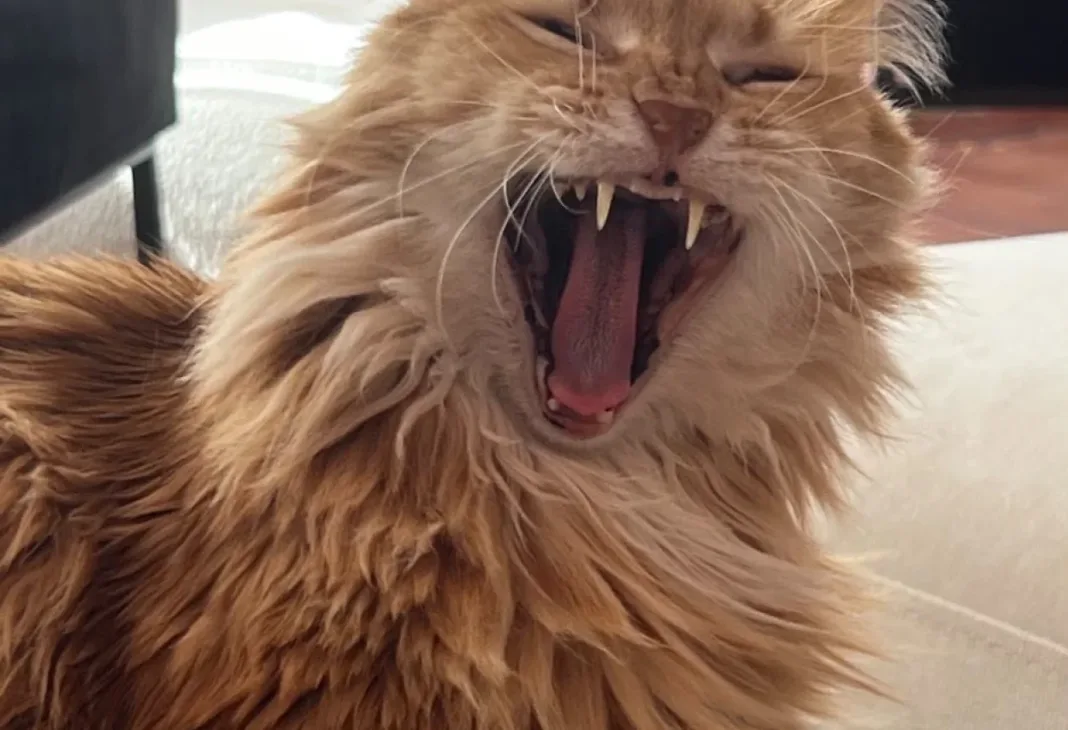
My fluffy orange cat, Baddiz (Potato) was part of my life for 22 years. She was not just my cat; she was my other half. And now that she is no longer here, I cannot explain the pain by words.
I wish I could have kept you forever. I wish I could have had just a little more time. But I will never forget you, your silly face, your purrs, your cattitude, your shenanigans, and your various meows. I will cherish every memory we made for the rest of my life. Whenever I eat chicken or fish, I will eat a little extra for you, my sweet little potato.
Goodbye, my sweet Potato. You may no longer be beside me, but you will always be a part of me. You were my home, my other half, and one of the greatest loves of my life. I was so lucky that you chose me. I hope you will have all the chickens, fishes, churus, and wet food wherever you are now. And yeah, bugs are in trouble there! The potato is in town!!
I will love you for as long as I live. And I will find you once more when the time comes.
Kaynakça
- Bowlby, J. (1982). Attachment and loss: Vol. 1. Attachment (2nd ed.). Basic Books.
- Eckerd, L. M., Barnett, J. E., & Jett-Dias, L. (2016). Grief following pet and human loss: Closeness is key. Death Studies, 40(5), 275–282. https://doi.org/10.1080/07481187.2016.1139014
- Vitale, K. R., Behnke, A. C., & Udell, M. A. R. (2019). Attachment bonds between domestic cats and humans. Current Biology, 29(18), R864–R865. https://doi.org/10.1016/j.cub.2019.08.036
- Zilcha-Mano, S., Mikulincer, M., & Shaver, P. R. (2012). Pets as safe havens and secure bases: The moderating role of pet attachment orientations. Journal of Research in Personality, 46(5), 571–580. https://doi.org/10.1016/j.jrp.2012.06.005