



The world is often held together by invisible stitches we rarely notice. When we wake up in the morning, we trust that the ground will support us, that our loved ones are safe, and that life unfolds within a general framework of justice. These silent assumptions function as psychological frameworks that allow us to continue living.
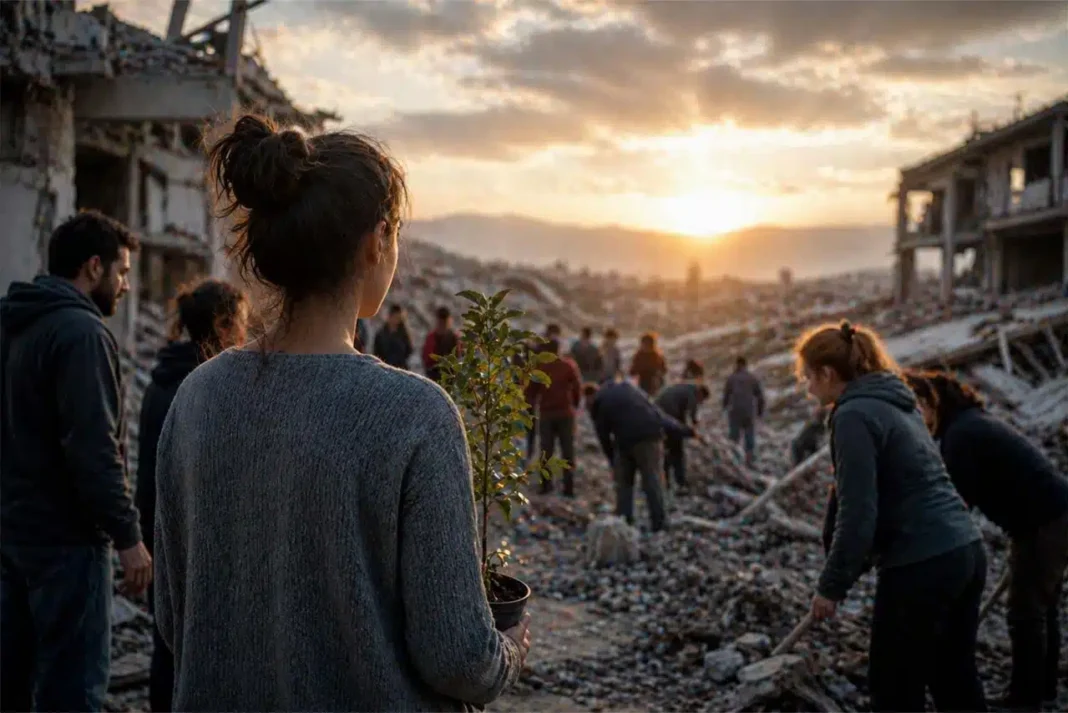
However, collective traumas —such as major earthquakes, wars, pandemics, or mass losses— suddenly tear these invisible stitches apart. In that moment, it is not only buildings that collapse, but also our way of perceiving the world. What is destroyed is not only external reality, but also the belief in a “safe world” that holds it together.
So is every shock merely destruction, or do these cracks allow a new form of meaning to emerge?
How Does Trauma Shatter Fundamental Assumptions?
Psychologist Ronnie Janoff-Bulman suggests that human beings need three core assumptions to maintain psychological stability: that the world is fundamentally good, that life is meaningful and just, and that the self has inherent value. Trauma violently shatters this protective glass dome.
For this reason, individuals begin to ask not only “What happened to me?” but also “What kind of world am I living in?” During collective trauma, people may become lost in questions such as: “If the world is safe, why did this happen to me?” or “If life is just, why do innocent people suffer?”
This is not merely the pain of an event; it is the end of the world as it was previously known. Old mental maps no longer point to new paths, and individuals are left in an existential void where no familiar ground remains.
This state of “emptiness” is one of the most fragile yet transformative thresholds of the human psyche. When old beliefs collapse, two possibilities remain: either to remain stuck in that void or to construct a new system of meaning. And it is precisely here that post-traumatic growth begins to take shape.
Is it Possible to Rebuild Beliefs?
After trauma, an individual either remains trapped in this state of emptiness or begins to construct a new system of meaning. This second possibility is precisely what is referred to as post-traumatic growth. However, this process of reconstruction is not about rebuilding the same building on the same foundation. Rather, it is about selecting the intact bricks from the ruins and integrating them into a new architecture that is resilient to future shocks.
According to Richard Tedeschi and Lawrence Calhoun, this form of growth is not the elimination of pain, but the reconstruction of meaning alongside it. The key point here is that our former “glass-like” beliefs are replaced by more “flexible” structures. Pre-trauma beliefs are often smooth but fragile. In contrast, rebuilt beliefs resemble bamboo that bends in the wind but does not break.
The individual no longer holds on to the illusion of a completely safe world; instead, they accept that the world is inherently risky, while also recognizing their own internal capacity to build trust and stability despite that risk.
Five Psychological Transformations Born From Pain
Researchers Richard Tedeschi and Lawrence Calhoun have shown that individuals can experience meaningful transformation in five key areas as a result of this process.
The first of these transformations is a profound shift in the perception of resilience. After enduring a highly challenging experience, the individual does not merely say “I survived it”; they also rediscover their inner strength. The sense of self that once felt fragile is transformed into a deeper feeling of resilience, grounded in the realization that they were able to endure difficult conditions.
This internal strengthening is accompanied by a deepening of external relationships. Trauma makes the superficial aspects of human relationships more visible; it becomes clearer who truly remains present during difficult times and who is only there when things are easy. Although this selectivity may seem like a narrowing of social ties, it actually leads to more authentic and sincere connections.
This clarification in relationships also enables individuals to rediscover the value of life itself. Ordinary moments of daily life —a morning light, a sound, a facial expression— begin to carry a much deeper meaning. The fragility of life makes the small moments that are often overshadowed by major tragedies suddenly visible and precious.
For individuals who begin to feel the limited and unpredictable nature of life more deeply, new possibilities start to emerge. This awareness brings postponed decisions and suppressed desires back into focus; people begin to explore new directions they previously did not have the courage to pursue.
Ultimately, this entire process culminates in a spiritual and philosophical transformation. The individual begins to question existence, meaning, and the wholeness of life on a much deeper level. This painful yet transformative journey ends with a broader perspective and a significantly deeper inner awareness.
Collective Healing and Collective Memory
Collective traumas do not only create individual ruptures; they also form and reshape a collective memory. Collective memory refers to the shared process through which a society remembers, interprets, and emotionally organizes its past.
It is not a passive archive of events, but an active system of meaning that shapes identity, belonging, and future expectations. Traumatic experiences become reference points that redefine a society’s sense of safety and trust.
What matters is not only what is remembered, but how it is remembered. If collective memory is shaped mainly through loss, destruction, and helplessness, it may reinforce long-term insecurity. However, when it also includes solidarity, mutual aid, and collective rebuilding, it becomes a psychological resource for resilience.
Collective memory also answers not only “what happened?” but also “how did we survive it together?” In moments of crisis, helping strangers, sharing resources, and rebuilding collectively do more than meet immediate needs —they actively reshape collective memory in real time.
Each act of solidarity strengthens the shared belief that human beings are capable of care and connection even under extreme conditions. In this way, collective memory does not merely preserve the past; it continuously reconstructs it.
Ultimately, collective memory becomes a living structure that shapes not only how a society understands its past, but also how it builds its future. A society that remembers trauma only through fragmentation tends to reproduce fear, while a society that also remembers resilience creates a foundation for trust, healing, and social cohesion.
Collective memory is therefore not just a record of what was lost, but also a framework for what can still be rebuilt.
References
Janoff-Bulman, R. (1992). Shattered Assumptions: Towards a New Psychology of Trauma. Free Press.
Tedeschi, R. G., & Calhoun, L. G. (2004). Posttraumatic growth: Conceptual foundations and empirical evidence. Psychological Inquiry, 15(1), 1–18.
Bonanno, G. A. (2004). Loss, trauma, and human resilience. American Psychologist, 59(1), 20–28.
Frankl, V. E. (2009). Man’s Search for Meaning. Beacon Press.
Herman, J. L. (1992). Trauma and Recovery. Basic Books.
Jung, C. G. (1959). The Archetypes and the Collective Unconscious. Princeton University Press.