


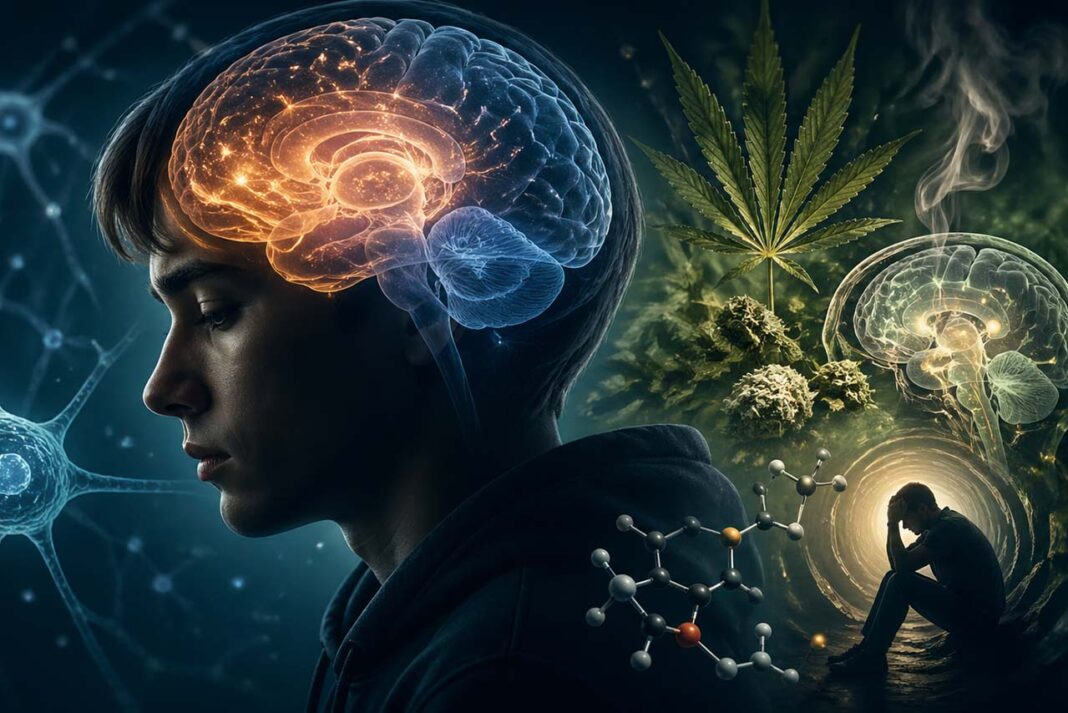

Cannabis use has become increasingly common worldwide in recent years, with many countries accelerating their legalization processes. While this substance was once associated with a specific subculture, its increasing prevalence due to changing social environments, cultures, and economic conditions has led to two extremes: It is either considered a substance for relief or evaluated for its potential risks. But beyond these discussions, there appears to be a fundamental question: how does marijuana affect the brain?
In order to discuss the substance, first we must understand how marijuana affects one’s body and brain, how it interacts with the dopamine system, why it makes people high, and how it causes addiction.
How Cannabis Works in the Brain
When cannabis is consumed, two main compounds called THC and CBD enter the body. CBD has more calming effects, while THC is the substance that causes us to get high and creates a change in the mesolimbic system, which is the brain’s reward system. This system is basically made up of three components: the prefrontal cortex, which manages decision-making and risk-taking processes; the reward and pleasure center; and the dopamine release center.
This system decides what is important for us and what is worth repeating. For instance, our social interactions and eating are also controlled by this system. But the use of cannabis changes these mechanisms by binding THC molecules to our receptors and activating the dopamine system. That is why people feel instantly better and reach the euphoric state of being “high.” But it also affects our self-control mechanisms, the sense of what feels meaningful and worth paying attention to, and some behavior patterns that may become repetitive over time or harder to control.
What Does Getting High Actually Mean?
Being high is not only about feeling better; it actually significantly changes the way our brain interprets information. When people are under the effects of THC, their sense of time starts working differently, the attention span decreases, colors might appear more vivid, some patterns might become more noticeable, and dizziness may occur.
Also, the flow of thoughts changes. Some people might feel like their self-awareness is increased and they are more focused on their thoughts. While some people find it interesting and relaxing, for others it can increase anxiety. Even in some individuals with genetic vulnerability, cannabis may cause psychotic symptoms and might even trigger schizophrenia.
Repeated Use
However, these effects do not remain the same over time, they become reversed. The brain becomes adapted to continuous usage of marijuana, and it develops a tolerance, which means you cannot get the same effect anymore with the same dose. In order to catch that euphoric feeling that one felt at first, individuals need to consume more and more. The reason is that the reward system in the brain also changes, and over time the brain becomes desensitized to THC.
That also affects one’s personal life, because activities that one liked before might not feel the same, and a person might feel anhedonia, which stands for not being able to enjoy life, because the brain starts responding less to natural rewards.
Another change also occurs in the brain, especially in the prefrontal cortex, which is responsible for our social connections, decision making, and risk evaluation mechanisms. It is one of the last brain regions to fully develop. So, usage of the substance at early ages might cause more damage in the brain.
How it Becomes an Addiction
The mesolimbic system not only creates a sense of reward, it also controls which actions are going to be repeated. THC kind of hacks this system by increasing the release of dopamine, and this leads to certain experiences being coded as more important. At this point, the prefrontal cortex, also known as the decision-making and impulse control center, becomes weaker under strong reward signals and may fail to make logical decisions. The brain then tends to choose low-effort, short-term rewards over long-term goals. As these actions repeat, it gradually becomes stronger and more automatic. Individuals stop thinking about why they engage in the behavior, and this creates the cycle of addiction.
Conclusion
Marijuana is a substance that affects a person’s perception and behaviour through its interactions with different brain regions. It especially affects attention, reward, and decision-making systems. At the same time, the medical use of marijuana has shown some significant positive effects, especially in chronic pain, anxiety, some neurological disorders, and in cancer patients.
Therefore, the use of cannabis and its effects on the brain must be evaluated through neurobiological processes. Understanding how these mechanisms work helps us understand the substance and how its effects evolve over time.