


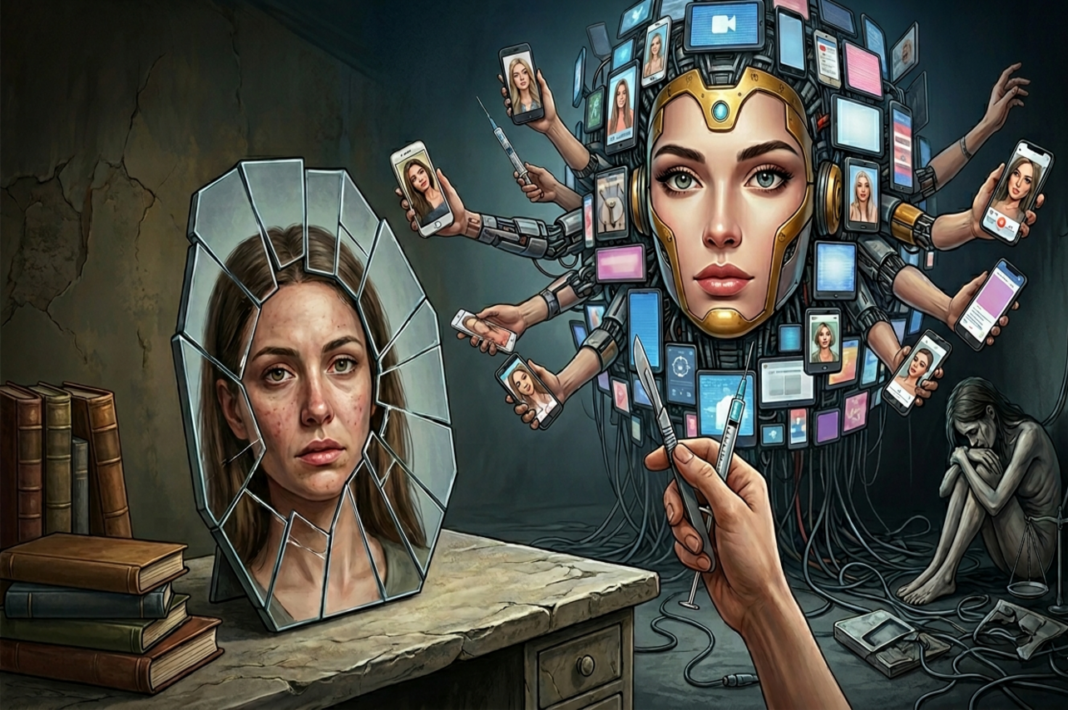

One of the most invisible yet potent transformations of the digital age is undoubtedly the shift of beauty perception from a fixed standard to a fluid, constantly reproduced structure. Once shaped within cultural and historical contexts, the understanding of beauty has now become an instantaneous phenomenon, driven by the speed of social media algorithms and dragging the masses in its wake (Avcılar, 2022). This shift is not merely an aesthetic preference; it is a psychological process that directly impacts an individual’s self-perception and sense of worth. When looking in the mirror, an individual no longer sees just themselves, but the internalized reflections of countless “ideal” images they have been exposed to (Türk & Bayrakçı, 2020). Consequently, the chronic sense of inadequacy often stems from these ruthlessly and constantly updated criteria.
The Race For Validation: Everyone Against Everyone
Humans naturally define themselves by comparing their attributes to others; however, social media has rendered this arena limitless and uncontrolled. The limited number of comparisons made in daily life has been replaced by a constant stream of idealized bodies and perfected lives. Moreover, these comparisons are predominantly “upward.” As individuals compare themselves to those perceived as more beautiful, fit, or “aesthetic,” their body perception becomes increasingly critical (Fardouly & Vartanian, 2016). This process leads to an erosion of self-perception over time, where the individual evaluates themselves through an imaginary image of who they should be rather than who they are. This creates immense pressure. Self-perception vacillates between two poles: the Actual Self and the Ideal Self (Gürcan, 2015). Social media and the fashion world push the definition of the “ideal self” to an unreachable point via digital manipulations. When the gap between reality in the mirror and the idealized version on the screen cannot be closed, self-perception is damaged, leading to a fundamental psychological incongruence characterized by feelings of inadequacy and worthlessness.
The Price Of Acceptance: Social Gains Of Being Beautiful
The Halo Effect plays a crucial role in positioning beauty at such a central point. Physical attractiveness influences the perception of an individual’s other traits, transforming beauty from an aesthetic category into a social advantage (Dion et al., 1972). Individuals perceived as “perfect” and who receive more validation on social media are also inclined to be viewed as more successful, happier, and more valuable. This drives individuals not just to want to look beautiful, but to seek social acceptance through this appearance. Beauty becomes a form of “invisible capital” determining one’s place in society. In social media environments, individuals often present the “best versions” of themselves—a concept defined as self-presentation. Shared content is curated, edited, and often filtered, creating a distorted reality for the viewer. When one compares the idealized moments of others to their own daily lives, they tend to evaluate not only their appearance but their entire life as inadequate (Meier & Gray, 2014). Thus, social media transforms into a powerful psychological space that shapes self-worth.
Slaves Or Owners Of Fashion?
According to Erving Goffman’s dramaturgical approach, social life is a stage where individuals play specific roles (Goffman, 2016). Social media has expanded this stage and made it continuous. Today, rather than being a means of free self-expression, fashion serves “ideal beauty” templates endorsed by social media. When deciding what to wear, digital validation mechanisms often take precedence over personal taste. Those who do not conform to a certain aesthetic standard risk being pushed off-stage. This reduces fashion from a tool of liberation to a mechanism that positions the individual as a “constantly needing-to-be-updated object.” Owning one’s aesthetic values is replaced by the struggle to fit into standardized beauty perceptions. Consequently, while social media introduces rapidly changing fashion trends, it also assumes the role of criticizing those who remain outside these trends as “outdated.”
Fear Of Non-Conformity: Reconciling With Our Bodies
Fast fashion culture and the lightning-speed change of trends render the process of identity formation fragile. The question “What do I like?” is replaced by “What is in fashion right now?” This can leave deep scars on body image. Beauty standards shaped by social media and fashion have profound effects on body perception, which in some cases relate to significant psychological issues. For instance, Body Dysmorphic Disorder is characterized by an excessive preoccupation with non-existent or minimal physical flaws, and social media exposure can exacerbate this perception. Similarly, the pressure of an ideal body is considered a major risk factor for the development of eating disorders like Anorexia Nervosa, particularly in young individuals.
Looking at the research, one of the most comprehensive studies in the literature, a meta-analysis by Groesz, Levine, and Murnen (2002), experimentally proved that exposure to “idealized thin-body” images in the media directly and negatively affects body satisfaction. This synthesis of 25 different studies reveals that individuals under the age of 19 are particularly vulnerable to these visual manipulations, and the deterioration in self-perception following exposure reaches an acute level. Furthermore, Ateq et al. (2024) found a significant positive correlation between intensive social media use and BDD symptoms. Even without reaching clinical levels, many individuals experience common yet deep-seated effects such as alienation from their own bodies, constant feelings of inadequacy, and self-evaluation based solely on appearance. The “curated and filtered” moments on social media damage the natural self by creating a distorted reality.
Finding Your Own Color: Farewell To Standards
Social media and fashion will continue to transform beauty perceptions. However, the true impact of this transformation manifests in the relationship individuals establish with themselves. Beauty is no longer just an aesthetic trait; it has become a determinant of social acceptance and the sense of value. Therefore, the issue is not just about being beautiful, but about feeling enough. Perhaps the most fundamental question of this age is this: When we look in the mirror, do we truly see ourselves, or just a uniform ideal imposed upon us?
References
Ateq, K., Alhajji, M., & Alhusseini, N. (2024). The association between use of social media and the development of body dysmorphic disorder and attitudes toward cosmetic surgeries: A national survey. Frontiers in Public Health, 12, 1324092. https://doi.org/10.3389/fpubh.2024.1324092
Avcılar, E. G. (2022). Sosyal Medyada Kadın Bedeninin İdealize Edilmesi. Ondokuz Mayıs Üniversitesi Kadın ve Aile Araştırmaları Dergisi, 2(2), 445-464.
Dion, K., Berscheid, E., & Walster, E. (1972). What is beautiful is good. Journal of Personality and Social Psychology, 24(3), 285-290. https://doi.org/10.1037/h0033731
Fardouly, J., & Vartanian, L. R. (2016). Social Media and Body Image Concerns: Current Research and Future Directions. Current Opinion in Psychology, 9, 1-5. https://doi.org/10.1016/j.copsyc.2015.09.005
Goffman, E. (2016). Günlük Yaşamda Benliğin Sunumu (Üçüncü basım). Metis.
Groesz, L. M., Levine, M. P., & Murnen, S. K. (2002). The effect of experimental presentation of thin media images on body satisfaction: A meta‐analytic review. International Journal of Eating Disorders, 31(1), 1-16. https://doi.org/10.1002/eat.10005
Gürcan, D. (2015). Benlik Farklılıklarına Rogers’ın Danışan OdaklıTerapisi ile Yaklaşım: Vaka Çalışması. AYNA Klinik Psikoloji Dergisi, 2(1), 13-26. https://doi.org/10.31682/ayna.470648
Meier, E. P., & Gray, J. (2014). Facebook Photo Activity Associated with Body Image Disturbance in Adolescent Girls. Cyberpsychology, Behavior, and Social Networking, 17(4), 199-206. https://doi.org/10.1089/cyber.2013.0305
Türk, G. D., & Bayrakçı, S. (2020). Sosyal Medya ve Toplumda Değişen Estetik İşlem Yaptırma Algısı. AJIT-e: Online Academic Journal of Information Technology, 10(39). https://doi.org/10.5824/ajit-e.2019.4.005