


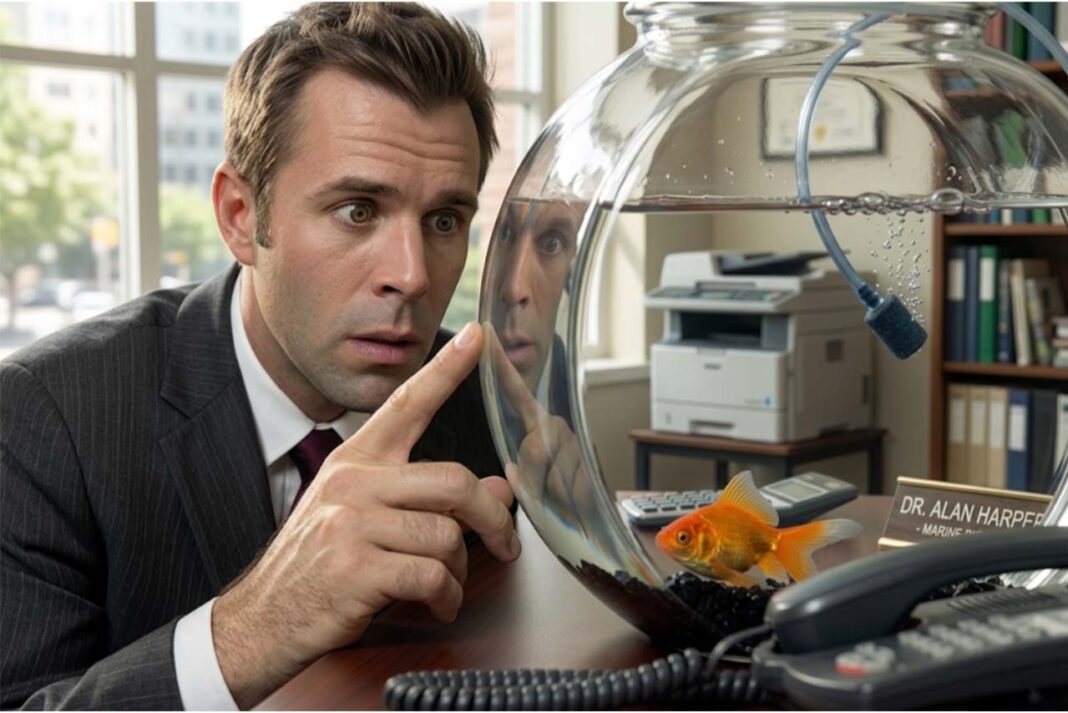

One of the most persistent myths of the digital era claims that the human attention span has declined from 12 seconds in 2000 to just 8 seconds by 2015, largely due to the rise of smartphones. The narrative often goes a step further, suggesting that we have become more distractible than goldfish—creatures supposedly capable of sustaining attention for 9 seconds.
But how much of this claim is grounded in scientific evidence?
The Origins of the Goldfish Myth
The widely cited “8-second attention span” can be traced back to a 2015 report by Microsoft Canada. However, closer inspection reveals that this figure did not originate from Microsoft’s own empirical findings, but from a secondary source—Statistic Brain—whose methodological basis remains unclear.
Researchers such as Gemma Briggs and Simon Maybin have pointed out the lack of transparency surrounding the data’s origin. Equally uncertain is how the attention span of goldfish has ever been measured in a comparable way.
In reality, biological studies suggest that goldfish possess more complex cognitive abilities than commonly assumed, including memory capacities that extend over days or even weeks. As such, comparing human attention to that of a fish is not only methodologically flawed but also conceptually misleading.
The persistence of this comparison reflects a broader tendency within popular discourse: reducing complex cognitive processes to simplistic and memorable statistics.
Attention Span or Attentional Selectivity?
Attention is not a singular, static resource. Michael Posner conceptualizes attention as a network composed of alerting, orienting, and executive control systems.
Within this framework, psychologists distinguish between:
- Sustained attention — the ability to maintain focus over time
- Selective attention — the ability to prioritize relevant stimuli among competing inputs
Digital technologies appear to influence these dimensions differently. Research suggests that heavy engagement with digital media is associated with increased multitasking behavior, leading individuals to shift rapidly between stimuli.
However, this does not necessarily indicate a reduction in attentional capacity. Rather, it reflects a redistribution of attention across multiple sources.
In this context, it is important to consider Attention Economy, a term popularized by Thomas Davenport. In an environment saturated with information, attention becomes a scarce resource, prompting the brain to become faster and more selective in filtering inputs.
The Illusion of Multitasking
Many individuals believe they can effectively perform multiple tasks simultaneously. Yet neuroscientific evidence suggests otherwise.
Earl Miller shows that the brain does not process multiple high-level cognitive tasks in parallel; instead, it rapidly alternates between them—a process known as task switching.
This rapid switching comes at a cognitive cost. Studies by Gloria Mark indicate that after an interruption, it takes, on average, over 23 minutes to fully regain focus.
Over time, a brain conditioned by constant stimulation may struggle with low-stimulation tasks, creating the subjective impression of reduced attention. In reality, what changes is not the capacity for attention, but its mode of operation.
Adaptation, Not Decline
Some scholars argue that these changes should not be interpreted as cognitive decline, but rather as an adaptive response to an information-rich environment.
In a world where individuals are required to make rapid judgments, the ability to quickly evaluate and filter content can be considered a sophisticated cognitive skill.
From this perspective, attention is not deteriorating—it is evolving. The brain continuously adjusts to environmental demands, optimizing its ability to process information efficiently.
The “8-second attention span” narrative, therefore, functions more as a metaphor than a scientifically validated measure.
The Double-Edged Nature of Technology
The cognitive impact of technology is neither entirely negative nor wholly positive.
On one hand, constant notifications and digital interruptions can fragment thought processes and undermine deep focus. On the other hand, digital environments can enhance rapid information processing, improve pattern recognition, and support faster decision-making.
Younger generations, in particular, appear to adapt more fluidly to these shifting attentional demands—challenging traditional assumptions about focus and productivity.
Conclusion: Reclaiming Attention in a Distracted World
The goldfish comparison may be provocative, but it oversimplifies a far more nuanced reality. Humans are not losing their ability to focus; rather, they are redefining what focus looks like in a fast-paced, information-saturated world.
The challenge lies not in cognitive limitation, but in cognitive management.
Attention remains a trainable skill. Practices such as digital detox, mindful technology use, and strategic notification management can significantly enhance focus. Techniques like time blocking, single-tasking, and minimizing distractions offer practical ways to strengthen attentional performance.
Ultimately, technology is not eroding our attention—it is reshaping it. In an age where attention is one of the most valuable cognitive resources, the ability to manage it effectively may be one of the defining competencies of modern life.