
Do We Stop Being Ourselves When We Panic?

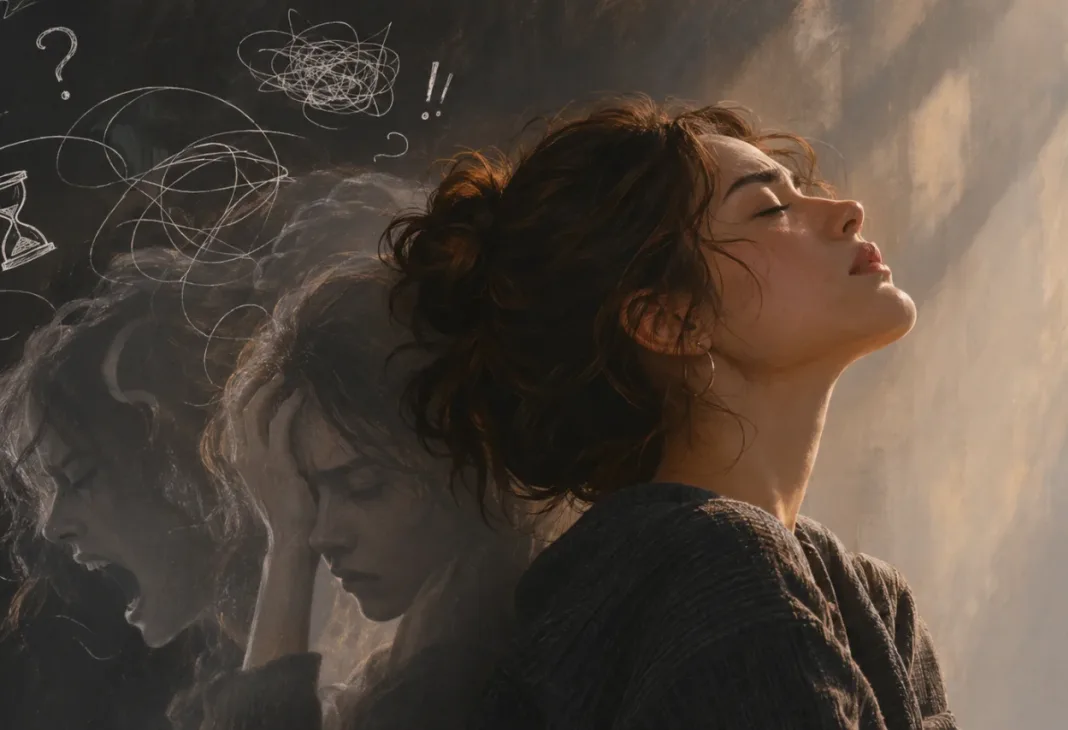
Have you ever found yourself desperately wanting to escape a situation?
Perhaps at a new job, in an unfamiliar city, or during a moment when you felt completely helpless.
Something goes wrong.
Then something else.
And suddenly, one thought takes over:
I can't do this.
Problems that once seemed manageable become overwhelming. Possibilities that have not even happened begin to feel inevitable.
What if things get worse?
What if nothing changes?
What if I made the wrong decision?
Before you have even decided what you want, you may already be searching for an escape.
Perhaps you consider quitting your job, ending a relationship, or booking a flight home from a foreign country.
But fear does not always make us want to run away. Sometimes, we become defensive, blame someone else, or say things we would never normally say.
Then time passes.
We calm down.
And the decision that seemed absolutely right suddenly feels less certain.
Why did I do that?
Did I really mean what I said?
Or was I simply afraid?
Sometimes, our priority during panic is not making the right decision but escaping the fear we are experiencing.
Yet the consequences of our actions do not necessarily disappear when the fear fades.
So, what happens in our minds when fear changes our thoughts, decisions, and behaviour?
And perhaps more importantly:
Do our reactions during panic reveal who we truly are, or who we can become when we are afraid?
What Happens in Our Brains When We Are Afraid?
When we perceive danger, our hearts may race, our breathing may change, and our muscles may tense. Sometimes our thoughts accelerate; other times, we freeze.
Fear is not merely an emotion. It also prepares our bodies to respond to potential threats.
These reactions are commonly described as fight, flight, or freeze responses.
Importantly, a perceived threat does not have to involve physical danger. Uncertainty, loneliness, or feeling that we have lost control can also trigger intense stress.
Different brain regions contribute to these processes. The amygdala plays an important role in processing threat-related information, while the prefrontal cortex supports attention, planning, decision-making, and behavioural regulation.
Under intense stress, these systems may function differently. Our attention becomes increasingly focused on the perceived threat, making it harder to consider alternatives or long-term consequences.
This is where catastrophizing may emerge.
In cognitive behavioural psychology, catastrophizing involves focusing on the worst possible outcome and overestimating its likelihood or impact.
Of course, considering risks is not inherently problematic. There is a difference between preparing for something that might happen and believing that the worst outcome is inevitable.
Fearful thoughts can also intensify our emotions, creating a cycle in which imagined possibilities begin to feel increasingly real.
But a frightening thought is not necessarily an accurate prediction.
And wanting to escape immediately does not mean that leaving is always the best decision.
Decisions Made in Panic
Sometimes, we spend weeks considering a decision.
Other times, fear compresses that entire process into minutes.
Imagine living in a foreign country. Daily difficulties are accumulating, you feel lonely, and everything is unfamiliar.
Suddenly, you think:
I can't do this anymore.
Before you know it, you are checking flights home.
You may not have decided to leave, but your mind is already exploring the possibility.
One psychological process that can help explain this is avoidance.
Avoidance involves moving away from situations, thoughts, or feelings that create fear or distress. Sometimes leaving protects us from genuine danger. Other times, however, what we want to escape is not the situation itself but the discomfort it creates.
Looking at flights may provide temporary relief because it reminds us that we have options.
I can leave if I want to.
I'm not trapped here.
This relief can be understood through negative reinforcement: when a behaviour reduces an unpleasant feeling, we may become more likely to repeat it.
If searching for escape routes temporarily reduces anxiety, we may turn to the same behaviour whenever difficulties arise.
This can happen in relationships, careers, or personal challenges.
However, leaving is not always wrong. Sometimes circumstances genuinely harm our well-being, and walking away is necessary.
The important question is not whether we should always stay.
It is understanding what motivates our desire to leave.
Do I genuinely want to go, or do I simply want this fear to stop?
Sometimes the answers overlap.
But not always.
Things I Wouldn't Normally Say
Have you ever finished an argument and wondered:
Why did I say that?
Perhaps you blamed someone, said something hurtful, or reacted before understanding what you were feeling.
At the time, you felt completely justified.
Later, you saw things differently.
Fear does not always produce withdrawal. Sometimes it appears as anger, defensiveness, or the need to identify someone responsible for what has happened.
When situations feel overwhelming, we naturally search for explanations.
Why did this happen?
Whose fault was it?
Psychology uses the concept of attribution to describe how we explain the causes of events and behaviours.
Under intense stress, we may focus on one person without fully considering the circumstances.
Perhaps that person genuinely contributed to the problem.
Perhaps they did not.
Fear and anger can also occur together, particularly when we feel threatened, obstructed, or treated unfairly.
Anger can help us protect ourselves and establish boundaries. But it can also lead us to react before understanding what we need.
This is where emotion regulation becomes important.
Emotion regulation does not mean suppressing emotions. It involves recognising what we feel, understanding those feelings, and choosing how to respond.
Under stress, this becomes harder.
Instead of saying, "I felt alone in that situation," we might say, "You abandoned me."
The difference matters.
One statement describes our experience; the other assigns responsibility.
Of course, other people's actions can genuinely hurt us. Expressing our feelings does not mean ignoring their responsibility.
But being affected by someone's behaviour and holding them responsible for every emotion we experience are not necessarily the same thing.
Fear may explain why we reacted a certain way.
But understanding our behaviour does not erase its consequences.
A sentence may take seconds to say.
Its impact may last much longer.
Quick Decisions, Lasting Consequences
Sometimes, a decision takes only seconds.
We send a message.
Close a door.
Change our plans.
Taking action can immediately create a sense of control.
But does immediate relief mean that a decision will also benefit us in the long term?
Under intense stress, reducing our current discomfort may become our priority.
An angry message might bring temporary relief, only to leave us facing a damaged relationship hours later.
A rushed decision might create new uncertainties rather than resolve existing ones.
Of course, quick decisions are not always wrong. Immediate action may be essential when our safety is threatened.
What matters is how our emotional state influences the options we consider.
When circumstances allow, perhaps the first step is distinguishing between feeling that something is urgent and something genuinely being urgent.
Must I send that message now?
Does this conversation have to happen today?
Will waiting really cost me an opportunity, or is uncertainty simply difficult to tolerate?
Sometimes, waiting a few minutes, hours, or overnight allows us to see possibilities we previously overlooked.
The fear may not disappear, and the problem may remain.
But we may approach it differently.
Before making an important decision, perhaps we can ask:
"When the fear I feel today has passed, how will I feel about this decision?"
Because sometimes the consequences of our decisions last much longer than the emotions behind them.
The Questions That Come After Fear
Sometimes, the hardest questions arrive after the danger has passed.
Our heartbeat slows. Our thoughts settle. What previously seemed like our only option becomes one possibility among many.
And sometimes, we begin questioning ourselves.
I'm not normally like this.
How could I have acted so thoughtlessly?
But there is something important we may overlook.
When evaluating our past behaviour, we possess information and emotional distance that we did not have at the time.
This relates to hindsight bias, our tendency to believe that an outcome was more predictable after we already know what happened.
We might ask, "How could I not have seen that this was a mistake?"
Yet we may be expecting our frightened past selves to have understood what our calmer present selves understand now.
This does not remove responsibility.
But there is a difference between understanding ourselves and simply blaming ourselves.
Instead of focusing exclusively on what we did wrong, we might ask:
What frightened me so much?
What outcome felt unbearable?
What did I actually need?
What could I do differently next time?
These questions cannot undo our actions.
Sometimes we need to apologise, reconsider a decision, or repair the damage we caused.
But regret does not have to keep us trapped in the past.
It can also become an opportunity to understand ourselves better.
Who Do We Become When We Are Afraid?
So, let us return to our original question.
Do we stop being ourselves when we panic?
Fear can make us behave differently. We may say things we would normally avoid, make unexpected decisions, or react in ways that surprise even us.
But that does not necessarily mean we become entirely different people.
Perhaps we encounter parts of ourselves we have not fully understood.
The part that fears losing control.
The part that struggles with uncertainty.
The part that becomes angry when feeling helpless.
The part that wants to escape to feel safe.
Yet can we define someone entirely by their reactions during their most frightening moments?
Fear is part of being human. Sometimes it protects us; sometimes it changes how we interpret situations and respond to others.
The goal is not to eliminate fear.
Feeling afraid and acting on every impulse fear creates are not the same thing.
Understanding ourselves does not mean we will never make another mistake.
Sometimes we will speak out of fear.
Sometimes we will misjudge situations.
Sometimes we will wish we had acted differently.
But those moments do not have to become the final definition of who we are.
We can also understand ourselves through what we learn, whether we take responsibility, and how we choose to respond when similar situations arise again.
A decision made in panic does not have to define our entire lives.
A sentence spoken out of fear does not have to be our final judgement of ourselves.
But we also don't have to pretend those moments never happened.
Because perhaps the question is not who we become when we are afraid, but how we face what we have done once the fear has passed.
Kaynakça
- ## Kaynakça
- Arnsten, A. F. T. (2009). Stress signalling pathways that impair prefrontal cortex structure and function. *Nature Reviews Neuroscience, 10*(6), 410–422. https://doi.org/10.1038/nrn2648
- Gross, J. J. (1998). The emerging field of emotion regulation: An integrative review. *Review of General Psychology, 2*(3), 271–299. https://doi.org/10.1037/1089-2680.2.3.271
- LeDoux, J. E., & Pine, D. S. (2016). Using neuroscience to help understand fear and anxiety: A two-system framework. *American Journal of Psychiatry, 173*(11), 1083–1093. https://doi.org/10.1176/appi.ajp.2016.16030353
- Roese, N. J., & Vohs, K. D. (2012). Hindsight bias. *Perspectives on Psychological Science, 7*(5), 411–426. https://doi.org/10.1177/1745691612454303