


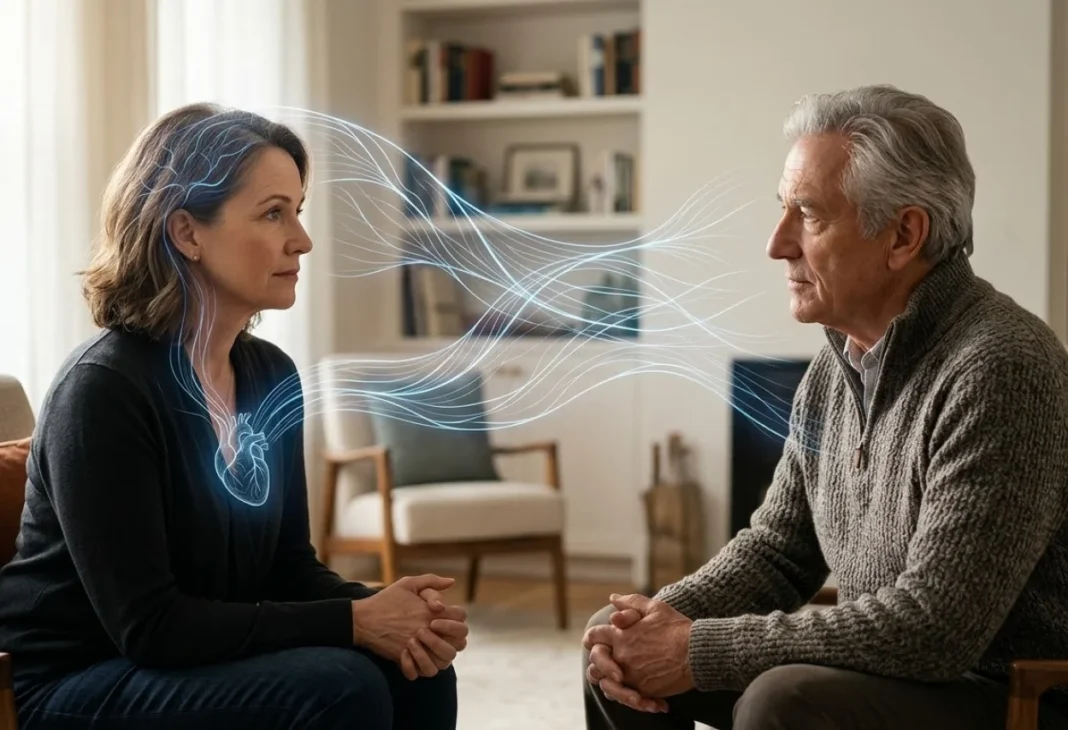

Interpersonal communication is not just a mechanical process of sharing words. It is a neurobiological interaction where two nervous systems shape each other. During human evolution, the brain did not develop as an isolated computer. It developed as a “social organ” programmed to connect with other brains (Cozolino, 2014). Because of this, our attitudes during communication are not just psychological choices. They are direct actions that affect the biology of the other person.
The Social Synapse and Communication Space
To understand the role of attitudes in communication, we need to look at brain anatomy. Inside a single brain, neurons communicate across small gaps using chemicals. Similarly, the interaction between two people happens in an invisible space. In the scientific literature, this space is called the “social synapse.” It is the space where people send signals to each other’s nervous systems using eye contact, tone of voice, facial expressions, and body language (Cozolino, 2006). Our open or closed attitudes during communication have the power to instantly organize or damage the other person’s physical state across this social synapse.
The Neurological Damage of Defensive Attitudes
In conflicts or prejudiced communication, blaming attitudes create a direct sense of threat in the other person’s nervous system. The human brain processes social rejection or judgment using the same neural networks as physical pain (Eisenberger et al., 2003). When a person faces a judging attitude, their amygdala (the brain’s threat center) activates very fast (Adolphs, 2003). The over-activation of the amygdala temporarily stops the prefrontal cortex, which is the part of the brain responsible for logical thinking and emotion control (Ochsner & Gross, 2005). This ruins the person’s ability to communicate rationally and puts the brain into a basic survival mode. Therefore, even the most logical arguments cannot be processed by a brain that is biologically closed to communication.
Empathetic Attitude and Neural Regulation
On the other hand, supportive and non-judging attitudes activate the brain’s social engagement system (Porges, 2007). Open-minded communication calms the amygdala and builds a feeling of safety in the other person’s nervous system. In this process, the mirror neuron system plays an active role. This system helps us feel the other person’s emotions and intentions in our own minds (Iacoboni, 2009). Empathetic attitudes between two people make their neural patterns match each other across the social synapse. This matching is known as neural synchronization. It makes the brain waves of two people move at the same time, which creates the foundation of psychological healing and trust (Hasson et al., 2012).
Conclusion
From a neuropsychological perspective, our attitudes in communication are real actions that shape each other’s brain architecture. Constantly facing judging attitudes makes stress reactions chronic. However, empathetic and supportive attitudes strengthen the brain’s emotional regulation capacity through neuroplasticity (Cozolino, 2014). For this reason, having the right attitude in interpersonal communication is not just a social skill. It is also a matter of neurobiological respect and responsibility towards the other person’s nervous system.
Kaynakça
- Adolphs, R. (2003). Cognitive neuroscience of human social behaviour. Nature Reviews Neuroscience, 4(3), 165-178.
- Cozolino, L. (2006). The neuroscience of human relationships: Attachment and the developing social brain. W. W. Norton & Company.
- Cozolino, L. (2014). The neuroscience of human relationships: Attachment and the developing social brain (2nd ed.). W. W. Norton & Company.
- Eisenberger, N. I., Lieberman, M. D., & Williams, K. D. (2003). Does rejection hurt? An fMRI study of social exclusion. Science, 302(5643), 290-292.
- Hasson, U., Ghazanfar, A. A., Galantucci, B., Garrod, S., & Keysers, C. (2012). Brain-to-brain coupling: A mechanism for creating and sharing a social world. Trends in Cognitive Sciences, 16(2), 114-121.
- Iacoboni, M. (2009). Imitation, empathy, and mirror neurons. Annual Review of Psychology, 60, 653-670.
- Ochsner, K. N., & Gross, J. J. (2005). The cognitive control of emotion. Trends in Cognitive Sciences, 9(5), 242-249.
- Porges, S. W. (2007). The polyvagal perspective. Biological Psychology, 74(2), 116-143.