



Exploring trauma, hypervigilance, overcontrol, and hope through the story of Odysseus.
1) A Man Among the Waves
A years-long war, countless storms, losses, battles with gods, and an exact 20-year journey. At first glance, this is how Odysseus’ story can be summarized. Yet his journey is not only the story of a hero returning home; it is also the story of a mind struggling to survive under extreme conditions. In Greek mythology, Odysseus is known as the king of Ithaca and stands out among the Trojan War heroes with his power, strategic thinking, and leadership. After a ten-year war guided by the goddess Athena, he sets out with his crew on the “nostos,” the journey home. He has only one goal: to return to Ithaca and reunite with his wife Penelope and his son Telemachus. However, his journey back home takes much longer and is more difficult than he expects. He faces Circe, Calypso, the Sirens, storms, and the gods’ anger. Nevertheless, he never loses hope or a sense of purpose. However, even when he eventually arrives in Ithaca, the twenty-year conflict does not conclude without leaving its lasting mark. Odysseus is not just a hero coming home, but a man who struggles with trauma, overcontrol, hypervigilance, and a sense of loss. In this article, we will look at his journey through a psychological lens and analyse how the human mind can endure difficult situations and how hope can act as a compass on the most challenging journeys.
2) Poseidon and Athena: Chaos and Control
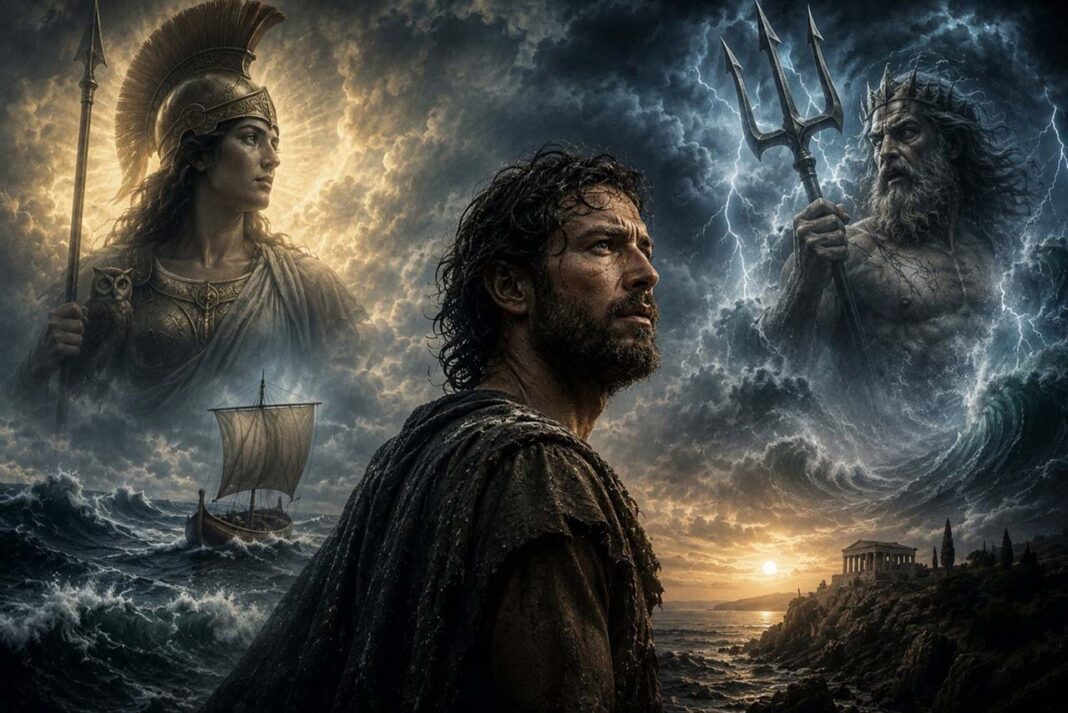
In Odysseus’ journey, two gods stand out: Poseidon, the unpredictable god of the sea, and Athena, the goddess of knowledge, strategy, and warfare. From a mythological perspective, they are Odysseus’ greatest help and greatest enemy. From a psychological perspective, however, they represent two fundamental forces within the human mind: control and chaos. Athena represents Odysseus’ rational side and his ability to maintain control. She helps him make plans, control his emotions, and remain rational under pressure. One of the things that distinguishes Odysseus from other heroes both during and after the Trojan War is his preference for wisdom over physical power.
Poseidon stands in complete contrast to this. He stands for chaos, unpredictability, and unpredictably changing circumstances. Their hostility begins when Poseidon’s son Polyphemus is blinded by Odysseus. From then on, Poseidon causes storms, changes his path, and keeps delaying his return home, creating new challenges at every turn. This is not only a conflict between two gods. It also shows the tension that arises between people’s demand for control and the unpredictable nature of life. Despite his greatest efforts to maintain control, Odysseus is always confronted with chaos in life. In everyday life, we have our own “Athenas” and “Poseidons.” When faced with unexpected loss and chaos, we, like Odysseus, seek direction, order, and control. This feeling leads us ahead and helps us deal with uncertainty.
3) Stoicism at Sea: Accepting What Cannot be Controlled
Stoicism says that we cannot control everything in life and that happiness depends on accepting things as they are. The main point is to accept what we cannot control and concentrate on what we can.
“There is only one way to happiness, and that is to cease worrying about things which are beyond the power of our will,” Epictetus says.
Throughout his journey, Odysseus tries to do everything correctly and keep every situation under control. However, he and his crew occasionally make mistakes because emotions sometimes dominate logic. These errors cause other problems and prolong the trip. Still, Odysseus keeps trying. With patience and determination, he manages his emotions and gives his best to return home. In daily life, we often encounter similar situations. Sometimes, while trying to hold everything together, we see everything fall apart at once. We may then begin to blame ourselves: “If only it had been different,” “If only I had done this differently.” Yet most of the time, what happens has already happened, and life is full of events beyond our control. Psychological resilience is not about preventing these events from happening; it is about being able to rise again afterward, adapting using available resources, and continuing forward. Like Odysseus, we cannot always stop the storm—but we can learn to move through it.
4) A Mind That Learns to Wait for the Storm: Overcontrol and Hypervigilance
At some point in life, after encountering a threat, we may continue to feel constantly on edge. We live in a state of alertness, struggle to sleep, startle at the slightest sound, consider every possibility, find it hard to breathe, and remain constantly watchful. The mind stays on high alert as if trying to protect us from another danger. In psychology, this is called hypervigilance. “Hypervigilance is a behavioral, cognitive, and physiological state of sustained alertness for potential threat” (Ehlers & Clark, 2000). It is especially common following traumatic events like abuse, natural disasters, violence, or war. Over the years, Odysseus also faced numerous challenges and dangers. After so many storms and dangers, it is not surprising that his sense of safety is shaken. To compensate, he develops overcontrol. Odysseus tries to be safe by calculating every possible scenario and preparing himself for the worst. But this continuous control makes it harder to relax and feel secure. Similar patterns can be seen in contemporary life. Hypervigilance and overcontrol are common in people with chronic anxiety, those who always expect the worst, and those who believe they have to be perfect. But overcontrol as a coping strategy can sometimes turn into an unseen burden.
5) Survivor’s Guilt: The Burden of Returning Alone
Odysseus sets out on this journey with hundreds, perhaps thousands of men. Yet at the end of the war and the long voyage, he returns to Ithaca alone. Every friend left behind, every loss, and every failure leaves a mark on him. Over time, he not only mourns his losses but also begins to carry responsibility for them: “Why did I survive?” Even if he knows logically that he is not to blame, emotionally he cannot escape the feeling of guilt. This experience is known in psychology as survivor’s guilt. Survivor’s guilt can be associated with post-traumatic stress disorder (PTSD), anxiety disorders, and complicated grief (Bistas et al., 2023). It is commonly seen in war veterans, disaster survivors, and individuals who have experienced significant loss. Odysseus’ return home is not only a victory story. He battles both the sea and his own mind. When he returns, he carries the absence of those who are no longer with him. Thus, his return is filled with both joy and grief.
6) Ithaca’s Meaning and the Hope That Survived the Storm
It was the hope of one day returning to Ithaca and reuniting with his family that kept Odysseus going on that long journey. Sometimes this desire was painful. But it was his greatest source of strength. He had suffered so many losses, and he had grown so tired. But it was hope that kept him going. His love for his family, his memories of them, and his desire to return gave him the courage to go on. He struggled for twenty years, fighting storms, gods, and himself. And finally, when almost everyone had given up on him, he returned to Ithaca. He reclaimed his home, reunited with his loved ones, and finally found the peace he had been chasing for so many years. In that sense, Ithaca was never only a kingdom or a symbol of status for Odysseus. It was a purpose, a sense of belonging, and a reason to keep moving forward. His greatest achievement, perhaps, was not only that he survived all those hardships, but that he kept his hope alive when it would have been easier to give up.
In many ways, life is very much the same. We are all living in a world of uncertainty and surprising events. Sometimes we lose our way in the middle of a storm, sometimes there are obstacles in our way. Sometimes we are torn between head and heart, and there are times when we try our best, but things still do not turn out the way we would have liked. But if we can keep that little light of hope burning in our hearts, then we will find our own Ithaca—the place where we really belong—sooner or later. Sometimes it takes just a bit of patience, a bit of time, and a bit of hope.
References
Bistas, K. G., & Grewal, R. (2023). The intricacies of survivor’s guilt: Exploring its phenomenon across contexts. Cureus, 15(9), e45703. https://doi.org/10.7759/cureus.45703
Ehlers, A., & Clark, D. M. (2000). A cognitive model of posttraumatic stress disorder. Behaviour Research and Therapy, 38(4), 319–345. https://doi.org/10.1016/S0005-7967(99)00123-0