


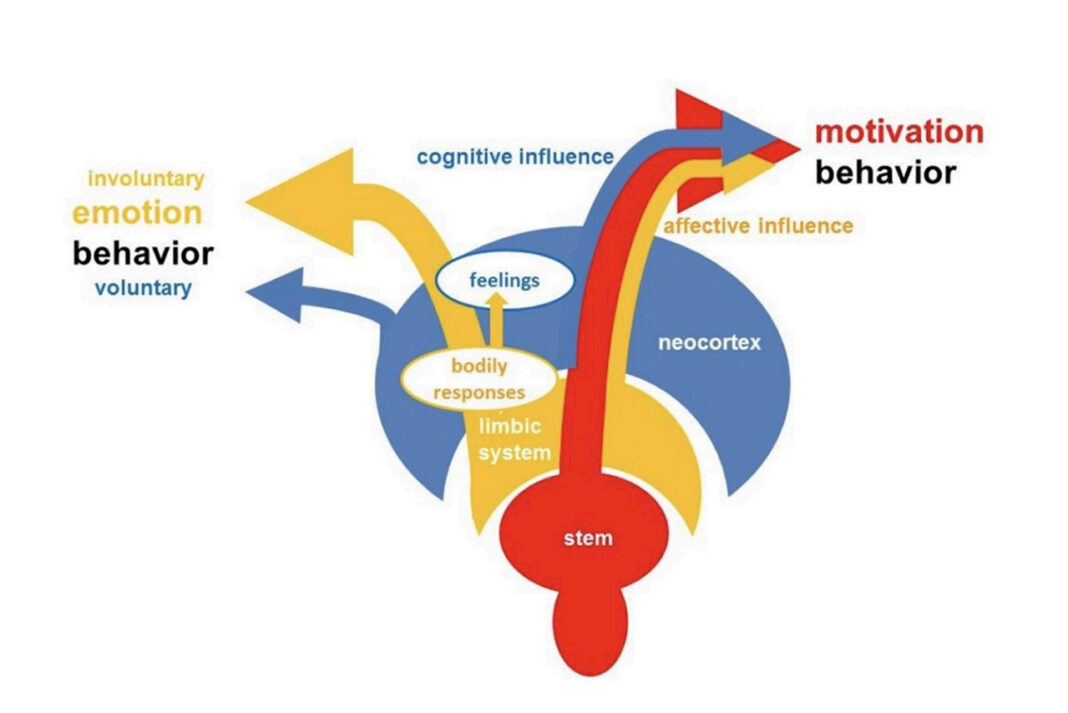

Despite decades of research, emotion science still lacks a clear, universally accepted definition of ‘emotion.’ This conceptual confusion continues to hinder scientific progress, complicate cross-disciplinary communication, and limit practical applications in everyday life. To address this, the Walla-Emotion-Model, proposed by Prof. Peter Walla, introduces a simplified and more precise approach – one that distinguishes clearly between feelings and emotions and brings much-needed clarity to both research and real-life understanding.
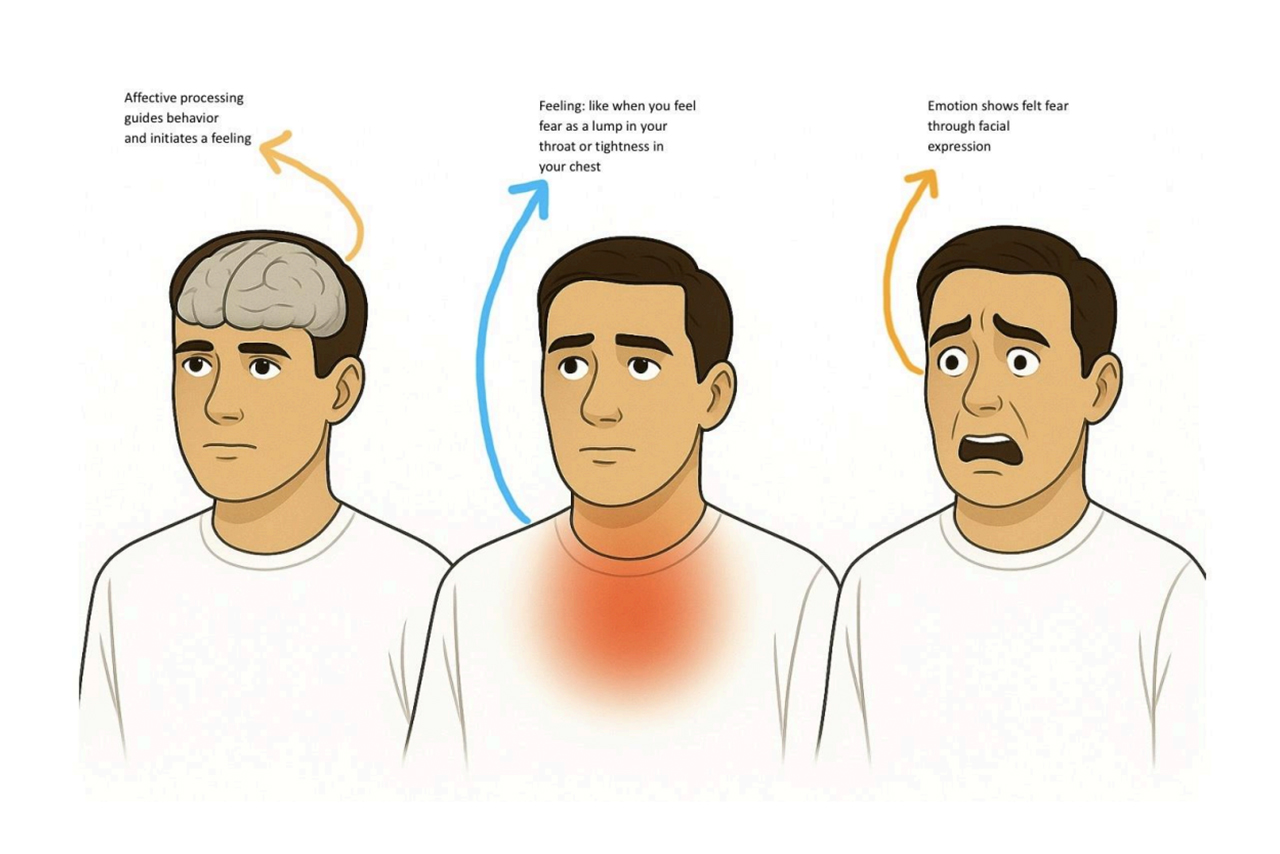
Main Issue: The Gap Between Language and Feeling – Almost 7 Million Years
Before spoken language existed, our ancestors (hominins) still experienced feelings. Fear signaled danger and triggered survival instincts; joy encouraged bonding and repeated safe behaviors. Feelings evolved as survival tools – long before humans had words to describe them.
Although early humans carried the FOXP2 gene necessary for language, the brain regions responsible for speech, like Broca’s and Wernicke’s areas, weren’t fully developed until about 135,000 years ago. Social language use emerged even later, around 100,000 years ago. This evolutionary gap explains the problem of, “I can’t put my feelings into words” – because feelings weren’t made to be spoken; they were made to protect.
As Walla explains, “raw affective responses arise from subcortical regions, while language is a cortical function.” These systems are neurologically distinct, which is why our feelings often exist beyond the reach of conscious expression. While a few people may develop strong internal awareness through introspection, most of us experience a disconnect between what we feel and what we can say.
“The brain often knows more than it tells our conscious mind.” – Peter Walla
This separation matters – in life and in science – and it creates a deeper problem: self-reports cannot accurately reflect what the brain and body are truly experiencing. Physiological data – like heart rate or brain activity – often reveal more about our feelings than words ever could.
The Walla-Emotion-Model
In this model, emotions are behavioral responses that result from unconscious affective processing – automatic affective evaluations made by the brain. In contrast, feelings are the conscious awareness of bodily responses (e.g., release of chemical substances) triggered by these processes (e.g., stomach tension).
However, the modern human brain is not limited to primitive systems. Cognitive processing can modify emotional behavior. A person may display an emotion – like a smile – strategically, even without genuinely feeling it. This is referred to as a voluntary emotion in the model. Through cognitive interference, individuals can manage social situations using controlled emotional expressions.
Thus, not all observed emotions reflect inner feelings. Emotions, at their core, are behaviors – and like any behavior, they can be consciously shaped.
Lift the Feeling’s Curtain – and Emotion Reveals Itself as Mere Behavior
Another compelling piece of evidence that emotions are fundamentally behavioral comes from emotional responses observed during epileptic seizures. In individuals with epilepsy, seizures can trigger outward expressions resembling fear, laughter, or pleasure. Among these, fear is especially common due to neural activation near key affective centers being part of the limbic system like amygdala and hippocampus.
What’s striking is that these patients often do not feel afraid – the response isn’t driven by subjective experience, but by neurologically (through affective processing) triggered behavior. In other words, we see fear-like actions without actual fear. This highlights a crucial point: emotions can occur without feelings, because at their core, they are behaviors resulting from affective processing.
Understanding this new model of emotion matters for everyone – not just academics. Why? Because what we often call “emotions” are actually feelings. Emotions aren’t what we feel – they’re what we do to convey a feeling. Feelings are internal, subjective, and mostly involuntary. Emotions, by contrast, are behavioral responses. So while we may not choose what we feel, we can be responsible for how we act on those feelings through voluntary emotion-behavior.
Moreover, without grasping this distinction, it is impossible to develop a healthy understanding of emotional regulation. When these concepts are not clear, people don’t know what to regulate, which leads to confusion, and even psychosomatic complaints that can make things even worse.
Alternatively, a person may live entirely at the mercy of their feelings, swinging between neuroses, euphoric highs, and depressive lows.
Understanding what feelings, emotions, and affective processing truly are is the first step toward a healthier relationship with them.
Affective Processing as an Internal Algorithm That Guides Behavior
Think of this new model as the core engine of a human emotional application – much like the foundational software that powers every instance of an AI model. This “affective algorithm” silently evaluates incoming stimuli and automatically guides behavior — unless there is a neurological impairment (e.g., lesions in the prefrontal cortex or brainstem). This core process, known as affective processing, is universal across humans and functions as an internal judgment mechanism that assesses stimuli as good or bad, safe or threatening.
The trigger for affective processing may vary depending on one’s context, such as past experiences, genetic makeup, hormonal sensitivity, and situational cues. However, these variations influence only the input and interpretation – not the existence of the algorithm itself. Just like all instances of ChatGPT share the same base model but can be fine-tuned or specialized, human affective systems share the same biological infrastructure, even though culture and personality shape the visible output.
When we study or talk about affect, we are referring to this core architecture, not its individual or cultural modifications – just as in clinical research, we refer to the underlying disorder, not every unique presentation (unless conducting a case study).
Some may critique this model for being reductionist, but this simplicity is precisely what makes it powerful in fields like neuroscience, where clarity and measurability are essential. In the brain, only processes that can be observed and measured can be reliably linked to psychological concepts.
Without clearly defined constructs, we risk asking the wrong research questions – or miscommunicating our findings entirely. In short, this model offers a stable, testable framework by stripping “emotions” down to behavioral responses.
Ultimately, we are talking about humans and emotions at the level of the internal code – not the decorative interface.
References
Walla, P. (2018). Affective processing guides behavior and emotions communicate feelings: Towards a guideline for the NeuroIS community. In F. Davis, R. Riedl, J. vom Brocke (Eds.), Information Systems and Neuroscience: Gmunden Retreat on NeuroIS 2017 (pp. 141–150). Springer.
https://doi.org/10.1007/978-3-319-99133-7_18
Henshilwood, C. S., d’Errico, F., & Watts, I. (2009). Engraved ochres from the Middle Stone Age levels at Blombos Cave, South Africa. Journal of Human Evolution, 57(1), 27–47.
https://doi.org/10.1016/j.jhevol.2009.01.005
Henshilwood, C. S. (2009). The origins of symbolism, spirituality and shamans: Exploring Middle Stone Age material culture in South Africa. In C. Renfrew & I. Morley (Eds.), Becoming human: Innovation in prehistoric material and spiritual cultures (pp. 29–49). Cambridge University Press.
Watts, I. (2009). Red ochre, body painting, and language: Interpreting the Blombos ochre. In R. Botha & C. Knight (Eds.), The cradle of language (pp. 62–92). Oxford University Press.
Jacobs, Z., Roberts, R. G., Galbraith, R. F., Deacon, H. J., Grün, R., Mackay, A., … & Henshilwood, C. S. (2008). Ages for the Middle Stone Age of Southern Africa: Implications for human behavior and dispersal. Science, 322(5902), 733–735.
https://doi.org/10.1126/science.1162219
Walden, T. A., & Smith, M. C. (1997). Emotion regulation. Motivation and Emotion, 21(1), 7–25.
https://doi.org/10.1023/A:1024471530399
Cendes, F., Andermann, F., Gloor, P., Gambardella, A., Lopes-Cendes, I., Watson, C., … & Olivier, A. (1994). Relationship between atrophy of the amygdala and ictal fear in temporal lobe epilepsy. Brain, 117(4), 739–746.
https://doi.org/10.1093/brain/117.4.739
Rilling, J. (n.d.). Broca’s and Wernicke’s areas. Center for Academic Research and Training in Anthropogeny (CARTA). Retrieved June 18, 2025, from https://carta.anthropogeny.org/moca/topics/brocas-and-wernickes-areas