



Salvador Dalí’s 1931 masterpiece The Persistence of Memory stands not only as an icon of Surrealism, but also as a striking visual articulation of psychoanalytic thought. At first glance, the melting clocks appear whimsical or absurd. Yet through a Freudian lens, they become symbols of a deeper disturbance; one that concerns time, memory, and the fragile structure of the self.
In everyday life, clocks represent order, control, and rationality. Time is measured, divided, and disciplined, and individuals are expected to conform to its rigid structure. Dalí’s clocks refuse this logic. They sag, dissolve, and lose their function, suggesting that within the unconscious, time does not move in a linear or predictable way. As Freud argued, dreams and unconscious processes collapse past, present, and desire into a single psychic space. The soft clocks thus embody the timelessness of the unconscious mind.
At the center of the painting lies an amorphous, almost organic figure, often interpreted as a sleeping self-portrait of Dalí. Sleep, in psychoanalysis, marks the moment when the ego loosens its grip and unconscious material is allowed to surface. This figure represents a state in which reality-testing is suspended and the boundaries of the self begin to blur. The fact that the clocks melt directly over this body suggests that time itself becomes meaningless once the ego’s defenses give way.
The barren, silent landscape surrounding the figure evokes stillness, decay, and emotional desolation. In some readings, the presence of insects (associated elsewhere in Dalí’s work with decomposition) reinforces this atmosphere. From a psychoanalytic perspective, this can be linked to Freud’s concept of the death drive (Thanatos): the underlying tendency toward dissolution, entropy, and return to an inorganic state. Time, as it melts away, no longer signals progress but gradual disintegration.
The title, The Persistence of Memory, is central to this interpretation. Traumatic memories do not obey chronological time; they persist, recur, and intrude upon the present as though they were never truly past. Dalí’s image captures this paradox visually: although time appears to dissolve, memory remains stubbornly intact. The clocks do not disappear, they endure, but in a deformed state, stripped of their ability to regulate experience. Thus, the painting suggests that memory, particularly unconscious memory, resists time’s authority.
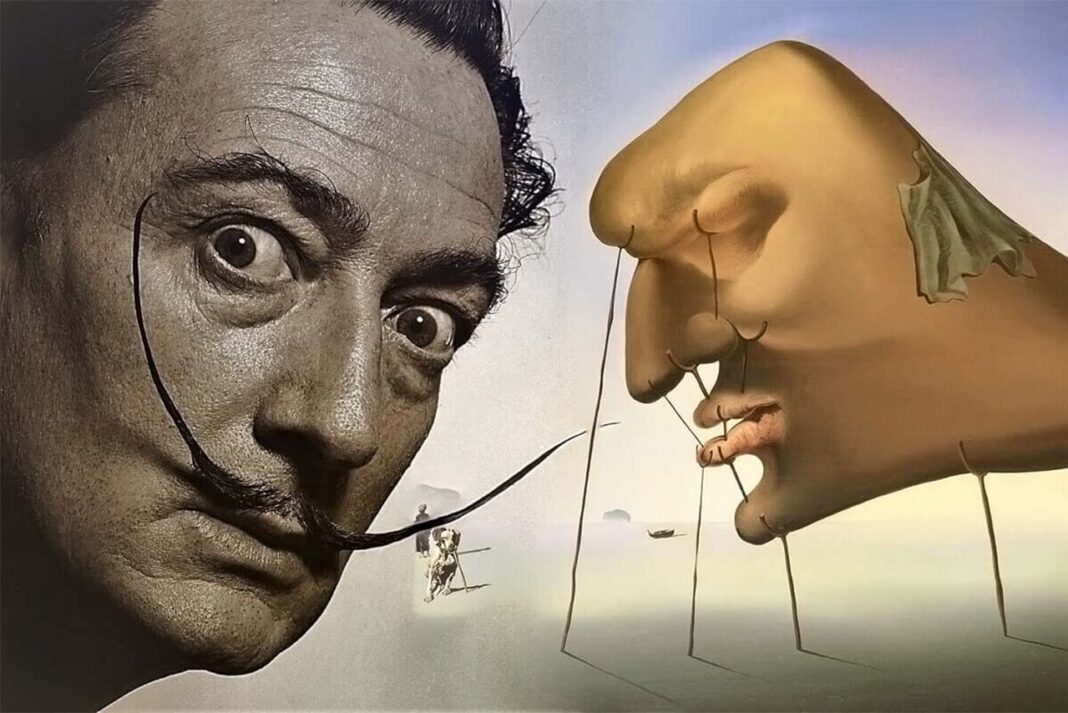
Dalí’s fascination with Freud and his own paranoiac-critical method is central to how this painting operates psychologically. Developed by Dalí himself, the method was neither drug-induced nor meditative in the conventional sense. Rather than calming the mind, Dalí deliberately intensified it. He trained himself to enter a state of heightened fixation, focusing obsessively on a single idea or image and allowing irrational associations to multiply.
In this controlled “paranoid” mode, unrelated elements began to feel meaningfully connected, and ambiguity was temporarily experienced as certainty. Crucially, Dalí never lost conscious control. The “critical” dimension of the method allowed him to step back, evaluate these associations, and translate them into meticulously realistic form. In The Persistence of Memory, this process is applied to time itself.
The idea that time is rigid, objective, and reliable is subjected to obsessive reinterpretation until it collapses, re-emerging as something soft, vulnerable, and organic. The clocks melt not as a dreamlike accident, but as the product of a disciplined mental exercise in which unconscious logic is allowed to reorganize perception. What the painting ultimately exposes is not chaos, but the unsettling fragility of rational structures when the unconscious is permitted to speak, revealing that even time, one of our most trusted frameworks, is sustained only as long as we believe in its solidity.
Perhaps this is why the painting remains so unsettling and familiar. It suggests that time, like reality itself, is not simply something we live within, but something the mind continuously constructs.
References
Freud, Sigmund (1915). Instincts and their vicissitudes. In J. Strachey (Ed. & Trans.), The Standard Edition of the Complete Psychological Works of Sigmund Freud (Vol. 14). London: Hogarth Press.
Dalí, Salvador (1935). The conquest of the irrational. New York: Julien Levy.
Breton, André (1924). Manifesto of surrealism. Paris.
Chipp, H. B. (1968). Theories of modern art. Berkeley: University of California Press.
Ricoeur, P. (1984). Time and narrative (Vol. 1). Chicago: University of Chicago Press.