
The Social Foundations of Violence in the Context of Bandura’s Experiments

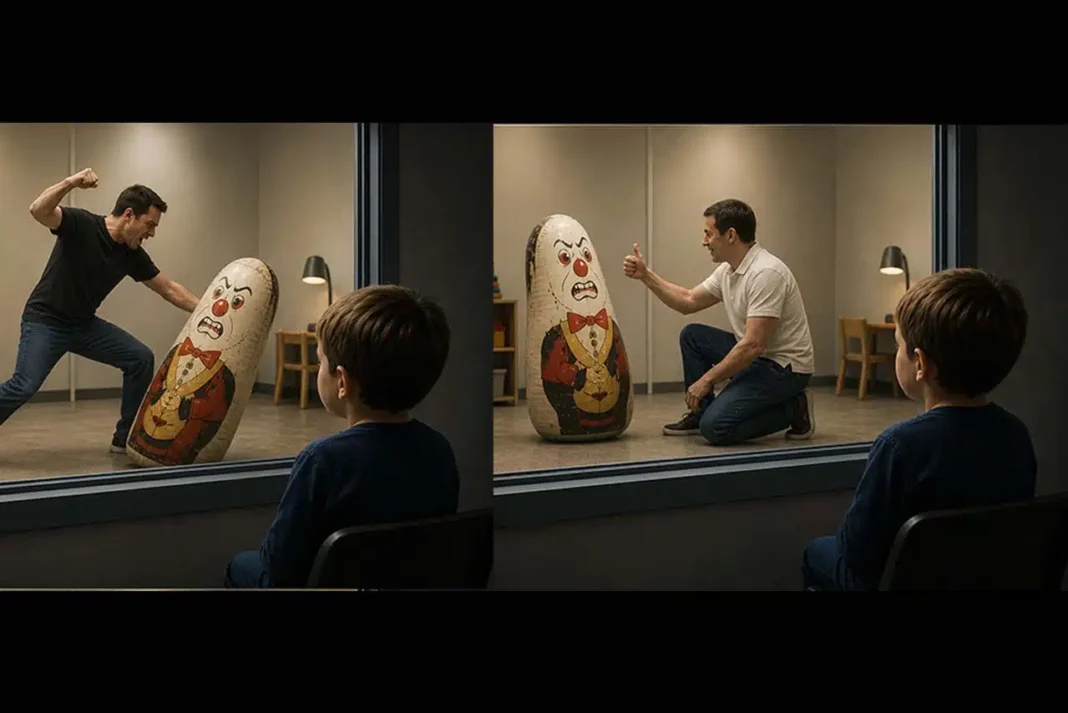
The origins of violence are often examined within the interaction between individual predispositions and environmental conditions. Within this interaction, mechanisms such as observation and social learning appear to play a particularly significant role. One of the most influential approaches that concretely demonstrates these mechanisms is Albert Bandura’s social learning theory and the supporting experimental studies. According to Bandura, individuals learn not only through direct experience but also by observing others. This perspective holds critical importance for understanding how behaviors such as aggression and violence emerge.
The Bobo Doll Experiment and Observational Learning
One of Bandura’s most well-known studies in this field is the Bobo Doll experiment conducted in 1961. A total of 72 children between the ages of 3 and 6 participated in the study and were randomly assigned to three groups. Children in the first group were taken into a room where they observed an adult model hitting, kicking, and using aggressive language toward an inflatable toy called Bobo. Children in the second group were also placed in a room, but in this case, the adult model behaved calmly and non-aggressively toward the toy. The third group did not observe any model.
Subsequently, all children were individually placed in another room containing the same toy. Children who had observed the aggressive model hit and kicked the toy, repeated the model’s aggressive statements, and even introduced new forms of aggressive behavior. Children who had not observed any model displayed limited aggression, whereas those who had observed the calm model exhibited the lowest levels of aggression. This behavioral difference clearly demonstrates that aggression and violence can be learned through observational learning, and that exposure to aggressive models increases such behaviors.
Vicarious Reinforcement and the Consequences of Behavior
In Bandura’s later work, it was shown that observational learning is not limited to imitation but is also shaped by the consequences of behavior. One of the most well-known experiments in this context is the Vicarious Reinforcement study conducted by Bandura in 1965.
In this experiment, 66 preschool children aged approximately 4 to 6 were randomly assigned to three groups. Children in the first group observed a scene in which an adult acted aggressively toward a Bobo doll and was subsequently rewarded, either through praise or a small reward. Children in the second group observed a similar aggressive scene, but in this case, the model was punished, receiving criticism or negative feedback. Children in the third group observed an aggressive model, but no reward or punishment followed the behavior.
Afterwards, all children were placed alone in a room containing the same toy, and their behavior was observed. Children who had observed the rewarded model displayed more aggressive behavior, hitting and kicking the toy more frequently and repeating aggressive statements. In contrast, children who had observed the punished model exhibited significantly lower levels of aggression. The third group displayed levels of aggression lower than the rewarded group but higher than the punished group.
However, the experiment did not end there. When children were later told that they would be rewarded for displaying aggressive behavior, those who had previously observed the punished model, and therefore initially showed low aggression, also began to exhibit the same aggressive behaviors. This finding demonstrates that children had, in fact, learned the aggressive behavior, but their decision to perform it depended on the observed consequences. In other words, children learn not only the behavior itself but also the conditions under which that behavior is appropriate or inappropriate.
Understanding Violence Through a Multidimensional Perspective
These findings do not deny the biological and individual predispositions underlying violence. Bandura’s work demonstrates that such predispositions are not solely determinative; instead, the environment, observation, and experience shape how and when this potential is expressed.
Individuals are not passive observers who merely imitate what they see; rather, they evaluate the behaviors around them, observe their consequences, and shape their own actions accordingly. Consequently, violence is too complex a phenomenon to be reduced to a single cause and should be understood within a multidimensional framework in which biological predispositions are activated by environmental conditions and transformed into behavior.
References
Bandura, A., Ross, D., & Ross, S. A. (1961). Transmission of aggression through imitation of aggressive models. Journal of Abnormal and Social Psychology, 63(3), 575–582. https://doi.org/10.1037/h0045925
Bandura, A. (1965). Influence of Models’ Reinforcement Contingencies on the Acquisition of Imitative Responses. Journal of Personality and Social Psychology, 1(6), 589–595. https://doi.org/10.1037/h0022070
Bandura, A. (1977). Social Learning Theory. Prentice-Hall.