


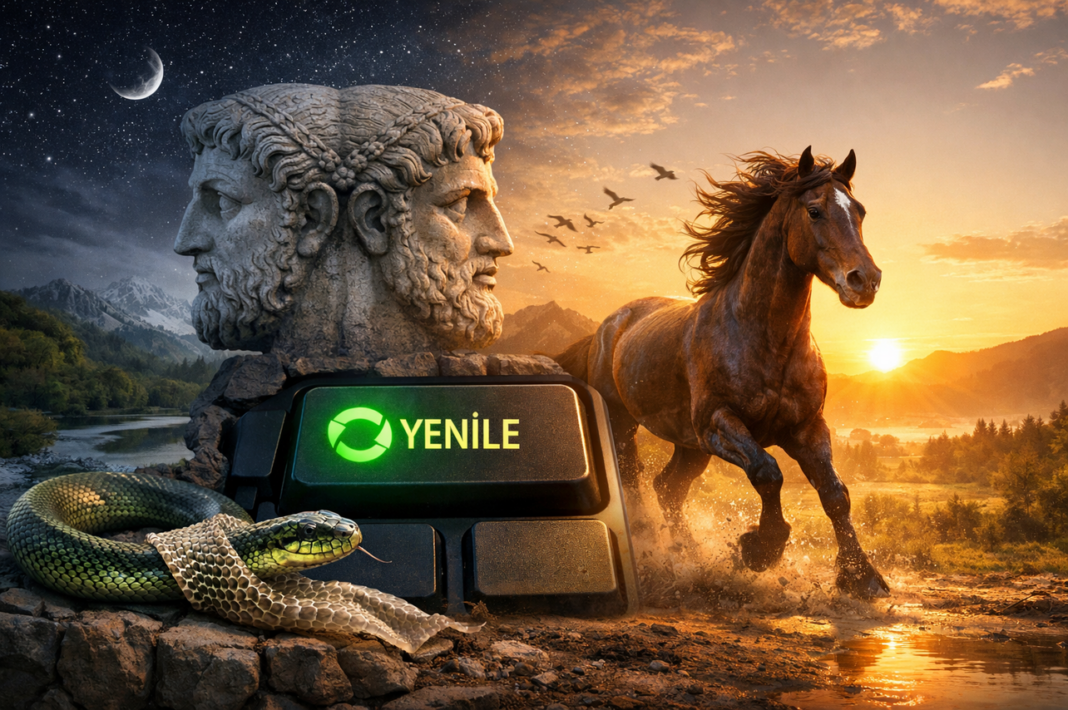

The “Refresh” Button of Consciousness and Time Markers
Waking up on the first morning of a new era has an indescribable, refreshing feeling. Experiencing that renewal in the perception of time is not merely a mathematical event. Essentially, we can say it’s a tremendous opportunity for a “neurological reset” for every beating heart and functioning nervous system on planet Earth.
In the context of neuroscience and behavioral psychology, these special moments are called temporal landmarks. In other words, the mind, struggling to perceive time as a straight line, breaks it down into segments. Significant dates like January 1st allow the mind to draw a thick line between the “past self” and the “present self.” Just like pressing a system’s “refresh” button, this symbolic date can trigger dopamine in the nervous system—that beautiful feeling of hope and motivation.
Shaking off the dust of a symbolic past, leaving old experiences in “that” file, throwing that file in the trash, and looking at a clean slate feels good. We should embrace this collective joy, this wave of universal hope, to the fullest. However, it’s also necessary to be aware that time perception and calendar systems are fictional. On the other hand, we shouldn’t ignore the ideological backgrounds of calendar systems that are widespread throughout the world.
The Gaze of Janus and “The Rhythms of Nature”
According to the historical legacy of Roman mythology, the month of January takes its name from Janus, the “God of Passages.” Depicted in iconography with two faces, Janus looks to the past with one face and to the future with the other. At the beginning of each term, the mind usually operates in Janus mode; moreover, it reviews the memories and lessons of the past term, and conversely, it delves into the plans and dreams of the coming cycle. Nevertheless, the planet’s legacy is not limited to this dual perspective.
Every region of the world welcomes novelty with a different language. For example, in the temperate zone, this is the cracking of the seed, symbolizing the “awakening of spring,” while in the equatorial zone, it’s the “arrival of the rains” that nourish the soil. Yet, in the polar regions, it’s the “return of light and the retreat of darkness.” Although it feels good, January 1st is an administrative construct that attempts to cram this immense diversity into a single day. However, “nature’s calendar” is local. This diversity offers a wonderful symbolic renewal within the constraints of modern life.
If your body still feels somewhat hibernating or in a dry period these days, there’s no need to feel like you’re missing out. There’s always a new threshold before you to harmonize with the local rhythm of your inner geography, your own body, and nature.
Transitioning From Duality to the Power of “Now”: A Logic Exercise
So, while Janus constantly looks to the past and the future, could it be overlooking the most important point – the ground it stands on? In other words, when the mind shuttles between the past and the future, it often produces anxiety.
Here we can turn our attention to ancient schools of logic, to Nyāya, which can be considered contemporary with, or perhaps even earlier than, the Aristotelian system. This approach offers a very clear proposition for breaking the illusions of the mind. Reality is neither in the fading past of memory nor in the yet-to-be-lived future. Reality (Satya) is only in the present moment, the moment of breathing.
We see this truth clearly when we look at life itself, at the flow of nature. No consciousness in nature consumes its energy by dividing time into “past regrets” or “future fears.” The essential nature of the nervous system is “center,” that is, “now.” In my workshops and sessions, this is a practice we frequently work on to invite attention to the “center,” to the reality of the moment. The aim is for the mind to emerge from that fictional time travel and return to this pure presence of life, to biological reality.
Because renewal does not occur when the calendar page or numbers change; renewal occurs when, with each breath, we awaken to present moment awareness without judgment.
A Mythological Journey: From the Secret of the Serpent to the Freedom of the Horse
This practice of “being in the moment” also facilitates understanding the energy (atmosphere) of the present. Mythological archetypes whisper wonderful stories to us about the qualities of the concept of time. According to legend, in the great river crossing race that determined the years, a serpent and a horse formed an interesting duo. The serpent silently crossed most of the river, clinging to the horse’s hoof. This is a dance of strategy and action.
We are currently in a very special transition based on the twelve-animal mythological calendar, which is also extremely important for Turk communities. We are still within the healing, calm, strategic, and renewing narrative of the “Year of the Serpent.” The serpent silently and patiently sheds its old skin. We are currently in this period of “letting go,” “lightening,” and establishing inner strategy. This is a process that needs time to mature, not to be rushed.
Soon, with February, we will encounter the free, vibrant, dynamic, and social narrative of the “Year of the Horse.” The wisdom of the Snake will already transform into the power of the Horse. Therefore, there is no need to rush. Enjoy the present moment.
Bibliography
Frankl, V. E. (1975). The Unconscious God: Psychotherapy and Theology. Simon & Schuster.
Matilal, B. K. (1998). The Character of Logic in India. State University of New York Press.
Esin, E. (1994). A History of Pre-Islamic and Early-Islamic Turkish Culture. Istanbul.
Droit, R. P. (Ed.). (2009). Philosophies d’ailleurs: Vol. 1. Hermann.
Droit, R. P. (Ed.). (2009). Philosophies d’ailleurs: Vol. 2. Hermann.
Chavannes, É. (1906). Le cycle turc des douze animaux. T’oung Pao, 7(1), 51–122.