


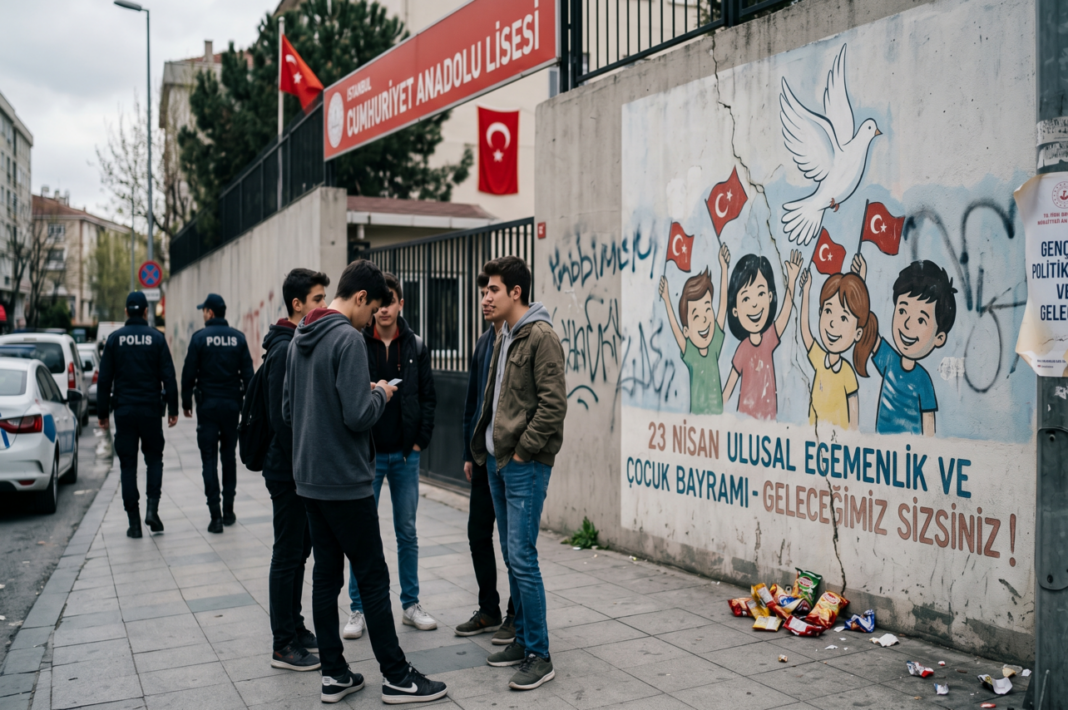

Societies often see youth and childhood as perfect ideas when they build their future. In Turkey, the April 23 National Sovereignty and Children’s Day is a clear example of this idea. However, the gap between social reality and these symbolic ideals is getting wider. Armed attacks and violence among young people in educational institutions, campuses, and public places are increasing. We cannot see these just as simple police problems. These actions show a deep psychological and sociological crisis. They also show structural tensions in public administration. We need to understand youth violence through structural inequality and psychological reactions, not just simple political differences.
To understand why individuals and groups use violence, we must look at how big economic factors affect personal psychology. In sociology and criminology, “structural strain” is very important to understand the root causes of crime. Merton (1938) created the Anomie Theory. It explains the rule-breaking that happens when people cannot reach social goals through accepted ways. Young people feel chronic stress in crisis times. During these times, traditional paths to success, like education and merit, are unclear, and worries about the future increase. Agnew (1992) brought this to a more psychological level with the General Strain Theory. He showed how the frustration of not reaching goals turns into crime and violence. When a person sees a gap between society’s goals and the tools to reach them, they create their own alternative rules based on violence. Losing trust in institutions and justice makes it easier for young people to use illegal ways to solve problems (Kızmaz, 2006). According to the Turkish Statistical Institute, child and youth crime statistics rise and fall together with economic difficulties. This is a scientific fact (Turkish Statistical Institute, 2023). Armed actions are not a goal; they are a destructive coping strategy against the feeling of being blocked.
Social Learning, Spatial Context, and Digital Echo Of Violence
From a psychological view, violence does not happen by itself. It is a learned, justified, and reinforced behavior. According to Bandura’s (1978) Social Learning Theory, young people copy conflict resolution skills directly from their environment, institutions, and media role models. A young person might see that physical force and aggression bring status in daily life, traffic, or public debates. Then, they use the same methods in their own small circles. Clinical and sociological studies by Ögel, Tarı, and Yılmazçetin Ercan (2006) clearly show that subcultures normalizing violence have a big effect on violent youth. A critical part of peer violence is problems in belonging and identity building. Individuals who cannot succeed academically or professionally feel invisible in the system. They try to gain respect by creating fear among their peers.
Moreover, the management of physical spaces where violence happens directly affects youth psychology. The Broken Windows Theory by Wilson and Kelling (1982) argues that ignoring physical disorder and small rule-breaking leads to bigger crimes over time. If there is a lack of authority or flexible rules in a school, campus, or neighborhood, young people feel unsafe. An unsafe person chooses aggression as a defense mechanism or joins unofficial groups for protection. Digital spaces act as a catalyst in this environment of insecurity and violence, just like physical spaces. Social media is uncontrolled. It turns violence from an action into a public performance. Hinduja and Patchin (2010) show that cyberbullying and digital provocations can quickly turn into real-life armed and physical attacks. Young people get approval for violent posts in digital echo chambers. They lose their empathy and become insensitive to the victim’s pain.
Preventive Public Administration and Social Policies
Understanding these complex dynamics stops us from seeing campus and street violence as simple police matters. Reactive measures like discipline, suspensions, or more police are not enough to solve the root causes of the problem. World Health Organization reports clearly show that youth violence is a preventable public health issue with the right socio-political interventions (World Health Organization, 2020).
Effective and inclusive public administration must create preventive social policies to eliminate structural inequalities and future anxieties of young people. It is necessary to reorganize urban areas and educational environments to support the psychosocial well-being of youth. We must also rebuild paths to success based on merit. In the light of social and structural realities, national days dedicated to children and youth can only find their true meaning in a fair system. This system must guarantee their physical, mental, and social safety. Punishing the results without removing the big conditions that create violence will not secure the future. It will only guarantee the continuation of the crisis.
References
Agnew, R. (1992). Foundation for a general strain theory of crime and delinquency. Criminology, 30(1), 47-88.
Bandura, A. (1978). Social learning theory of aggression. Journal of Communication, 28(3), 12-29.
Hinduja, S., & Patchin, J. W. (2010). Bullying, cyberbullying, and suicide. Archives of Suicide Research, 14(3), 206-221.
Kızmaz, Z. (2006). Sosyolojik suç kuramlarının suç olgusunu açıklama potansiyelleri üzerine bir değerlendirme [An evaluation of the potential of sociological crime theories to explain the phenomenon of crime]. C.Ü. Sosyal Bilimler Dergisi, 30(1), 149-176.
Merton, R. K. (1938). Social structure and anomie. American Sociological Review, 3(5), 672-682.
Ögel, K., Tarı, I., & Yılmazçetin Ercan, V. (2006). Türkiye’de suç işleyen ve işleme riski taşıyan çocukların özellikleri [Characteristics of delinquent children and children at risk of delinquency in Turkey]. Anadolu Psikiyatri Dergisi, 7(4), 253-258.
Turkish Statistical Institute. (2023). Güvenlik birimine gelen veya getirilen çocuk istatistikleri [Statistics on juveniles received into security units]. https://data.tuik.gov.tr
Wilson, J. Q., & Kelling, G. L. (1982). Broken windows: The police and neighborhood safety. The Atlantic Monthly, 249(3), 29-38.
World Health Organization. (2020). Youth violence. https://www.who.int/news-room/fact-sheets/detail/youth-violence