
Children Who Learn Equality: How Gender Awareness Develops In Childhood

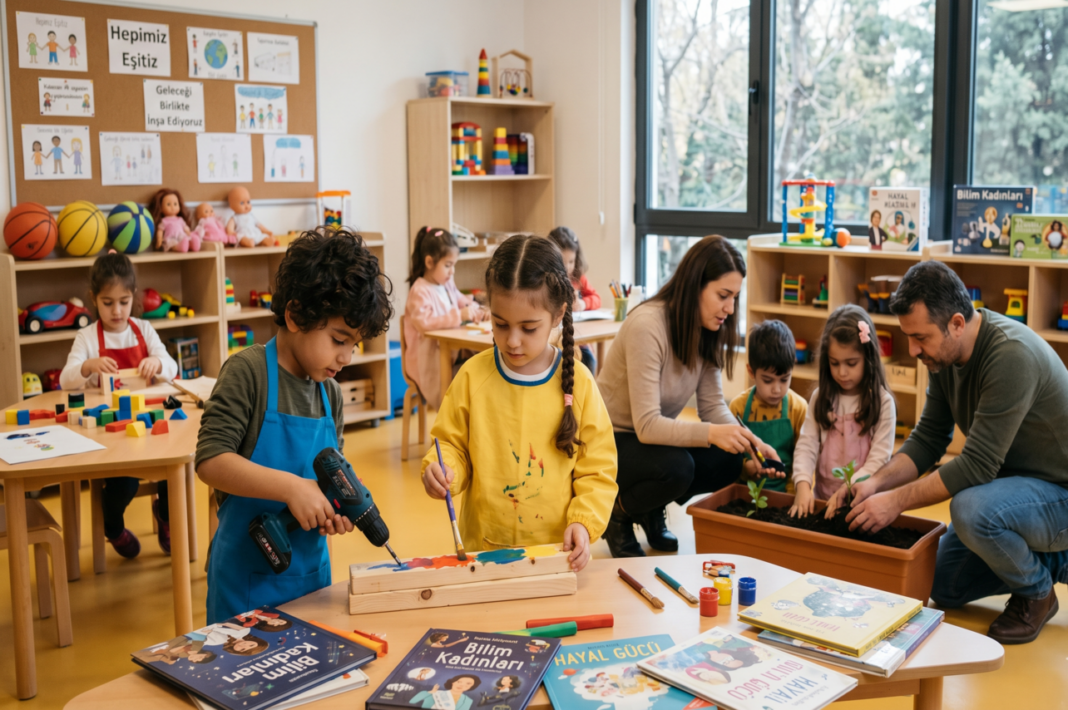
Children are not born with rigid ideas about gender. Beliefs such as “girls should behave this way” or “boys should act that way” are not innate; rather, they are learned over time through social interaction and observation. For this reason, children’s understanding of gender is best seen as a developmental and social process, shaped by their environment.
Research shows that children begin to recognize gender categories at a very early age. By around ages 2 to 3, children can distinguish between “boys” and “girls,” and by ages 5 to 6, they may develop more rigid beliefs about what each gender should be like (Martin & Ruble, 2004). This highlights how strongly children are influenced by the messages they receive from the world around them.
How Does Gender Awareness Develop?
Gender awareness develops as children begin to understand not only biological differences but also the roles, expectations, and norms that society assigns to different genders. This process is influenced primarily by three sources: family, social environment, and media.
1. Family and Daily Life The family is one of the most powerful contexts in which children learn about gender. Everyday experiences, such as how responsibilities are shared at home, how emotions are expressed, and how adults communicate, shape children’s perceptions of what is “normal.”
For example, if household tasks are consistently divided along traditional gender lines, or if one parent models emotional expression while the other does not, children may internalize these patterns as gender-specific behaviors. According to Bandura’s (1977) social learning theory, children learn by observing and imitating others, especially those they see as role models.
2. Social Environment and School Schools and peer relationships also play a significant role in shaping children’s gender beliefs. Teachers’ expectations, classroom dynamics, and peer interactions all contribute to how children understand themselves and others.
For instance, if girls are subtly encouraged to be quiet and compliant, while boys are allowed more freedom to be active or assertive, these patterns can reinforce gender stereotypes. Over time, such expectations may influence children’s behavior, self-expression, and even their sense of identity.
3. Media and Cultural Representation Children are constantly exposed to messages about gender through books, cartoons, movies, and digital content. Traditional representations often portray girls as passive, emotional, or nurturing, while boys are depicted as strong, independent, and dominant.
These portrayals can shape how children see their own potential and place in the world. However, exposure to diverse and inclusive representations can help children develop a more flexible and open understanding of gender roles.
The Impact Of Gender Stereotypes
Gender stereotypes not only influence behavior; they also affect children’s self-esteem, interests, and emotional development.
-
Boys may feel discouraged from expressing vulnerability or sadness.
-
Girls may learn to limit themselves or avoid taking up space.
-
Children may believe they are “not good enough” in certain areas because of their gender.
Research suggests that rigid gender norms can be associated with higher levels of anxiety, lower self-confidence, and more restricted career aspirations in the long term (Blakemore, Berenbaum, & Liben, 2009).
Children, as they grow up, look for representations around them that they can identify with; the representations they find help shape what they believe they can do or become in the future. For this reason, it is important to expose children to diverse individuals from a variety of professions. Understanding that people of all genders can pursue any career helps prevent the development of restricted career perceptions.
What Can Adults Do?
Supporting gender awareness in children is not about imposing strict rules but about helping them become curious, reflective, and empathetic individuals.
Use Inclusive Language: Avoid labeling activities, toys, or behaviors as “for girls” or “for boys.” Language plays a powerful role in shaping thought.
Create Space for Emotions: Encourage all children to express a full range of emotions. Emotions are human, not gendered.
Be a Role Model: Children learn most effectively through observation. Modeling equality, respect, and emotional openness in everyday life is one of the most impactful ways to teach these values.
Encourage Diversity: Introduce children to books, stories, and experiences that reflect different identities, roles, and ways of being.
Stay Open to Questions: Children are naturally curious about differences. Responding to their questions in an age-appropriate and honest way supports healthy understanding.
Gender awareness is not something children learn in a single moment; it develops gradually through experience, observation, and interaction. Rather than teaching rigid ideas about what children “should” be, it is more valuable to create environments where they feel free to explore who they are.
Children who grow up with a sense of equality and respect are more likely to become individuals who value diversity, empathy, and fairness, not only in their own lives but also in the wider society.
References
Bandura, A. (1977). Social learning theory. Englewood Cliffs, NJ: Prentice Hall.
Blakemore, J.E.O., Berenbaum, S.A., & Liben, L.S. (2009). Gender Development (1st ed.). Psychology Press. https://doi.org/10.4324/9780203889756
Martin, C. L., & Ruble, D. (2004). Children’s search for gender cues: Cognitive perspectives on gender development. Current Directions in Psychological Science, 13(2), 67–70. https://doi.org/10.1111/j.0963-7214.2004.00276.x
Bussey K, Bandura A. Social cognitive theory of gender development and differentiation. Psychol Rev. 1999 Oct;106(4):676-713. doi: 10.1037/0033-295x.106.4.676. PMID: 10560326.
Eccles, J. (2011). Gendered educational and occupational choices: Applying the Eccles et al. model of achievement-related choices. International Journal of Behavioral Development, 35(3), 195–201. https://doi.org/10.1177/0165025411398185