



In the first part, we discovered that a pedestrian path or the warmth of a coffee cup can rewrite the emotional contract between an individual and their institution. In the second, we found that a mascot’s face, a room bathed in blue, or a corridor breathing with plants can make the student feel not like a visitor, but a resident of their own experience. Now we arrive at what many consider the crown of modern design: technology. And yet, as with all crowns, this one carries thorns.
The Paradox Of Transparent Comfort
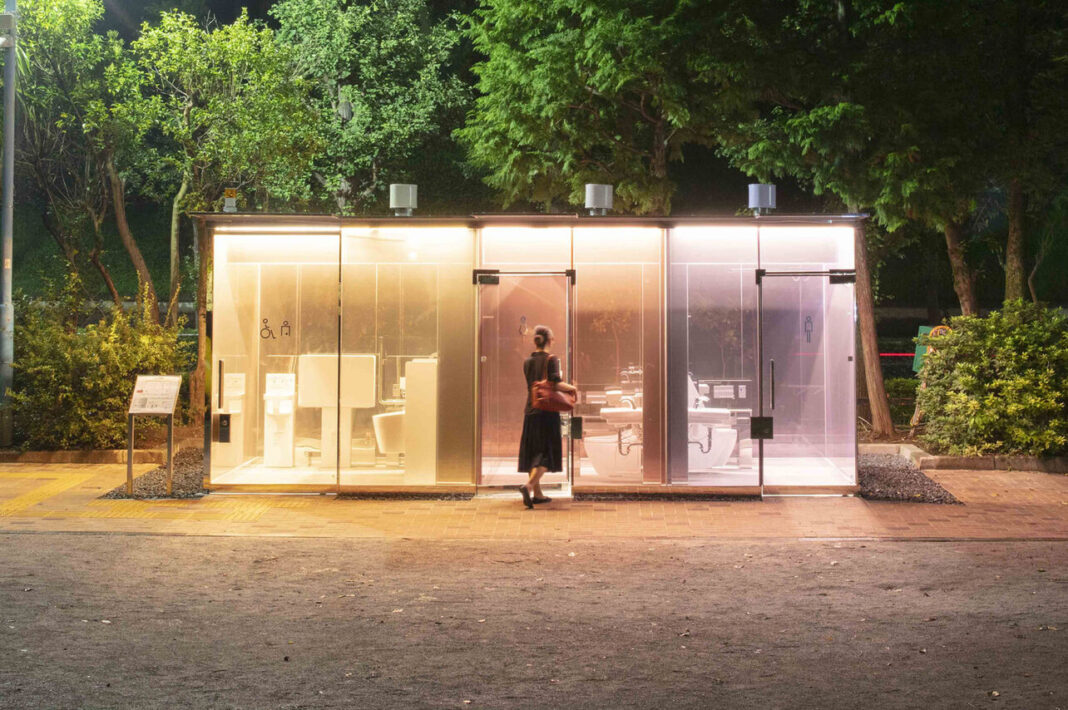
Technology sometimes arrives with the boldest promises precisely where we are most vulnerable. A city government, in partnership with a social innovation foundation, launched the Tokyo Toilet Project, inviting the world’s most celebrated architects to reimagine public restroom facilities as landmarks of trust and design. One entry became something close to a manifesto: a structure built almost entirely of glass, transparent from the outside, so that any passer-by could see at a glance whether it was occupied, dissolving one of the oldest anxieties of shared public space. Then, upon locking the door, the glass would frost over automatically, sealing the private from the public.
The idea was elegant. The execution, over time, was not. Cold weather degraded the electrochromic panels. Malfunctions appeared. Occasionally, the glass refused to frost on command. A design conceived to dissolve anxiety had quietly manufactured a new and far more intimate one: what if the glass does not close when I need it to?
“Every new technology is not only an opportunity; it is also the invention of a new kind of accident.” — Paul Virilio
This is the paradox every smart campus must face honestly. When a technological solution fails, it does not merely fail technically; it fails emotionally. The student who cannot trust that a door will close, or that a system will protect, withdraws something far more important than convenience: the willingness to feel at home. Technology that cannot accommodate human fragility does not become a tool of belonging. It becomes an expensive instrument of alienation.
The Weight Of The Invisible Network
The modern campus is increasingly woven from invisible threads; sensors, data streams, interconnected systems that learn and adapt. The global volume of data, sitting at roughly 0.48 zettabytes in 2008, had reached 40 zettabytes by 2020, with projections climbing toward 175 zettabytes by 2025. Moore’s Law ensures that the computing power required to process this ocean of information grows smaller, faster, and cheaper with each passing year. More devices. More campuses wired with more intelligence. More interconnected systems.
“We shape our tools, and thereafter our tools shape us.” — Marshall McLuhan
The mathematical implication is uncomfortable but unavoidable: as the system grows, so does the surface available to those who would exploit it. In 2008, a cyberattack on a website serving epilepsy patients flooded it with seizure-inducing imagery, harming thousands of people who had visited simply seeking help. No physical presence was required. Only a connection, and a willingness to cause harm. This is not an argument against technology in campus design. It is a reminder that technology deserves the same philosophical seriousness we bring to the placement of a bench or the selection of a scent. A campus that protects its students’ bodies through biophilic corridors and ergonomic furniture, yet leaves their digital experience unguarded, has paid only half of its duty of care.
The Architecture That Endures
At the close of this three-part journey, we arrive at the question all these elements, nudge strategies, embodied warmth, olfactory memory, the psychology of color, biophilic design, and technology, ultimately converge upon: What does a campus need to be, so that the person who leaves it never fully leaves?
A former student, walking through a city years after graduation, catches a particular scent. For a fraction of a second, they are back; sitting under a window that no longer exists, worried about an exam they have long since forgotten. The campus, in that moment, is not a building. It is a living residue in the nervous system. This residue is not produced by any single intervention. It accretes, like sediment, through thousands of unremarkable encounters with a space designed to care. The chair that respects the body. The mascot at the courtyard’s center. The blue light of a creative studio. The trees visible through a corridor window. Belonging is never declared; it is accumulated.
To the designers of today and tomorrow who are reading this, a humble piece of advice: Let nudges be gentle. Let design be warm. Carry nature inside. Trust technology only as far as you trust your own capacity to repair it when it fails. Every design decision, however small, however invisible, is a silent sentence in a very long letter the institution writes to its students. A letter that some of them, years later, will still be reading.
References
Thaler, R. H. and Sunstein, C. R. (2008). Nudge. Yale University Press.
Ko, Y. J. et al. (2020). Do humanized team mascots attract new fans? Journal of Sport Management, 34(6).
Mehta, R. and Zhu, R. (2009). Blue or red? Science, 323(5918), 1226-1229.
Özdemir, H. (2024). Integrating nature into academic spaces: Biophilic campus.
Zengin, D. (2015). The role of olfactory memory in spatial belonging.
Moore, G. E. (1965). Cramming more components onto integrated circuits. Electronics, 38(8).
Guo, H., Wang, L., Chen, F. and Liang, D. (2014). Scientific big data and digital Earth.
Norman, D. A. (2013). The design of everyday things. MIT Press.