


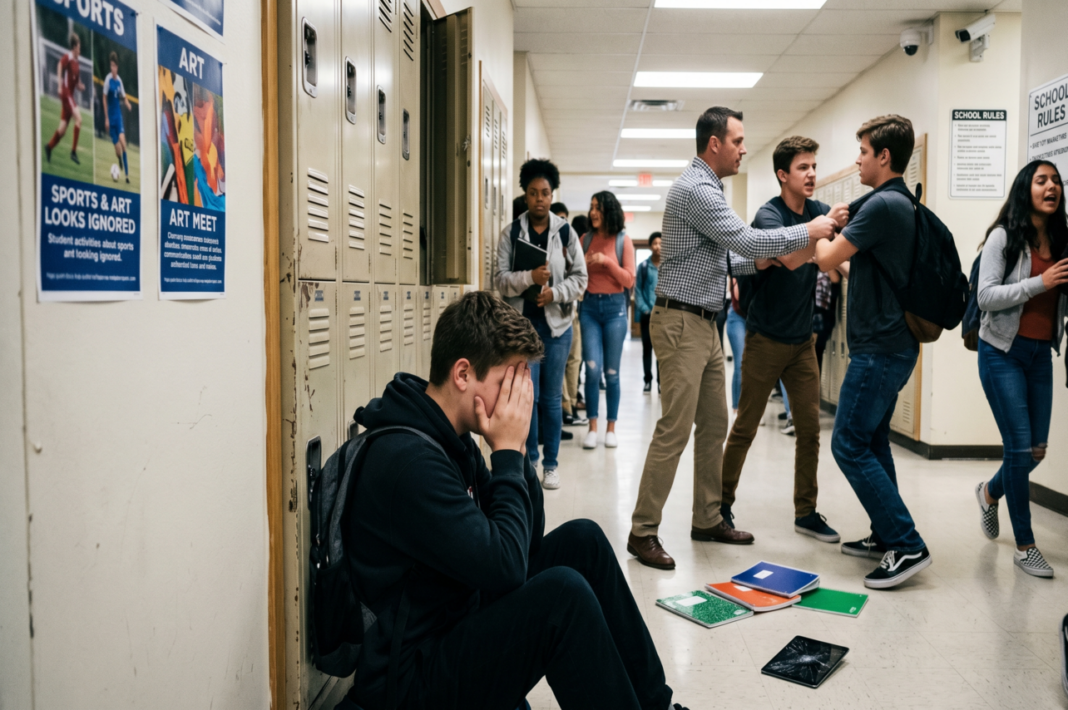

In recent years, the rise in aggression and violent tendencies among adolescents has become too widespread and salient to be explained solely by individual behavioral problems. Particularly, the increase in violent incidents in schools indicates that this issue should no longer be considered merely an individual concern, but rather a broader public mental health problem. Physical altercations among peers, anger directed toward teachers, conflicts escalating from minor triggers, and a steadily decreasing tolerance threshold have become increasingly common phenomena observed by professionals in the field.
A profile of adolescents who become angry more quickly, react more intensely, and express their emotions in more extreme ways is emerging across school environments, social settings, and digital platforms. However, defining this pattern simply as an “anger problem” risks overlooking its deeper psychological dimensions. From a clinical perspective, aggression is often understood as the external expression of an unregulated internal burden. This raises a more complex question: Is the increase in adolescent aggression primarily a result of a loss of control, or does it reflect a deeper loss of meaning?
Weakening Of Emotional Regulation: Why Is Control Diminishing?
The most visible dimension of aggression lies in the weakening of emotional regulation capacity. Emotional regulation refers to the ability to recognize, tolerate, and appropriately express one’s internal states of arousal. Adolescence, by its very nature, is a developmental period during which this capacity has not yet fully matured. However, in today’s context, this inherent vulnerability is further intensified by environmental factors.
Constant exposure to stimuli, a culture of rapid consumption, the expectation of immediate gratification, and decreasing tolerance for delay all contribute to the erosion of emotional resilience in adolescents. As a result, frustration tolerance declines, and responses to perceived obstacles become increasingly intense. This creates a context in which anger escalates more rapidly and is expressed in more uncontrolled ways.
Within school settings, this dynamic becomes particularly visible. A minor classroom warning, a simple peer disagreement, or a teacher’s attempt to set limits can quickly trigger aggressive reactions in some adolescents. This should not be interpreted merely as a disciplinary issue, but rather as a direct reflection of impaired regulatory capacity. Clinical observations indicate that many adolescents experience emotions either in excessively intense forms or in a completely suppressed manner. The loss of emotional gradation—the inability to modulate affect—transforms aggression into a mechanism of discharge. In this sense, aggression is not merely a behavior, but a manifestation of regulatory failure.
Cognitive Processes and Impulsivity: Reacting Without Thinking
Aggression is not only emotional but also cognitive in nature. Under conditions of high arousal, the individual’s capacity to evaluate situations, anticipate consequences, and generate alternative responses becomes compromised. Consequently, aggressive behaviors often occur impulsively, without deliberate thought.
In many school-related incidents, statements such as “I don’t know how I did it” or “it just happened suddenly” reflect this process clearly. These reactions are less indicative of planned aggression and more representative of an inability to regulate internal arousal. However, this should not be reduced to an individual deficit. Impulse control and cognitive regulation are developmental capacities shaped by environmental learning. Adolescents raised in contexts where boundaries are unclear, feedback is inconsistent, or emotional regulation is not modeled may struggle to develop internal control mechanisms.
Loss Of Meaning: The Invisible Dimension Of Aggression
One of the most critical yet often overlooked aspects of aggression is the weakening of the capacity to generate meaning. Meaning functions as an internal compass that guides behavior. Values, goals, and a sense of belonging provide direction and coherence to an individual’s life.
Today, many adolescents struggle to determine what they are connected to, what they value, and which principles should guide their behavior. The limited availability of identity-defining domains beyond academic achievement can further intensify this sense of inner emptiness.
This sense of disconnection is also reflected within the school environment. For adolescents who do not feel a sense of belonging, who are unable to establish meaningful relationships with teachers, or who feel unseen, school may become merely an obligatory space. In such contexts, rules may be perceived not as meaningful structures but as oppressive constraints—thereby increasing the likelihood of aggressive responses. From this perspective, aggression is not only an uncontrolled emotional reaction but also an expression of a loss of direction. Violence may represent an attempt to externalize an unarticulated inner void or an unresolved psychological tension.
What Should Be Done?
Addressing the rise in adolescent aggression, particularly within schools, requires a multi-layered approach. The tendency for counseling services to intervene only during crisis situations leads to a neglect of preventive efforts. However, aggression should not be treated solely as a condition to be managed after it emerges, but rather as a process that must be proactively structured.
First, emotional regulation skills should be systematically taught. This should extend beyond the therapy setting and be integrated into the school environment. Skills such as emotional awareness, anger management, and stress coping should be incorporated into educational frameworks.
Second, psychological support systems within schools must be strengthened. Counseling services should evolve from reactive problem-solving units into structures that provide preventive mental health interventions.
Third, the psychological competence of teachers should be supported. Teachers are not only transmitters of academic knowledge but also key emotional regulators within the classroom. Training in classroom crisis management, boundary-setting, and emotional communication is therefore essential.
Fourth, collaboration with families should be enhanced. Consistent boundaries across home and school environments play a critical role in supporting adolescents’ internal regulatory capacities.
Finally, opportunities that support meaning-making should be expanded. Engagement in sports, arts, social responsibility projects, and productive activities provides adolescents with avenues for self-expression and the development of a sense of value and purpose.
Conclusion
The increase in aggression among adolescents cannot be understood as a single-dimensional problem. It reflects both a weakening of emotional regulation capacity and a disruption in meaning-making processes. The rise in school-based violence represents one of the most visible and critical manifestations of this broader dynamic.
Rather than viewing aggression solely as a behavior that must be suppressed, it is essential to understand the underlying psychological processes. Control and meaning are two fundamental and interdependent structures; neither can be sustained in the absence of the other. Therefore, the solution lies not merely in discipline, but in the integration of structure, understanding, and psychological support. Supporting adolescents in developing a more balanced, self-aware, and purpose-oriented psychological framework is only possible through the adoption of such a multidimensional approach.