



People are defined not by who they are, but by the choices they make throughout their lives (May & Yalom, 1995; Yalom, 1980). Perhaps the most terrifying aspect of decision-making is not the fear of choosing incorrectly, but the possibility of terminal regret—the realization that one must live with the consequences (Becker, 1973).
At first glance, Eternity (2025) presents itself as a romantic and comforting depiction of life after death. It offers a highly structured afterlife, aesthetically pleasing settings, and a seductive promise of a “happy ending.” Beneath this theme, the movie gradually reveals a world where humans cannot escape their darkest curse: the obligation to choose.
In the afterlife, just like everyone else, Joan needs to decide who she will spend eternity with. Her options are painfully symbolic: Luke, her first love who died young in World War II and waited for her in the afterlife ever since, or her husband of sixty-five years, Larry, with whom she built a life shaped by routine, compromise, and mutual devotion. She must decide within a limited time frame, and once chosen, it is irreversible.
From the perspective of existential psychology, it is claimed that people are not born with a fixed identity; it is constructed through choices (May, 1975). While this approach appears liberating, it also carries the unbearable weight of the responsibility of one’s decisions and their outcomes (May & Yalom, 1995). Such responsibility creates existential anxiety (Yalom, 1980; Kierkegaard, 2013), rooted in the ever-present possibility of having chosen wrongly. This often results in individuals trying to escape responsibility altogether—not by choosing wisely, but by avoiding choice itself (Langford, 2002). Joan’s initial decision operates precisely in this register. By choosing her friend, she seeks temporary emotional relief rather than authentic commitment (Moore & Goldner-Vukov, 2009). Only after Larry urges her to choose Luke does Joan confront the choice she has been postponing.
For Joan, Larry and Luke do not function merely as two romantic alternatives fighting for her attention, but as two distinct versions of herself. What looks like a regular love triangle is actually a journey of discovering which self is more authentic (Binder, 2022).
Luke stands for her idealized self. He embodies youth, passion, and emotions that resist time, frozen somewhere in the intensity of her early twenties. Being with him is choosing intensity over duration (Bugental, 1969). The eternity he offers is emotionally powerful, but also an extension of idealized moments. There is passion, but little room to grow (Langford, 2002).
Larry, on the other hand, represents her authentic self. He stands for ordinary days, old routines, shared sacrifices, and a life built together (Binder, 2022). In this version of love, grand romantic gestures are replaced by continuity and responsibility. Love is no longer something you feel, but something you choose repeatedly (Bugental, 1969).
From this angle, Luke reflects the aesthetic side of Joan’s life—intensity, beauty, and emotional elevation. Larry reflects meaning, commitment, and ethical depth (Heine et al., 2006; Temple & Gall, 2016). The idealized self may look dazzling, but it is not always easy to inhabit. The authentic self, though flawed and ordinary, is ultimately more sustainable (Bugental, 1969; Binder, 2022). The question is not “Which man does she love more?” but “Which version of herself is she willing to live with?” (Tillich, 1952).
In the movie, everyone appears in the afterlife the way they looked at the happiest moment of their lives. At first, the idea is undeniably appealing—who wouldn’t want to spend eternity as the best version of themselves?
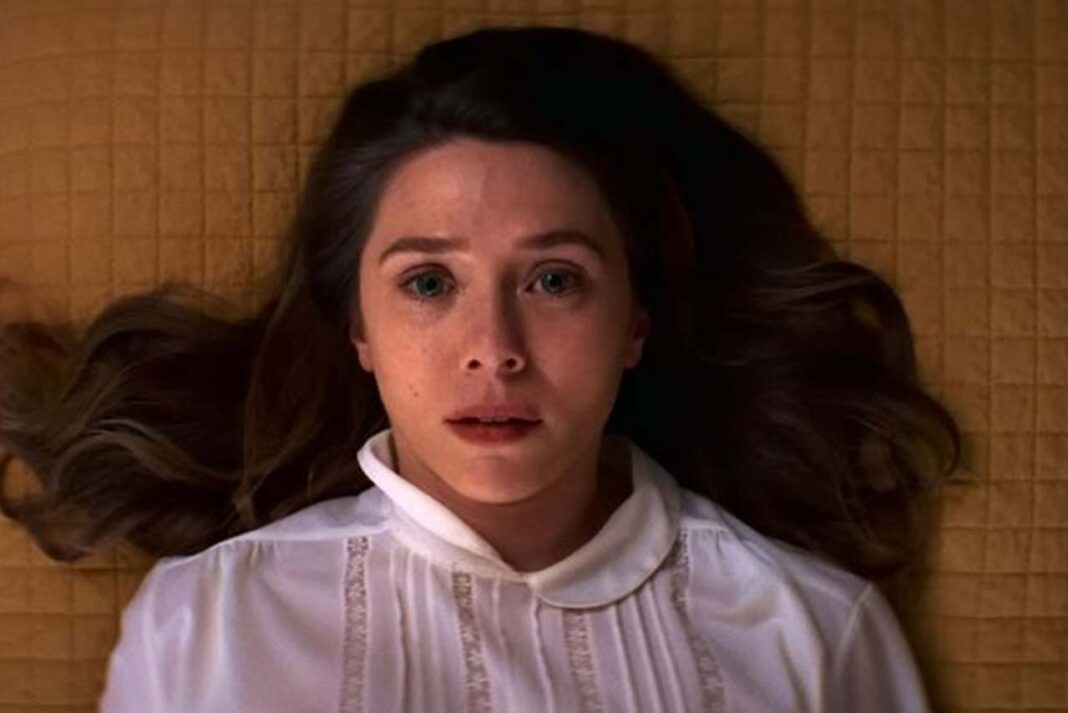
That romantic fantasy starts to crack when Larry has a painful realization. Throughout their life together, Joan always wore her hair short. Yet in the afterlife, her hair falls long over her shoulders. He understands that her happiest moment did not happen with him, but with Luke. As much as he tries to accept this truth, the scene quietly exposes how flawed it is to reduce happiness to a single frozen moment (Bugental, 1969).
Larry telling Joan to choose Luke becomes one of the most devastating and emotionally mature moments of the movie. He suppresses his own longing and places Joan’s happiness above his desire to keep her (Cohen, 2003). His choice is deeply ethical. In Viktor Frankl’s terms, love is not about possession, but about allowing the other person the freedom to move toward their own sense of meaning and well-being (Frankl, 1967).
In the end, Eternity (2025) does not function as a peaceful last destination, but as a space where one is forced to confront the naked self. Time stands still, bodies appear younger, yet the obligation of choice remains unavoidable. Through Joan’s eyes, we come to realize that happiness cannot be reduced to a single moment and that love is less about intensity than dedication. Glitter might appear tempting, but over time meaning quietly emerges from ordinary days. Eternity shows that infinity cannot save us from choice; it can only reveal which self we are brave enough to carry forever.
References
Becker, E. (1973). The Denial of Death. New York, NY: Free Press.
Binder, P. (2022). The call of the unlived life: On the psychology of existential guilt. Frontiers in Psychology, 13, 991325. https://doi.org/10.3389/fpsyg.2022.991325
Bugental, J. F. T. (1969). Someone needs to worry: The existential anxiety of responsibility and decision. Journal of Contemporary Psychotherapy, 2(1), 41–53. https://doi.org/10.1007/bf02110895
Cohen, B. N. (2003). Applying existential theory and intervention to career decision-making. Journal of Career Development, 29(3), 195–209. https://doi.org/10.1177/089484530302900306
Frankl, V. E. (1967). Psychotherapy and Existentialism: Selected Papers on Logotherapy. New York: Washington Square Press.
Heine, S. J., Proulx, T., & Vohs, K. D. (2006). The meaning maintenance model: On the coherence of social motivations. Personality and Social Psychology Review, 10, 88–110.
Kierkegaard, S. (2013). The Concept of Anxiety. Princeton, NJ: Princeton University Press.
Langford, I. H. (2002). An existential approach to risk perception. Risk Analysis, 22(1), 101–120. https://doi.org/10.1111/0272-4332.t01-1-00009
May, R. (1975). The Courage to Create. New York, NY: W. W. Norton.
May, R., & Yalom, I. D. (1995). Existential psychotherapy. In R. Corsini & D. Wedding (Eds.), Current Psychotherapies (5th ed., pp. 262–292). Itasca, IL: F. E. Peacock.
Moore, L. J., & Goldner-Vukov, M. (2009). The existential way to recovery. Psychiatria Danubina, 21, 453–462.
Temple, M., & Gall, T. L. (2016). Working through existential anxiety toward authenticity: A spiritual journey of meaning making. Journal of Humanistic Psychology, 58(2), 168–193. https://doi.org/10.1177/0022167816629968
Tillich, P. (1952). The Courage to Be. New Haven, CT: Yale University Press.
Yalom, I. D. (1980). Existential Psychotherapy. New York: Basic Books.