


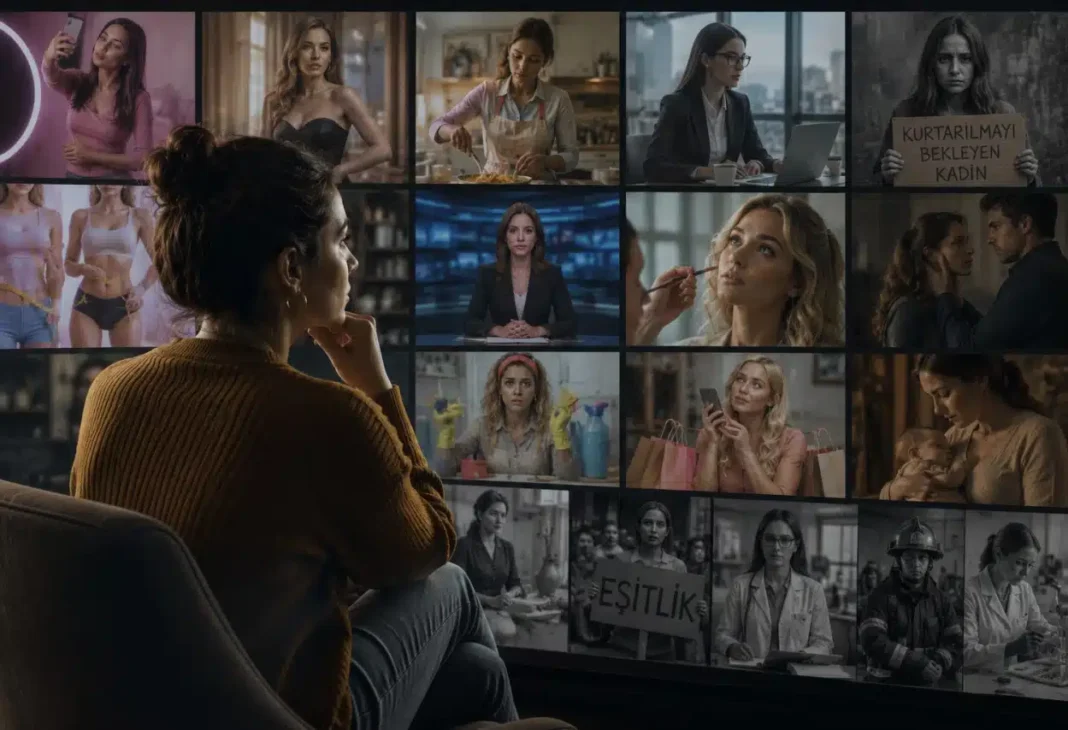

Gender refers to the socially constructed roles, responsibilities, and behavioural expectations that societies attribute to women and men, independent of biological sex. These roles influence many aspects of individuals’ lives, including everyday practices, career choices, family roles, and interpersonal relationships. Alongside family, educational institutions, and peer groups, the media plays a significant role in the acquisition and reinforcement of gender roles. Television series, in particular, are among the most influential mechanisms for reproducing gender norms because they reach large audiences and have become an integral part of everyday life (Aktaş, 2020).
Television series are not merely products that reflect social reality; they also construct cultural narratives that shape audiences’ perceptions of femininity and masculinity. Consequently, the representation of female characters can influence viewers’ expectations, attitudes, and stereotypes regarding women. Studies examining Turkish television dramas indicate that female characters have traditionally been portrayed through roles centred on motherhood, self-sacrifice, emotionality, and the protection of the family (Varlı Gürer & Gürer, 2020). However, more recent research suggests that women are increasingly represented as independent, resilient, and decision-making individuals (Gecü, 2025).
The aim of this study is to examine how female stereotypes are represented in Turkish television series and to evaluate the psychological consequences of these representations from a gender perspective.
The Reproduction of Gender Through the Media
Gender roles are not innate characteristics but behavioural patterns acquired through social learning processes. Within this process, the media communicates messages regarding which behaviours are considered appropriate for women and men. According to Aktaş (2020), television is not only influenced by social and cultural transformations but also possesses the power to shape them. Therefore, the way female and male characters are portrayed in television dramas plays a crucial role in constructing and maintaining social norms.
In television series, women are generally associated with the private sphere, whereas men are linked to the public sphere. Female characters are commonly depicted as responsible for household chores, childcare, and maintaining family relationships, while male characters are portrayed as economically powerful, professionally successful, and authoritative decision-makers (Aktaş, 2020). Such representations may contribute to the perception that gender inequality is natural and inevitable.
From a psychological perspective, repeated exposure to these portrayals facilitates the internalisation of gender stereotypes. Children and adolescents who are frequently exposed to media content may develop their understanding of femininity and masculinity according to these recurring representations. Consequently, the media does not merely reflect existing social structures but actively contributes to reproducing them.
Defining Womanhood Through Motherhood and Self-Sacrifice
One of the most prominent dimensions of female stereotypes in Turkish television series is the emphasis on motherhood. The study conducted by Varlı Gürer and Gürer (2020) revealed that female characters are predominantly portrayed as mothers, nurturing figures, self-sacrificing individuals, and devoted caregivers. According to their findings, motherhood is the characteristic most frequently associated with women, while even female characters who are not mothers are often depicted as possessing maternal qualities.
This pattern of representation suggests that female identity is largely defined through motherhood. Women are portrayed as individuals who hold the family together, solve domestic problems, and consistently prioritise the needs of others over their own. Such portrayals reinforce the societal expectation that women should naturally be self-sacrificing. Indeed, Varlı Gürer and Gürer (2020) emphasise that female characters are frequently characterised as devoted and selfless.
Psychologically, these representations may have significant consequences. Constantly associating femininity with caregiving and self-sacrifice strengthens social expectations that women should suppress their own needs for the benefit of others. Particularly for young women, these portrayals may foster the belief that being a “good woman” requires living primarily for others. As a result, characteristics such as personal achievement, autonomy, and self-development may become secondary.
The Objectification of the Female Body and the Ideal Female Image
Women in television series are often defined not only through their familial roles but also through their physical appearance. Aktaş (2020) argues that many female characters are portrayed primarily as attractive and physically appealing individuals. Similarly, Varlı Gürer and Gürer (2020) highlight that women’s success is frequently associated with beauty.
Such portrayals place women’s bodies at the centre of social evaluation. Rather than emphasising professional competence, intellectual abilities, or personality traits, television series often prioritise physical attractiveness, thereby reinforcing the notion that a woman’s value is determined by her appearance.
Psychological literature demonstrates that continuous exposure to idealised body images is associated with body dissatisfaction, lower self-esteem, and negative body image. Repeated beauty standards presented in television dramas may produce similar psychological effects, particularly among young women. Therefore, television not only reproduces media representations of gender but also reinforces broader social norms regarding women’s bodies.
The Audience’s Role and Resistance to Stereotypes
Media audiences were traditionally viewed as passive recipients of media messages. However, contemporary research suggests that viewers actively interpret media content in different ways. Demirer Sancar’s (2013) study on representations of motherhood demonstrates that audiences are capable of critically evaluating portrayals of femininity and motherhood.
One notable finding concerns participants’ perceptions of the stepmother stereotype. A considerable number of participants rejected the traditional belief that all stepmothers are inherently malicious, indicating resistance to stereotypical portrayals. This finding suggests that media stereotypes are not always accepted without question.
Nevertheless, the study also revealed that audiences perceived television portrayals of motherhood as largely consistent with real-life motherhood (Demirer Sancar, 2013). This finding illustrates the reciprocal relationship between television dramas and social reality. Television series draw upon existing social norms while simultaneously contributing to their continuation.
Changing Representations of Women: Empowerment or Reproduction?
In recent years, female characters in Turkish television dramas have increasingly been portrayed as stronger and more independent individuals. Gecü’s (2025) study examined changes in gender roles across television series from different periods and found that contemporary female characters are represented as more rational, autonomous, and resilient.
Recent productions depict women responding to experiences such as infidelity, betrayal, or family conflict more actively rather than passively accepting their circumstances. Instead, they are shown taking control of their own lives and making independent decisions. This shift may be interpreted as supporting women’s self-efficacy while challenging traditional gender expectations.
However, this transformation appears to remain limited. Even strong female characters are often defined primarily through their roles as wives, mothers, or family members. Their empowerment is generally presented not as individual autonomy but as their ability to resolve family crises. Therefore, despite visible changes, traditional gender norms continue to be reproduced in new forms.
Conclusion
An examination of female representations in Turkish television series demonstrates that traditional gender stereotypes continue to persist. Women are predominantly portrayed as mothers, wives, devoted caregivers, and protectors of the family. Physical beauty and attractiveness also remain central characteristics in defining female characters.
At the same time, the increasing portrayal of women as independent, resilient, and decision-making individuals reflects broader social transformations within media content. Nevertheless, these changes often remain superficial, as traditional gender norms continue to be reproduced in different ways.
From a psychological perspective, television series play a significant role in shaping individuals’ perceptions of femininity and masculinity. Therefore, promoting media representations in which women are depicted not solely through motherhood, self-sacrifice, or physical attractiveness, but as multidimensional individuals with diverse life experiences, professional identities, personal goals, and unique characteristics, is essential for advancing gender equality.
References
Aktaş, G. (2020). A sociological evaluation of the reflection of gender roles in television series. Sosyolojik Bağlam Dergisi, 1(1), 1–12.
Demirer Sancar, E. (2013). Audience reception of motherhood representations in television dramas: Adını Feriha Koydum (Unpublished master’s thesis).
Gecü, G. (2025). From Meltem to Bahar: Reflections of gender roles in television series—Has anything changed? Toplum ve Kimlik Dergisi, 2(2), 258–274.
Varlı Gürer, S. Z., & Gürer, M. (2020). Female stereotypes presented in Turkish television series within the context of gender roles. Alanya Akademik Bakış Dergisi, 4(3), 631–650.