


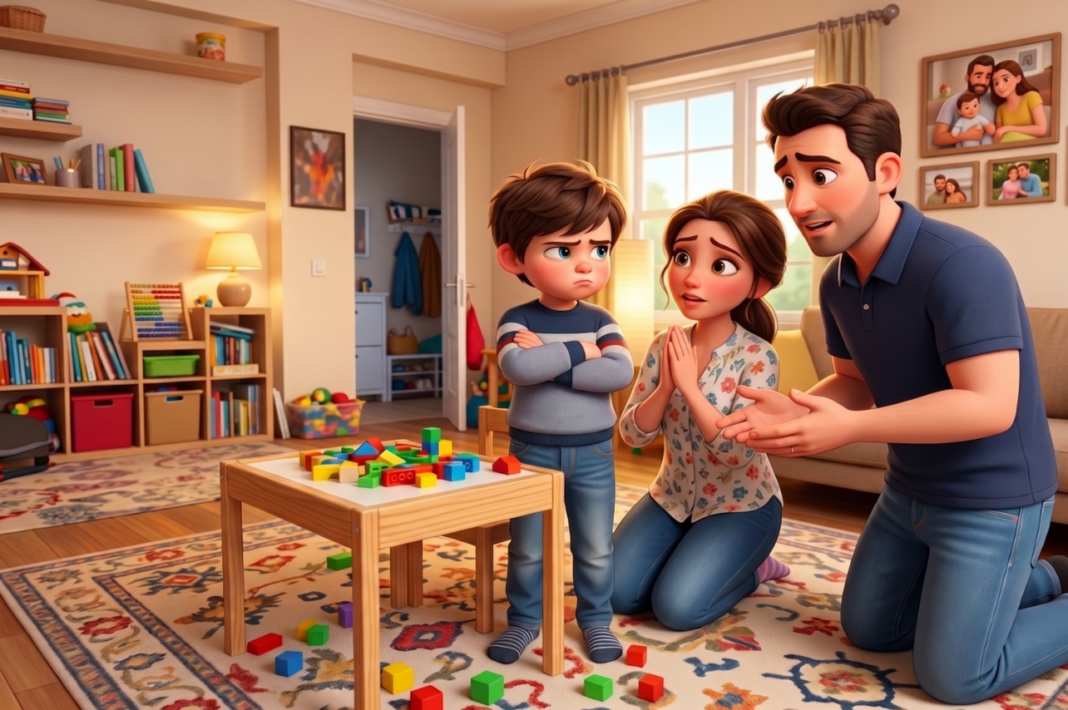

1. Introduction: The Invisible Roots Of Behavior
In contemporary psychology, behavioral problems in children are often superficially attributed to the child’s “temperament” or “difficult personality.” However, modern psychological frameworks and systemic family therapy approaches remind us that a child does not grow in a vacuum; rather, they are an integral part of a family ecosystem. From birth, children learn the language of this social structure. The early years of life are when neuroplasticity is at its peak, and the family environment is the primary variable in how a child codes the world as either “safe” or “threatening.”
Parents are the first lenses through which a child interprets the world. If these lenses are blurred or distorted, the child’s reactions to the external world—their behaviors—will be shaped accordingly. Behavioral problems are often a “cry for help” or a functional response to a malfunction within the family system.
2. Definition and Scope Of Behavioral Problems
For a behavior to be defined as a “problem,” it must meet certain criteria. Not every maladaptive act is a disorder; it must be evaluated based on whether it is developmentally appropriate. For instance, a temper tantrum in a two-year-old (the “terrible twos”) is developmentally expected, whereas similar behavior in a ten-year-old requires clinical attention.
Key Behavioral Problems Include: • Externalizing Disorders: Aggression, opposition, theft, lying, and destructive behaviors. • Internalizing Disorders: Excessive anxiety, social withdrawal, selective mutism, and somatic (physical) complaints. • Attention and Impulse Control Issues: Restlessness, acting without considering consequences, and difficulty focusing.
Each of these problems may be fueled by an unmet need within the family or a result of faulty communication methods.
3. The Family: A Laboratory For Emotional Development
The family is not just a place where a child is biologically nurtured; it is a laboratory where they learn emotional regulation. When an infant sees their mother remain calm during a frightening moment, they learn to soothe their own nervous system. This is known as “co-regulation.”
If the family environment is characterized by constant tension, chaos, or emotional coldness, the child will struggle to manage their own emotions. Unmanaged intense emotions are often projected outward. Outbursts of anger may actually be a masked version of unregulated fear or sadness. In this context, family interaction patterns form the child’s “behavioral repertoire.”
4. An In-depth Examination Of Parenting Styles
The parenting styles defined by Baumrind and other researchers are the primary structural pillars of a child’s character building.
4.1. Authoritative (Democratic) Style In this model, “unconditional love” and “clear boundaries” go hand in hand. The parent accepts the child as an individual, asks for their opinions, but also sets clear rules for the household. Children raised in this environment can establish cause-and-effect relationships. When they make a mistake, they learn to compensate for the consequences rather than just being punished. This leads to high self-esteem and fewer behavioral issues in the long run.
4.2. Authoritarian Style “Because I said so!” is the slogan of this approach. Rules are rigid and non-negotiable. In this environment, the child cannot internalize discipline; they obey only to avoid punishment. When the parent is absent, these children often display suppressed anger by bullying peers or secretly breaking rules. This hidden resentment toward authority can turn into a serious explosion during adolescence.
4.3. Permissive (Indulgent) Style This is a model where love is excessive, but boundaries are non-existent. The child is like the “little boss” of the house. Children who get everything they want instantly face immense disappointment when they encounter the realities of the outside world (school rules, waiting, sharing). This disappointment returns as social maladjustment and aggression. Boundaries are actually a safety zone for children; a lack of boundaries causes anxiety.
4.4. Neglectful (Uninvolved) Style This is the highest-risk category, where both love and control are low. Although the child is physically present, they are emotionally abandoned. These children may exhibit the most severe behavioral problems under the logic that “negative attention is better than no attention at all.” The risks of truancy, substance abuse, and delinquency are significantly higher in this group.
5. The “Reward-Punishment” Trap In Reinforcing Behavior
Many families inadvertently fuel problem behaviors. For example, when a parent buys a toy for a child who is screaming in the market to avoid “being embarrassed,” they send this message to the child’s brain: “Screaming works; scream louder to reach your goal.” This is the reinforcement of the behavior.
Similarly, a parent who only interacts with a child when they misbehave (even if it is to scold them) causes the child to meet their “need for attention” through negative means. For a child, negative attention is more nourishing than no attention.
6. The Neurobiological Impact Of Family Communication
Communication is not just about words; tone of voice, gestures, and facial expressions (body language) send direct messages to the child’s nervous system. A child constantly exposed to criticism or phrases like “you are incompetent” or “I am exhausted because of you” maintains a chronically high level of cortisol (the stress hormone). A brain under chronic stress acts through the amygdala (the survival center) rather than the prefrontal cortex (the logical thinking center). This manifests as impulsivity and aggression.
7. Parental Psychological Health and Reflection
The saying “Happy parents, happy child” is a scientific reality. A depressed parent may fail to read a child’s emotional cues. An anxious parent may project the world as overly dangerous, causing the child to become withdrawn or hyper-anxious. A parent’s own childhood traumas can unintentionally dictate their attitude toward their child. Unless this “intergenerational transmission” is broken, behavioral problems can be passed down from generation to generation.
8. Consistency and Predictability
For a child, the world is a complex place. What makes them feel safe is “predictability.” If a mother says “no” while a father says “yes,” or if a mother laughs at a situation one day and gets very angry the next, the child cannot learn which behavior is correct. This uncertainty creates anxiety, which manifests through behavioral symptoms like nail-biting, bedwetting, or defiance.
9. Modeling: The Child Is The Mirror Of The Family
Parents are the greatest teachers, but they teach most through what they do rather than what they say. A father who slams doors when angry has no impact when telling his child “don’t hit your friend.” Children learn problem-solving skills by watching their parents. If conflicts are solved by shouting at home, the child will shout at a friend at school.
10. Family Dynamics In The Digital Age
Technology has become the “third parent” of the modern family. A tablet handed to a child during dinner is actually a silencer used to suppress a momentary restlessness (behavioral problem). However, this stunts the child’s ability to cope with boredom and control their impulses. Furthermore, parents burying themselves in their phones and failing to maintain “eye contact” with their child can create a deep sense of worthlessness.
11. Solutions and Intervention Strategies
To solve behavioral problems, providing therapy only to the child usually does not offer a permanent solution. The family system must change.
• Nurturing Interaction: Spending just 15 minutes a day without technology, simply playing with and listening to the child, solves many problems at their root. • Catch the Positive: Instead of focusing on correcting mistakes, noticing and praising the smallest positive behavior (“I like how you tidied your room”) is much more effective than punishment. • Clear and Concise Commands: Instead of giving long lectures, clear and understandable rules should be established. • Emotional Mirroring: Saying “You are very angry right now because your toy broke, I understand you” makes the child feel understood and begins the calming process.
12. Conclusion: Building The Future
Children’s behavioral problems are not illnesses; they are messages. Reading this message correctly is the parent’s duty. The family is the mold into which a child’s character is poured. If this mold is built with love, trust, consistency, and clear boundaries, the child’s behavior will reflect this balance.
The foundation of a healthy society lies not in children who have no behavioral problems, but in children who can manage their emotions, take responsibility, and empathize. The only place such children can grow is in a conscious family environment. It should not be forgotten: before educating children, we must educate ourselves and provide them with a correct model for the person they wish to become.