



“A child grows where imagination meets friendship.”
The sound of childhood was sometimes laughter, sometimes an imaginary campsite built in the middle of the room, and sometimes a few toys that came alive through play. A cardboard box could become a spaceship, blankets could turn into a castle, and certain toys could become the heroes of unforgettable adventures. Play was not simply a way to have fun; it was one of the most natural ways of discovering the world, building relationships, and expressing oneself.
Today, however, childhood is undergoing a very different kind of transformation. Digital technologies, smart toys, and screens have become an integral part of children’s everyday lives. Although children still appear to be playing, an important question arises: Is play really the same kind of play anymore?
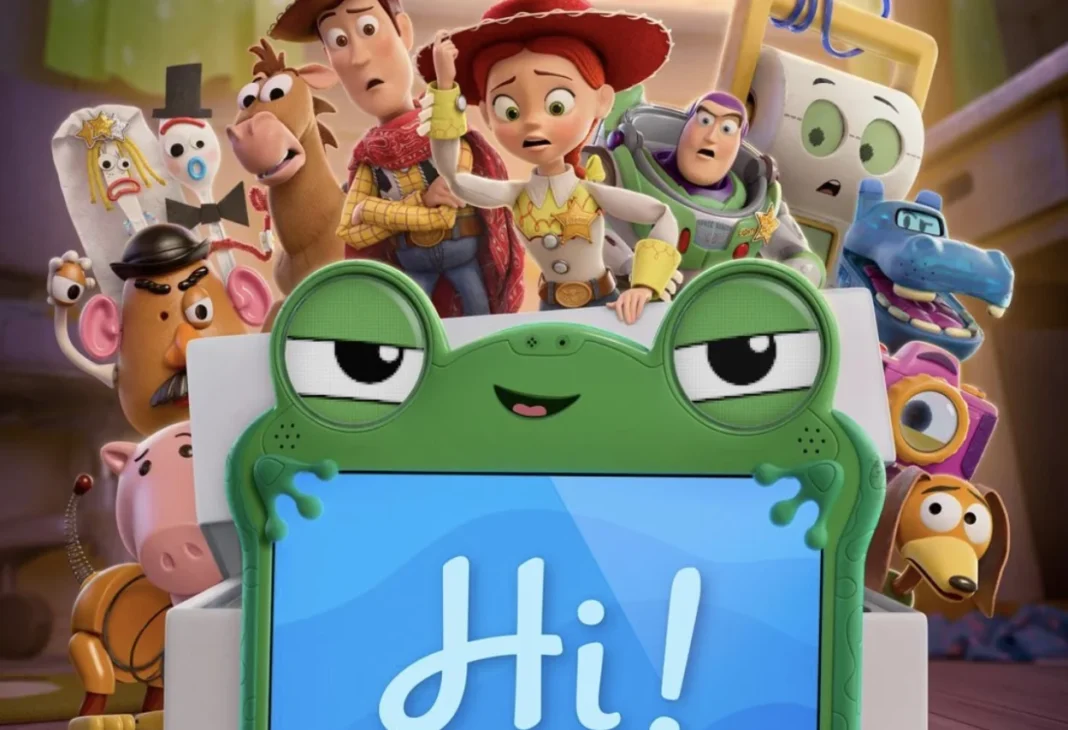
One of the most beloved animated film series of all time, Toy Story 5, explores precisely this question. At first glance, the film may seem to focus on the shift from traditional toys to new-generation technological toys. Yet, in fact, it questions a much more fundamental transformation. Rather than focusing on which toys children choose, the film draws attention to how children’s ways of playing—and their relationship with play itself—are changing.
With the arrival of Lilypad, a new-generation toy that captures children’s attention and represents a screen-based digital gaming experience, Jessie and the other toys gradually begin to fade into the background. Yet the real issue is not simply that the old toys are being forgotten. What is truly changing is the children’s experience of play. Children who once created stories with their toys, assigned roles to characters, and built new worlds through their imagination are increasingly becoming passive consumers of ready-made content.
One of the most striking aspects of the film is the quiet struggle the toys undertake to regain the children’s attention. Jessie and her friends do not simply want children to play with them again; they want children to rediscover their ability to imagine, create stories together, and experience play as something that can be shared. In this sense, the toys’ disappointment reflects a question that many parents and educators today are also asking: Are children really playing, or are they simply consuming content?
Perhaps the most striking message of the film is this: Children are not alone; they are in the same room, sitting next to one another, yet they are not together. Each child is focused on their own screen rather than creating a shared story, reading one another’s facial expressions, negotiating within play, or trying to rebuild a game together when something goes wrong. Being together does not necessarily mean playing together.
These scenes invite us to think not only about the world of the film but also about childhood today. We have all witnessed moments in cafés, restaurants, or at home when children sitting around the same table are each absorbed in their own screens. There is silence, but it is not the peaceful silence of children immersed in shared play. It is the silence of a loneliness quietly woven by screens.
Yet developmental psychology tells us that play has a much more significant role in childhood. When children play, they do not simply have fun; they learn to plan, sustain their attention, generate different solutions to problems, and sometimes tolerate frustration when things do not happen immediately as they wish. They think about how to build a tower, rebuild a game when it falls apart, or adapt to a friend’s idea. In fact, all of these experiences lay the foundation for skills that will later become useful in many areas of life, from school to social relationships. Recent research also suggests that free and imaginative play supports children’s abilities to manage their attention, plan, and regulate their behavior (McHarg et al., 2020; Walker et al., 2020).
The benefits of play are not limited to cognitive skills. Play is a natural context in which children learn how to relate to others. Through play, they experience sharing, taking turns, cooperating, negotiating, and sometimes coping with frustration. They learn to recognize a friend’s feelings, give up what they want when necessary, and create new rules together. When children play, they are not only playing with toys; they are also rehearsing for life.
Imaginative play has a particular significance in this regard. When a child transforms a teddy bear into a sick patient, a cardboard box into a ship, or a small stone into a magical treasure, they are not simply using their imagination. They are also experimenting with different perspectives, expressing their emotions, and trying to make sense of the world around them. Research suggests that symbolic play provides an important context for both cognitive and emotional development in children (Thibodeau-Nielsen et al., 2020).
This is precisely why Toy Story 5 is not simply a film about changing toys. At its heart, the film questions the transformation of play itself, because changes in play also mean changes in the way childhood is experienced. Rather than focusing on what children play with, the film makes visible how the relationships and experiences children develop through play are changing.
Theorists who have explored the role of play in child development have also drawn attention to this point. According to Donald Winnicott, children can be most fully themselves when they are playing because play provides a special space in which they can freely use their imagination, express their emotions, and safely explore the world. A child may become a superhero, a teacher, or a veterinarian. Each new role becomes a way of trying to understand both themselves and others.
John Bowlby (1988), the pioneer of attachment theory, similarly emphasized that children need to feel secure before they can confidently explore the world. Secure attachment relationships provide children with a solid base from which to explore, and play is one of the most natural contexts in which this sense of security can be expressed. During play, children do not simply have fun; they also learn to trust, cooperate, share their emotions, and develop relationships. From this perspective, play is not merely an activity that supports development; it is also a fundamental experience that nurtures human relationships.
Of course, it would not be appropriate to view technology as entirely negative. Digital tools, when used with developmentally appropriate content, limited screen time, and adult guidance, can support learning, stimulate curiosity, and offer children new experiences. Toy Story 5 reminds us of precisely this point. The film does not present technology as an “enemy” or a “villain.” The problem is not the existence of technology itself; it is the reduction of play to technology alone. When children move away from being the creators of their own stories and become merely consumers of stories prepared by others, the very nature of play begins to change.
Perhaps, instead of asking children, “How much screen time did you have today?”, we should be asking, “Did you really get to play today?” Because the power of a toy does not lie in the toy itself, but in the kind of experience it invites the child into. Whether a toy is made of wood, plush, or digital technology is not, by itself, what matters. What matters is whether the child can imagine, share, create, and connect through it.
Perhaps what children need most today is not more toys, but time in which they can play together, safe environments in which they can develop relationships, and spaces where they can use their imagination freely. Play is not simply an activity through which children pass the time; it is one of their first relational experiences through which they begin to understand themselves, others, and the world.
Rather than suggesting that childhood should be separated from technology, Toy Story 5 invites us to imagine a world in which technology and play can complement and balance one another. Digital tools can provide children with knowledge, skills, and new experiences. Play, meanwhile, teaches them how to develop empathy, create together, negotiate, lose, try again, and write a shared story.
Perhaps the most important question the film leaves us with is this: Are our children really playing together, or are they simply growing up side by side?
Kaynakça
- Bowlby, J. (1988). A secure base: Parent-child attachment and healthy human development. Basic Books.
- McHarg, G., Ribner, A. D., Devine, R. T., & Hughes, C. (2020). Screen time and executive function in toddlerhood: A longitudinal study. Frontiers in Psychology, 11, 570392.
- Thibodeau-Nielsen, R. B., Gilpin, A. T., Palermo, F., Nancarrow, A. F., Brown Farrell, C., Turley, D., DeCaro, J. A., Lochman, J. E., & Boxmeyer, C. L. (2020). Pretend play as a protective factor for developing executive functions among children living in poverty. Cognitive Development, 56, 100964.
- Walker, S., Fleer, M., Veresov, N., & Duhn, I. (2020). Enhancing executive function through imaginary play: A promising new practice principle. Australasian Journal of Early Childhood, 45(2), 114-126.
- Winnicott, D. W. (1971). Playing and reality. Tavistock.