


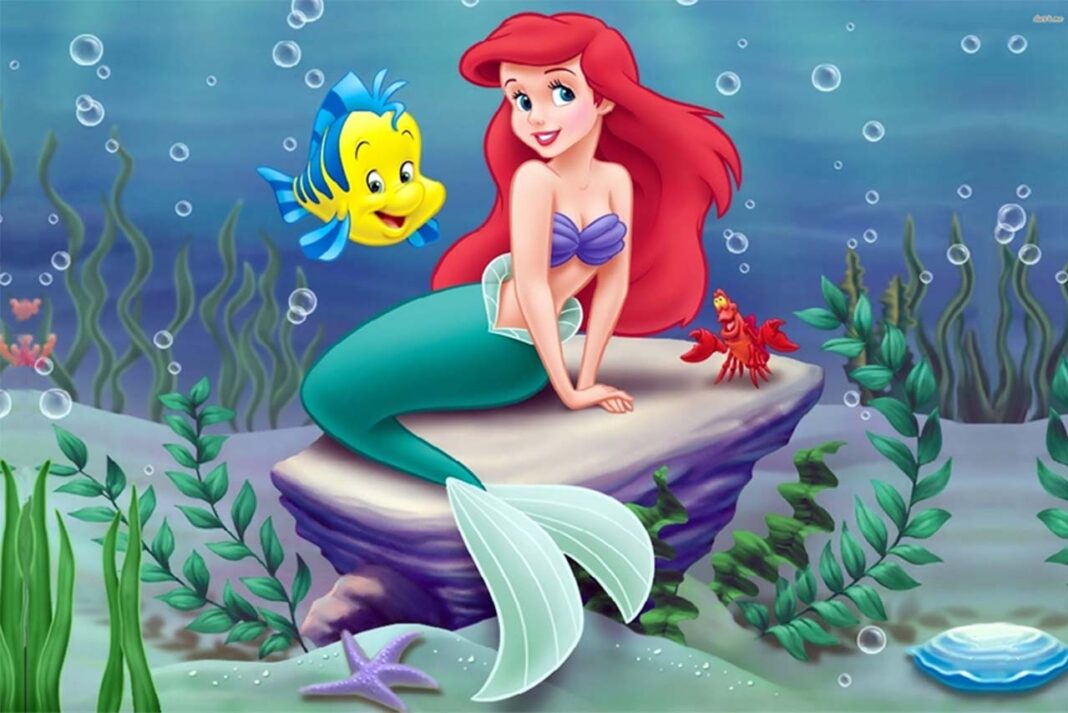

At first glance, The Little Mermaid seems like a simple love story. Yet beneath the waves lies something deeper — a psychological journey of identity, belonging, and the timeless question: “Who am I?”
Both Andersen’s original tale and Disney’s 1989 adaptation explore the conflict between the ideal self and the real self — a central theme in human development and psychotherapy.
Carl Rogers (1959) defined the ideal self as the person we think we should be, shaped by social expectations and the desire for approval. The real self, in contrast, represents our authentic nature — imperfect yet genuine. When the gap between these two selves widens, we experience inner conflict, shame, and feelings of inadequacy. Ariel’s story vividly captures this psychological tension.
Identity Versus Role Confusion
Under the sea, Ariel is a curious, free-spirited soul, collecting treasures from the human world, longing for something beyond her familiar environment. Yet she feels she doesn’t belong where she is — a hallmark of Erik Erikson’s (1950) stage of identity versus role confusion.
Like many adolescents, Ariel is caught between her father’s values and her own desire for independence.
She wrestles with the universal questions:
“What do others expect of me?”
“Who do I truly want to be?”
This stage of development is not merely about rebellion but about forming a coherent sense of self amid external pressures and internal desires.
The Symbolism of the Voice
Ariel’s voice is not just a physical trait — it is a symbol of identity, authenticity, and emotional expression. In Jungian (1953) terms, the voice represents the bridge between the inner self and the outer world.
When Ariel trades her voice to Ursula in exchange for humanity, she sacrifices her authentic self for an idealized image — who she believes she must become to be loved and accepted.
This is a vivid metaphor for how individuals, especially children and adolescents, may silence their true selves in pursuit of external approval or perfection.
The Social Learning of Silence
Society often sends subtle yet powerful messages, particularly to young girls:
Be pleasant. Be quiet. Be agreeable.Over time, these ideals teach children that silence brings acceptance — but at the cost of authenticity.
Albert Bandura’s (1977) social learning theory explains this dynamic. Children observe how others are rewarded or punished for their behavior. If compliance is praised while assertiveness is criticized, they quickly learn that muting their emotions ensures safety.
But the price they pay is disconnection from their real self.
Unconditional Positive Regard and the Role of Parents
Rogers (1961) emphasized that a person can only grow into a healthy self when they experience unconditional positive regard — being accepted for who they are, not just for what they achieve.
King Triton’s anger toward Ariel, though rooted in love, conveys rejection of individuality.
His disapproval drives her to seek validation outside her family’s world — a pattern familiar to many children who hide or distort their true selves when their identity isn’t accepted at home.
From a developmental psychology perspective, a parent’s task is not to mold the child into perfection, but to nurture the emergence of the child’s authentic voice.
Affective Attunement: Listening to the Child’s Inner World
Daniel Stern’s (1985) concept of affective attunement highlights how children learn emotional regulation through empathic parental responses. When parents meet a child’s emotions — anger, sadness, fear — with understanding instead of criticism, the child internalizes a message:
“My feelings are acceptable. Therefore, I am acceptable.”
Ariel’s journey mirrors the inner world of many children whose feelings are dismissed.
They may grow up believing that love must be earned through silence or compliance, not through authenticity.
Psychological Lessons from Ariel’s Story
Ariel’s transformation teaches timeless lessons for parents and caregivers:
-
Listen to your child’s voice. Ask not only what they did, but how they felt. True listening fosters emotional trust.
-
Model unconditional acceptance. Focus on emotions, not only behavior. Instead of saying “You shouldn’t feel that way,” try “I understand this feels hard.”
-
Support the real self. Avoid projecting your own unfulfilled dreams onto the child; let them create their own path.
-
Celebrate uniqueness. Like Ariel embracing her world under the sea, teach children that difference can be a strength, not a flaw.
Modern Ursulas: The Digital Era and the Loss of Authenticity
Ariel’s voice may have been stolen by Ursula, but today’s world presents modern forms of silence. Social media filters, flawless images, and constant comparison pressure children to trade authenticity for approval. The digital age reinforces the illusion that one must be perfect to belong — echoing Ariel’s painful choice to give up her voice for acceptance.
The Power of Being Heard
At the film’s end, when King Triton restores Ariel’s voice, it symbolizes more than reconciliation — it represents unconditional love and acceptance. He finally allows his daughter to choose her own path.
Rogers (1961) would describe this as the foundation of the fully functioning person — someone free to grow into their true potential without fear or shame. Ariel’s regained voice is the return of authenticity — the reunion between her real self and ideal self.
Conclusion: The Voice as the Core of the Self
The Little Mermaid reminds us that parenting is not about giving a child a voice, but about not taking it away. A child’s voice embodies emotion, boundaries, and identity all at once.
When a child says, “This is how I feel,” the task is not to silence them — but to listen.
True growth, for both children and adults, does not come from silence, but from emotional acceptance.
And perhaps, the most magical transformation of all is not tail into legs, but silence into speech.
References
Bandura, A. (1977). Social Learning Theory. Englewood Cliffs, NJ: Prentice Hall.
Erikson, E. (1950). Childhood and Society. New York: W. W. Norton & Company.
Jung, C. G. (1953). Collected Works of C. G. Jung, Volume 9 (Part 1): The Archetypes and the Collective Unconscious. Princeton University Press.
Rogers, C. R. (1959). A theory of therapy, personality, and interpersonal relationships, as developed in the client-centered framework. Psychology: A Study of a Science, Vol. 3, 184–256.
Rogers, C. R. (1961). On Becoming a Person: A Therapist’s View of Psychotherapy. Boston: Houghton Mifflin.
Stern, D. N. (1985). The Interpersonal World of the Infant: A View from Psychoanalysis and Developmental Psychology. New York: Basic Books.