


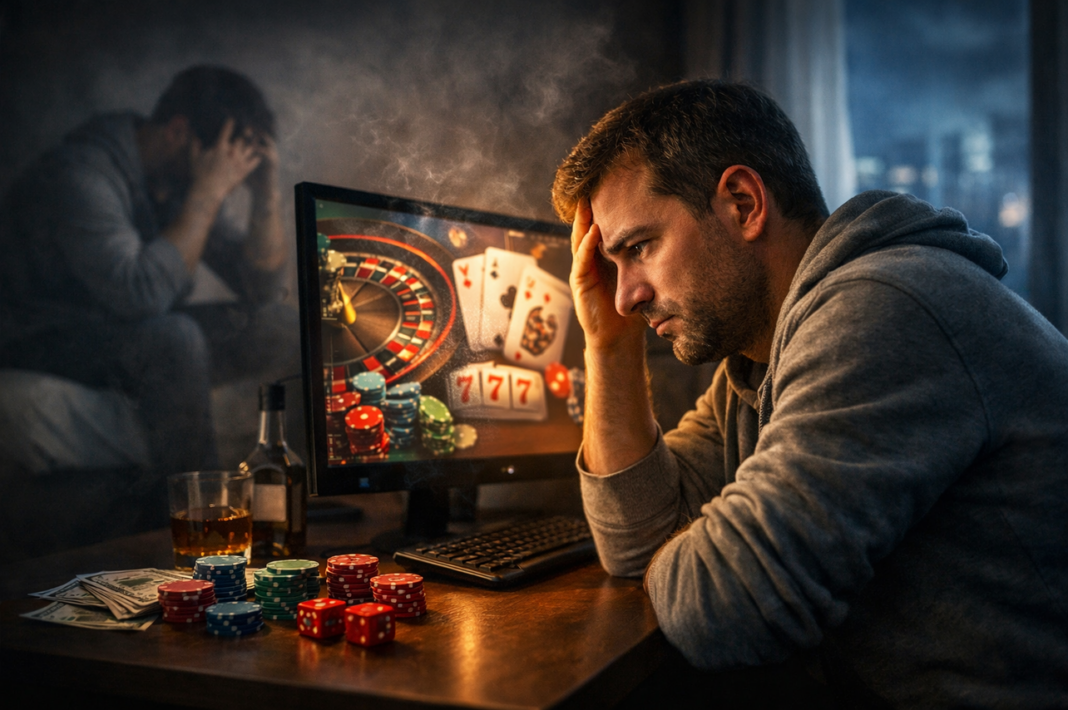

Online gambling is often explained by the desire to make money. However, the prevalence of this behavior and its strong tendency to repeat run far deeper than financial motivation alone. For many people, online gambling responds to a specific emotional need. For this reason, asking “what does it serve?” is often far more illuminating than simply asking “why is it played?” Because in many cases, online gambling functions less as a means of reaching a goal and more as a way of distancing oneself from an internal state.
Many individuals do not begin online gambling with a conscious intention to escape. The starting point is more commonly boredom, mental exhaustion, tension, or an undefined sense of emptiness. At the end of the day, when intrusive thoughts persist, attention feels scattered, or emotions intensify, online gambling creates a short-term zone of focus. The mind narrows, attention locks onto a single point, and this narrowing brings temporary relief. In these moments, the person does not register what they are feeling, but rather notices the distance created from the immediate emotional burden.
From Entertainment To Emotional Regulation
At this stage, online gambling shifts from being a form of entertainment to becoming a tool for emotional regulation. When a distressing emotion emerges, the individual learns to seek relief through an indirect route rather than engaging with the emotion itself. Gambling offers this relief quickly and with minimal effort. As attention moves toward the game, feelings such as anxiety, restlessness, loneliness, or a sense of losing control temporarily recede. This effect facilitates repetition, as the mind begins to associate the behavior with relief.
The function of escape becomes particularly evident here. Online gambling distances the individual not only from the external world but also from challenging inner experiences. While playing, thoughts simplify, internal complexity decreases, and the person feels less weighed down. However, this relief is not lasting. When the game ends or the effect fades, the individual returns to the same emotional state as before. This recurring cycle gradually creates the conditions for the behavior to be used more frequently.
When Coping Becomes Automatic
Over time, online gambling ceases to be one option among many and becomes the primary means of coping with certain emotional states. Whenever stress arises, a sense of emptiness appears, or mental overload intensifies, the same pathway is activated. At this point, the behavior increasingly becomes automatic. The question “should I play?” is no longer asked; an urge emerges and the behavior follows almost reflexively. This marks one of the critical thresholds on the path toward dependence.
Dependence rarely begins with a sudden moment of realization. The individual may still believe they are in control. Daily life continues, and responsibilities may largely remain intact. Yet the most significant changes occur internally. As online gambling becomes one of the main ways of carrying emotional weight, other coping strategies begin to weaken. Contact with distressing emotions becomes increasingly difficult. When not playing, unease intensifies, and the mind persistently generates the urge to return.
Avoidance And The Narrowing Of Emotional Space
At this point, online gambling is no longer merely an escape; it becomes an escape that feels necessary. The more the individual distances themselves, the harder it becomes to return. This is because what is being avoided is not only a stressful moment, but also suppressed emotions, unresolved needs, and undefined inner emptiness. When gambling does not take place, these internal areas become more visible, making disengagement from the behavior even more challenging.
Another important factor in the transition from use to dependence is accessibility. The distance between urge and action is extremely short. This leaves little room to pause, reflect, or develop alternative responses. Each repetition slightly reinforces the behavior. As the escape function strengthens, gambling ceases to be merely a tool and becomes the primary mechanism for maintaining inner balance.
What Happens When You Don’t Play?
The most crucial step in understanding this process is letting go of the idea that online gambling is simply a “bad habit.” More often, the behavior signals an emotional area the individual struggles to manage. Alongside the question “why am I playing?”, an equally meaningful question emerges: “what do I face when I don’t play?” Because online gambling does not usually fill a void; it prevents direct contact with that void.
For this reason, change related to online gambling begins not solely with stopping the behavior, but with recognizing the needs it serves. As individuals start to identify the emotions they have been avoiding, the function of gambling begins to weaken. As the need for avoidance decreases, the central role of the behavior becomes open to reconsideration. This process is not easy, as escape has been effective for a long time. Yet awareness is the first step that makes the cycle visible and opens the possibility for change.
Conclusion
When online gambling serves distancing rather than winning, the core issue is not money but a lack of emotional contact. As individuals begin to recognize how much they have been avoiding, what they are avoiding slowly comes into focus. And this realization signals not merely a change in behavior, but the beginning of a shift in the individual’s relationship with their own inner world.