


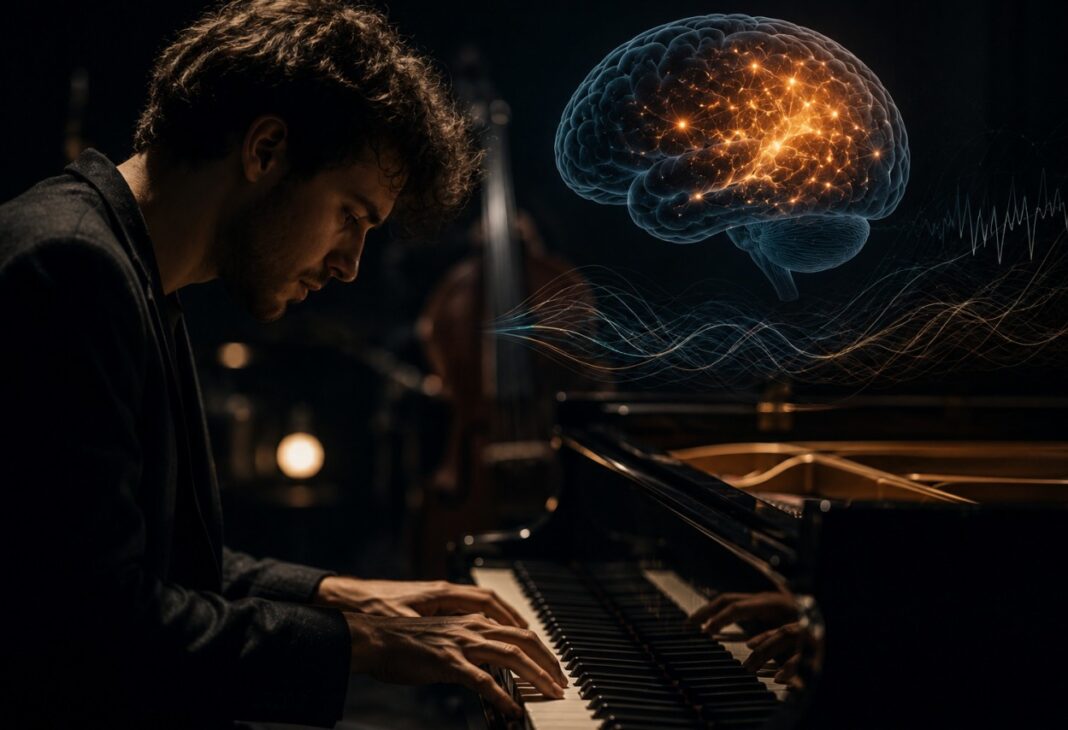

Have you ever wondered why some musicians seem completely absorbed in their performance, almost as if they are playing without thinking? Many professional performers describe moments when the music feels effortless and everything simply “clicks.”
Psychologists often describe this experience as a flow state, but neuroscience offers another fascinating explanation: hypofrontality.
Hypofrontality refers to a temporary reduction in activity within the prefrontal cortex—the region of the brain responsible for planning, decision-making, self-monitoring, and executive control. Although these functions are essential in everyday life, they can sometimes interfere with spontaneous creativity.
Viewing musical performance through the lens of hypofrontality helps explain why experienced musicians are often able to perform with remarkable freedom, confidence, and expressiveness.
From Conscious Control to Automatic Performance
The prefrontal cortex functions much like the brain’s executive manager. It helps organise information, solve problems, inhibit inappropriate responses, and think before acting.
These abilities are especially important while learning a musical instrument because beginners must consciously monitor every movement, every note, and every technical decision.
However, after years of deliberate practice, many musical skills become highly automated.
At that stage, excessive conscious control may actually interfere with performance.
This is where hypofrontality becomes particularly interesting.
During highly demanding musical performances, activity within the prefrontal cortex may temporarily decrease. Rather than consciously controlling every movement, the brain begins to rely more heavily on well-established motor programmes and musical memory.
As a result, musicians are able to respond more naturally to the music instead of constantly analysing every action they perform.
Many experienced performers describe this experience as trusting their instincts rather than consciously planning each musical phrase.
Brain Imaging Studies and Jazz Improvisation
Jazz improvisation provides an excellent example of this process.
A jazz musician cannot predict every note before performing because improvisation requires the spontaneous creation of music in real time.
Functional brain imaging studies have shown that when skilled jazz musicians improvise, brain regions involved in self-monitoring become less active, whereas regions associated with creative expression remain highly engaged (Limb & Braun, 2008).
Rather than following a rigid mental plan, musicians allow musical ideas to emerge naturally throughout the performance.
This does not mean that they stop thinking altogether.
Instead, years of training enable the brain to generate complex musical structures with remarkably little conscious effort.
Another concept closely associated with hypofrontality is the flow state.
During flow, performers become fully immersed in the activity, lose awareness of time, and often stop worrying about mistakes or external evaluation.
Many musicians report that their most memorable performances occur precisely when they stop overthinking.
Temporary hypofrontality may help explain this phenomenon because reduced self-monitoring allows performers to remain focused on the music itself rather than on possible errors or the audience’s reactions.
The Importance of Balance
At the same time, it is important not to assume that reduced activity in the prefrontal cortex is always beneficial.
Musicians still require planning, discipline, critical thinking, and deliberate analysis while practising, preparing for performances, and learning new repertoire.
If the brain relied exclusively on automatic processing, continued improvement would become considerably more difficult.
In other words, successful musicians appear to alternate between two complementary modes of functioning:
careful cognitive control during practice and greater spontaneity during performance.
Although researchers continue investigating hypofrontality, current evidence suggests that creativity depends upon maintaining a balance between control and freedom.
The brain does not simply “switch off” during musical performance.
Rather, it reorganises the way different neural systems interact, allowing creativity, technical skill, and accumulated experience to work together more efficiently.
Conclusion
Hypofrontality provides a fascinating perspective on what happens inside the brain during musical performance.
By temporarily reducing activity within the prefrontal cortex, experienced musicians may become better able to rely on automatic skills, enter a flow state, and express themselves with greater spontaneity.
However, creativity does not emerge from hypofrontality alone.
Current research suggests that creativity is shaped not only by talent but also by the brain’s remarkable ability to adapt during performance. It is equally dependent upon years of practice, accumulated knowledge, technical mastery, and lived musical experience.
For this reason, the relationship between the brain and music is far more complex than it may initially appear.
Nevertheless, research on hypofrontality offers valuable insight into why some of the most unforgettable performances appear almost effortless—even though they are built upon years of disciplined practice.
References
Dietrich, A. (2003). Functional neuroanatomy of altered states of consciousness: The transient hypofrontality hypothesis. Consciousness and Cognition, 12(2), 231–256.
Limb, C. J., & Braun, A. R. (2008). Neural substrates of spontaneous musical performance: An fMRI study of jazz improvisation. PLoS ONE, 3(2), e1679.