


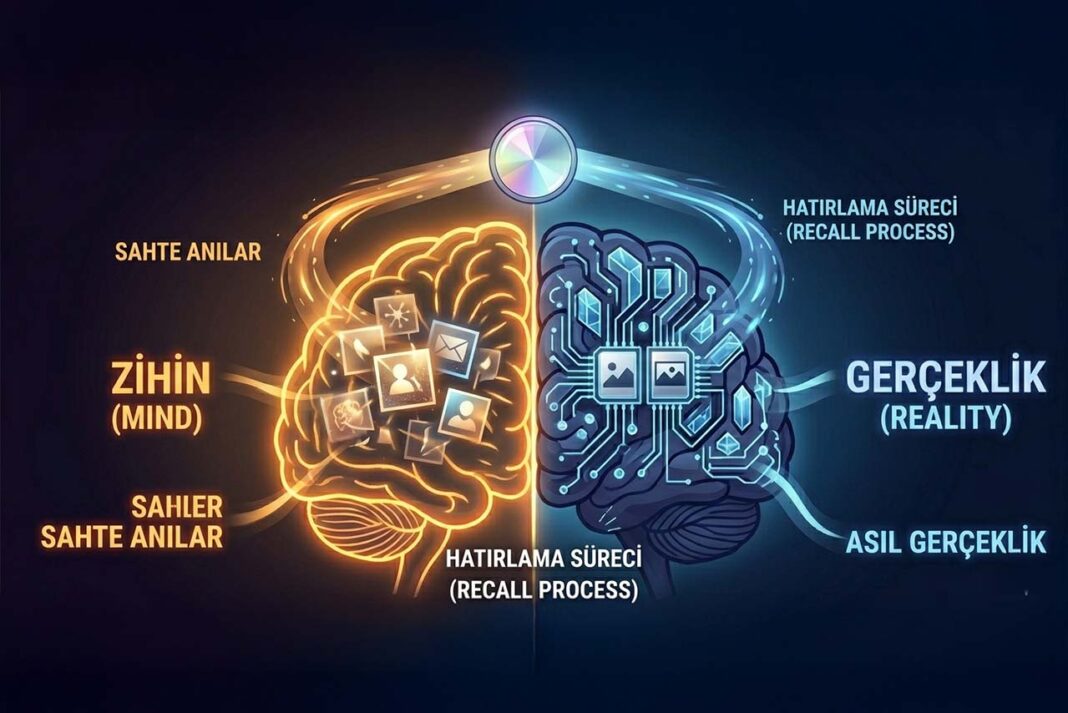

Most people in daily life assume that their minds are reliable. We tend to believe that what we perceive is accurate and that our memories correspond exactly to what we have experienced. However, neuropsychological research demonstrates that the mind is not a passive recording device; rather, it is an active, interpretative, and often misleading system (Bartlett, 1932; Friston, 2010).
Instead of reflecting the external world as it is, the brain continuously reconstructs it.
Perception As a Constructive Process
This reconstructive process becomes particularly evident in perception. Contrary to common belief, perception does not arise solely from sensory input reaching the brain. Instead, the brain interprets incoming information by integrating it with past experiences, expectations, and contextual cues.
This process is referred to as top-down processing (Goldstein, 2014). For example, when looking at an ambiguous image, what we perceive often depends on what we expect to see at that moment. Therefore, two individuals may look at the same object yet perceive entirely different things.
Perception, in this sense, is not a mirror of reality but an interpretation shaped by the mind.
Memory: Reconstruction Rather Than Storage
Memory is even more fragile in nature. Contrary to widespread belief, memories are not stored in a fixed and stable form. Each act of remembering is, in fact, a process of reconstruction (Bartlett, 1932).
When recalling a past event, the brain assembles fragments related to that memory; however, these fragments may be incomplete, distorted, or influenced by later information. This creates the conditions for the formation of false memories.
An individual may come to remember an event they never experienced as if it were real, especially through repetition or suggestion (Loftus & Pickrell, 1995).
Cognitive Economy and Mental Shortcuts
At the core of these misleading processes lies one of the brain’s fundamental operating principles: cognitive economy. To conserve energy, the brain processes information in fast and efficient ways.
For this purpose, it relies on mental shortcuts known as heuristics (Tversky & Kahneman, 1974). However, these shortcuts do not always yield accurate results.
For instance, the more frequently we hear a piece of information, the more likely we are to believe it is true. This phenomenon, known as the familiarity effect, can lead to the acceptance of false information as truth over time (Hasher, Goldstein & Toppino, 1977).
The Limits of Attention
Another important mechanism is the limitation of attention. The human brain can focus on only a limited number of stimuli at a given time. As a result, many details outside our attentional focus go unnoticed.
As demonstrated in the invisible gorilla experiment, when individuals concentrate on a specific task, they may fail to notice an obvious stimulus directly in front of them (Simons & Chabris, 1999).
This highlights the selective and incomplete nature of perception.
Error as a Feature, Not a Flaw
From a neuropsychological perspective, these errors are not flaws but rather inevitable outcomes of how the system operates. The brain is optimized for speed and efficiency rather than perfect accuracy (Kahneman, 2011).
This makes it both highly functional and, under certain conditions, prone to error. Rather than representing reality exactly as it is, the human mind transforms it into a form that is meaningful and manageable.
Conclusion
Acknowledging the fallibility of our minds is crucial for both individual awareness and scientific understanding. Recognizing that our perceptions and memories are not absolute truths allows us to make more cautious decisions.
Neuropsychology clearly shows that reality is not as objective as we assume; rather, it is an interpretation shaped by the filters of our minds.