


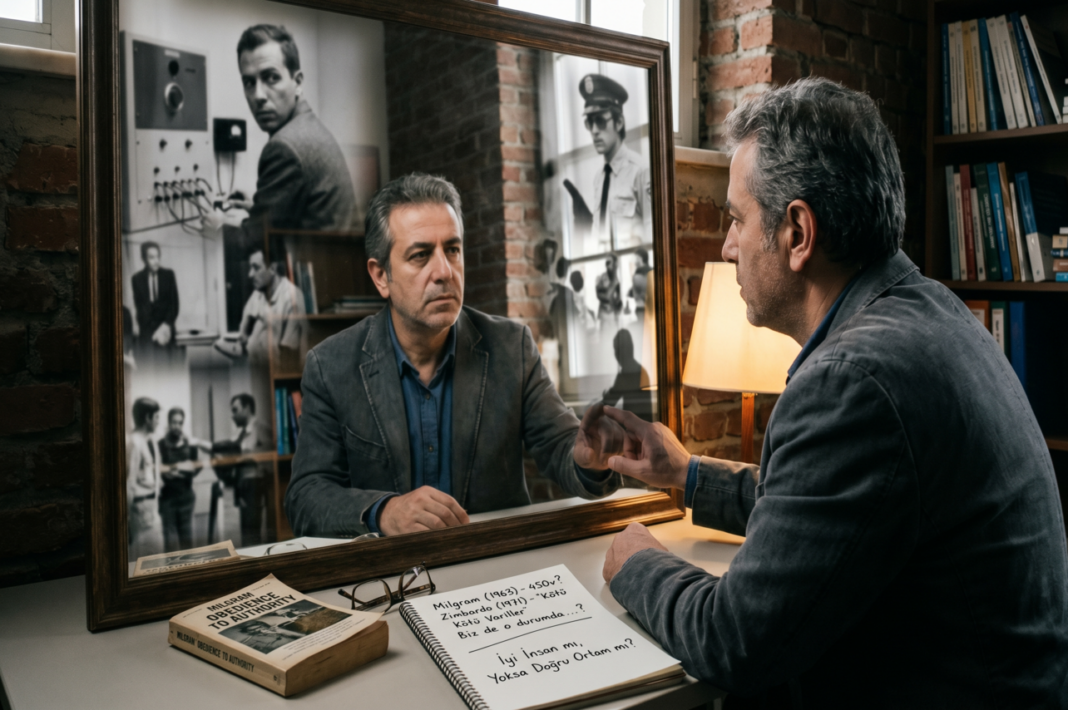

I know what’s going through your mind right now. “I’m not that kind of person.” Or maybe, “My values are solid — I would have acted differently in that situation.” Completely understandable. I used to think the same. But that’s exactly where social psychology steps in and starts asking some rather uncomfortable questions.
We all do it — watching the news or reading through the dark chapters of history, we tell ourselves, “I would never have done that.” But would we, really?
What Did Milgram Tell Us?
In 1963, Stanley Milgram invited ordinary people into his laboratory. He told them: whenever the person across from you gives a wrong answer, you will administer an electric shock. The shocks weren’t real — the person on the other side was an actor. But the participants didn’t know that.
The result? Sixty-five percent of participants, encouraged by an authority figure simply saying “continue,” went all the way up to 450 volts. The label on that switch read “Danger: Severe Shock.” They pressed it anyway.
Were those people monsters? No. They could have been your neighbors, your coworkers — maybe even you.
Why Do We Always Say “I Would Have…”?
In psychology, we call this the fundamental attribution error. When someone else makes a mistake, we say “that’s just who they are.” When we make the same mistake, we say “I was exhausted that day, I was under pressure.” Sound familiar?
That’s exactly why “I would never have done that” isn’t a very reliable statement. When we place ourselves in a scenario in our minds, we don’t feel the weight of that environment — its social pressure, its ambiguity, its hierarchy. We evaluate everything from the outside, calmly and with hindsight. But had we actually been inside that moment, the story might have been entirely different.
Zimbardo’s 1971 Stanford Prison Experiment illustrated this vividly. Psychologically healthy university students were randomly assigned to the roles of guards and prisoners. No one told them how to behave. Within six days, the experiment had to be shut down. The students playing guards had begun applying psychological pressure and humiliation. Those playing prisoners had started to submit. All they had been given was a role. But that role had swallowed their identities.
Does This Free Us From Responsibility?
No — absolutely not. It’s tempting to conclude “so the fault lies with the environment, not with me,” but that’s not the point.
If a system consistently pushes people toward harmful behavior, the real question shouldn’t be “are these people bad?” It should be “who built this system, and who keeps it running?” Zimbardo put it well: bad barrels spoil good apples. The solution isn’t to blame the apple — it’s to change the barrel.
On an individual level, we need to ask ourselves: what kinds of environments am I placing myself in? Which authorities do I follow without questioning? These might seem like small questions, but they’re the very things that shape our moral compass.
A Final Note
As a counseling candidate, I think about this a great deal in the context of the therapy room as well. Many people spend years judging themselves harshly for something they did in the past. When the question “How did I become this kind of person?” transforms into “What forces were influencing me during that period?”, something shifts. People begin to see themselves more clearly — and more fairly.
Saying “I am a good person” is a lovely thing. But perhaps the more honest question is: under what conditions am I good? Where am I being tested without even realizing it?
Social psychology doesn’t hold up a comfortable mirror. But it’s worth looking into. Because it’s not the certainty of “I would never have done that” that truly helps us grow — it’s the question, “I could have been in that situation too. So what can I do now?”
References
Milgram (1963) · Zimbardo (1971) · Ross (1977) · Epley & Dunning (2000)