


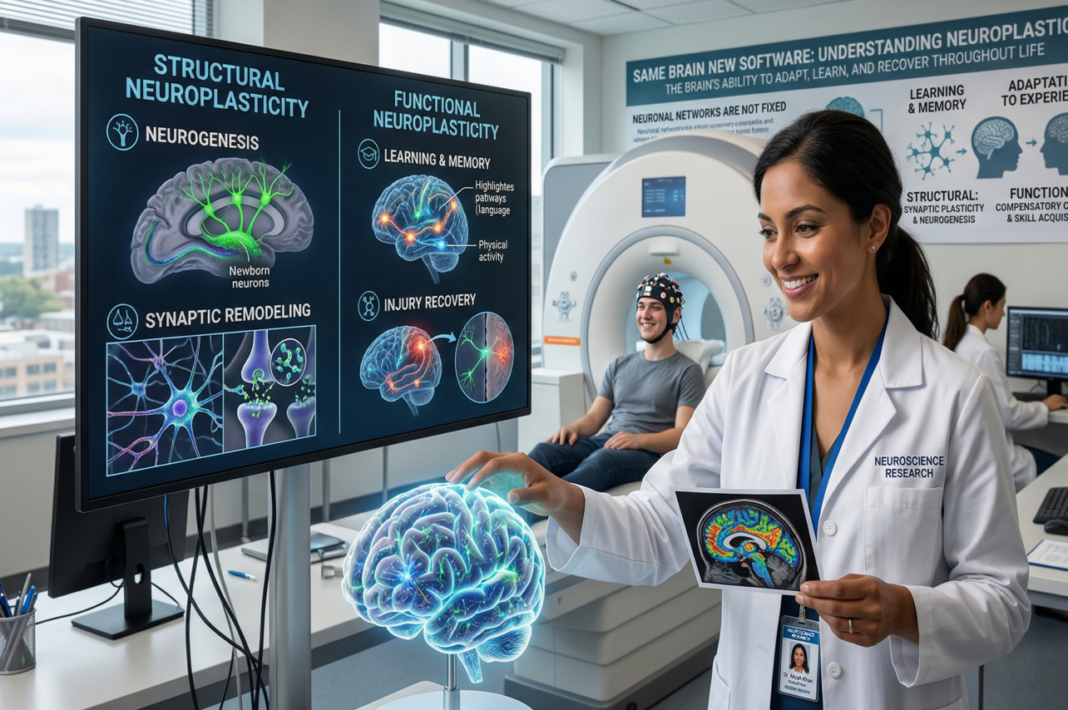

Human brain is very complicated also very amazing part of the human body. Brain can be change, develop, and it can transform with the new information it recives. How the brain can do that? Neuroplasticity also known as brain plasticity refers to the brain’s ability to modify change, remodel, and adapt both sturcture and function throughout life and also that neural networks are not fixed, can be response, and depending to experience. This ability is central to learning, memory, injury, recovery, and adaptation to environmental changes.
The Types Of Neuroplasticity
Neuroplasticity refers to ability to reorganize neuronal connections and form new neural pathways. These changes can take place at the synaptic level, the tiny gaps between neurons where neurotransmitters transmit signals, as well as across broader neural networks in the brain. Brain plasticity classified into two types: Structural neuroplasticity, and Functional neuroplasticity. (Marmarosh, 2023)
Structural Neuroplasticity
Functional Neuroplasticity
Functional Neuroplasticity referes to the brain’s ability to changes and shift in functional from damaged to healthy areas. Primarily based on two processes; learning and memory. (Vida Demarin, Sandra Morovic, Raphael Bene, 2014) Long-term potentiation strengthens synapses, making communication between neurons more efficient, and is key for learning and memory. In summary both plasticity are essential for normal brain function, and may be linked to various disorders of the central nevrous system. Although neuroplasticity is most evident during early development, and it continues across the lifespan. (Patrícia Marzola, Thayza Melzer, Eloisa Pavesi, Joana Gil-Mohapel, and Patricia S. Brocardo, 2023)
Neurodevelopmental Stages
The brain is very complicated, and its develop, learn, impelement during life time. Neurodevelopment begins around 2-3 weeks with the formation of the neural tube (fondation of the entire nervous system) and critical step for creating the brain. Abnormalities in this process can cause neural tube defects, and influenced by envrionmental factors like stress, alcohol etc. After birth, the brain continues to reorganize, and early experiences like, exposure to language play important role in shaping brain development. During childhood important skills like attention, working memory are develop with social and emotional abilities. These developing stages are strongly influenced by evnironmental factors, and genetics. But this stage also influenced with negative factors, abuse, poverty, neglect is very stressful, so activates the stress response system. Long-term stress, increased risk of anxiety, depression, and difficulties in emotional regulation and relationships.
During adolescence, the important factors for the developing the brain is inclued prefrontal cortex, which is responsible for decision-making, control, attention and, emotional regulation. The developmentaş stages supports social skills, empathy and ability to manage complex relationships. In adulthood, brain development getting slows, but the brain ramains capable of adaptation for adult neurogenesis. (Patrícia Marzola, Thayza Melzer, Eloisa Pavesi, Joana Gil-Mohapel, and Patricia S. Brocardo, 2023)
Conclusion
In conclusion, neuroplasticity is fundamental property of the brain that enables it to adapt functionally in life. It involves learning memory, and overall cognitive functions, and with those functions brain can be change, develop and learn about something. It continues across the lifespan, allowing the brain to respond to new experiences, environmental influences, and also injuries. Both positive and negative factors very important in shaping neuroplasticity. Physical activity, supportive environments is affected during developmental periods. Undersrandig of mechanisms of neuroplasticity provides insight into brain development, and also highlights its potential in some diseases. Promoting healthy envrionments and targeted some treatments may help optimize brain plasticity across the lifespan.
References
-
Marcos Altable, Emilio Díaz-Moreno, Muhammad Akram. (n.d.). Neuroplasticity: A Comprehensive Review of Its Implications for Prevention, Rehabilitation, and Therapeutic Interventions.
-
Marmarosh, P. (2023). Brain Plasticity: The remarkable Adaptability of the Human Mind . Neuroscience And Psychiatry .
-
Patrícia Marzola, Thayza Melzer, Eloisa Pavesi, Joana Gil-Mohapel, and Patricia S. Brocardo. (2023). Exploring the Role of Neuroplasticity in Development, Aging, and Neurodegeneration. brain sciences.
-
Vida Demarin, Sandra Morovic, Raphael Bene. (2014). Neuroplasticity.