


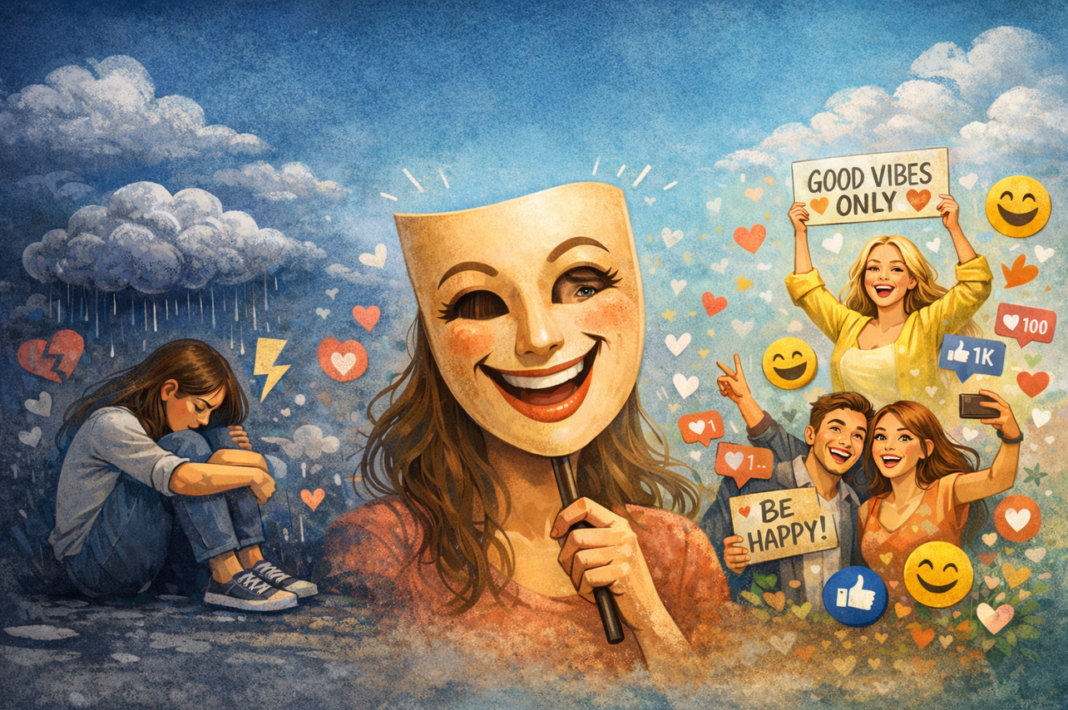

Is Happiness An Obligation?
Today, happiness is presented more as a duty than an emotion. From social media posts to self-help books, the same message is everywhere: “You must be happy.” However, while seemingly innocent at first glance, this discourse creates significant pressure on individuals. We are in a culture where people are only “allowed” to feel good, while other emotions must be suppressed. This situation leads to a process that undermines the naturalness of emotions and makes the human experience one-dimensional.
The Culture Of Positivity and Social Media
Social media has become one of the most powerful carriers of the culture of positivity. While people share their happiest moments in a filtered and idealized way, emotions such as pain, anxiety, and unhappiness become invisible. This triggers the thought in individuals, “Everyone is happy, only I am like this.” However, what is overlooked here is that the shared happiness is often a performance. People share not only moments when they are happy, but also moments when they need to appear happy. Thus, happiness ceases to be an internal experience and becomes a social spectacle.
The Hierarchy Of Emotions: “Good” and “Bad” Feelings
Society explicitly categorizes emotions: Happiness, peace, and joy are labeled “good”; anger, sadness, and anxiety are labeled “bad.” This distinction causes individuals to suppress certain emotions. However, from a psychological perspective, all emotions are functional. For example, anxiety warns us of dangers, while anger indicates that our boundaries have been violated. Sadness is part of our process of coping with loss and change. However, under the pressure of positivity, individuals avoid experiencing these emotions, which can lead to greater psychological problems in the long run.
Toxic Positivity: The Bullying Of Feeling Good
“Toxic positivity” is an approach that imposes positive thinking in all circumstances. Phrases like “There’s a silver lining in everything,” “It could have been worse,” and “Think positive, it will pass” often invalidate a person’s feelings instead of offering support. This approach downplays the individual’s suffering and prevents them from confronting their reality. The person begins to feel guilt for the negative emotions they experience: “Why can’t I be happy?” This creates a second burden—the shame of being unhappy.
Sociological Perspective: The Social Construction Of Emotions
Emotions are not merely individual experiences; they are also socially shaped. Society sets invisible rules about when and how certain emotions should be expressed. These rules limit individuals’ emotional repertoire. In modern society, since productivity, success, and performance are prioritized, happiness becomes part of this system. The perception of a happy individual equals a successful individual becomes widespread. Therefore, unhappiness is perceived not only as an emotion but also as an indicator of “failure.”
The Return Of Repressed Emotions
Repressed emotions don’t disappear; they only change form. Individuals who constantly try to appear happy may develop problems such as burnout, anxiety, and depression over time. This is because the person has learned to ignore their true emotions instead of confronting them. For emotions to be processed healthily, they must first be accepted. Being able to experience them as they are, without labeling them as “good” or “bad,” is fundamental to psychological well-being.
Making Room For All Emotions
Happiness is not the only and constant state of life; nor does it need to be. Being human is not just about feeling good. Sadness, anxiety, anger, disappointment… Each of these is a natural, even necessary, part of life. These emotions tell us something; they make our limitations, needs, losses, and values visible. However, individuals who grow up under the pressure of positivity eventually become alienated from their inner voice. Instead of recognizing what they feel, they begin to think about what they “should” feel. This weakens the relationship a person has with themselves. Because true connection is established not only with “good” emotions, but with all emotions.
Perhaps the first step to breaking this cycle is giving ourselves this permission: I don’t always have to be good. Sometimes I may be sad, sometimes angry, sometimes anxious. And this doesn’t mean I’m flawed or a failure. On the contrary, being able to connect with these emotions is an indication that I am psychologically more resilient and stronger. Establishing a healthy relationship with emotions begins not with suppressing them, but with understanding and accepting them. The question, “Why do I feel this way?” is far more transformative than “How can I feel better faster?” Because healing happens not by ignoring emotions, but by creating space for them.
At the societal level, this transformation can be achieved by changing the language we use to describe emotions. Instead of telling people to “Be strong,” ask them, “How are you feeling?”; instead of saying, “Don’t worry about it,” say, “This must be difficult for you.” These seemingly small changes actually lay the foundation for a culture where emotions can be experienced more freely. It creates.
In conclusion, true well-being is not simply about being happy. True well-being is about being able to connect with one’s own emotions, accept them without judgment, and express them when necessary. Because sometimes the healthiest thing is not trying to feel good, but making room for feeling bad. And perhaps it is precisely at this point that happiness ceases to be a necessity and becomes a spontaneous experience.