


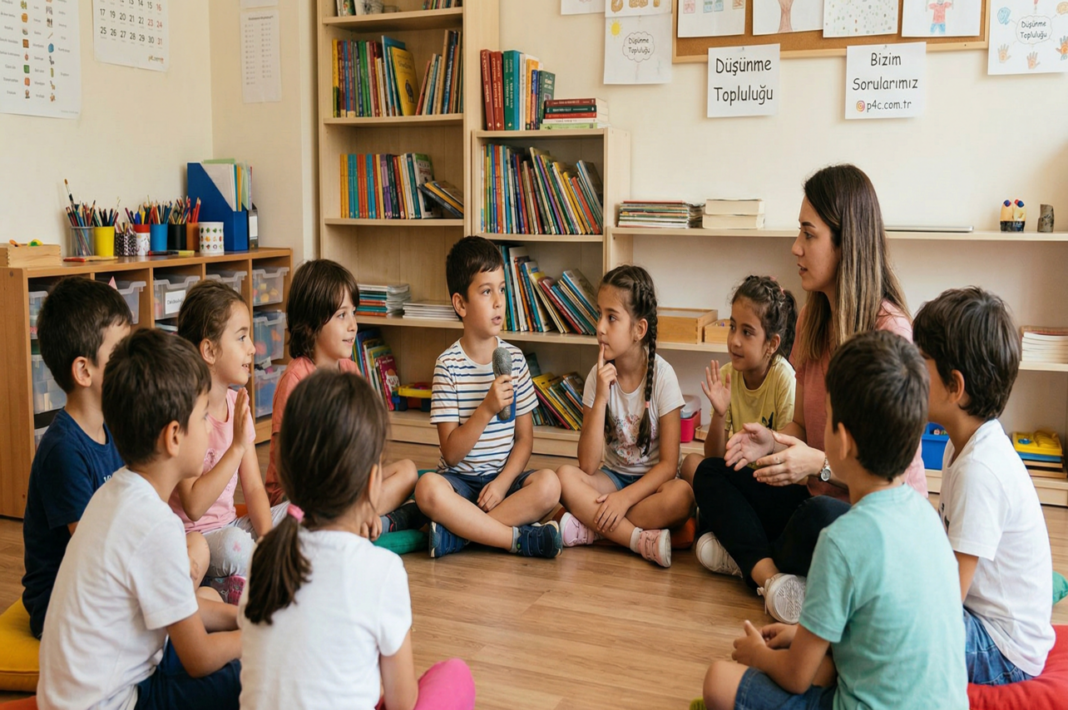

Early childhood is a critical period during which the foundations of an individual’s social, emotional, and cognitive development are established. During this stage, children’s ability to express themselves, listen to others, and actively participate in social environments plays a decisive role in shaping the relationships they will build later in life. Today, many children are observed to display behaviors such as shyness, withdrawal, and avoidance of communication, especially in social settings. This situation increases the need for learning environments where children can express themselves, share their thoughts, and participate without fear of judgment.
At this point, the Philosophy for Children (P4C) approach emerges as an important alternative. Developed by Matthew Lipman, this approach is based on bringing children together within a “community of inquiry,” where they reflect on open-ended questions, express their ideas, and evaluate different perspectives. The aim of P4C is not to provide children with correct answers; rather, it is to support their thinking processes, develop their inquiry skills, and expand their space for expression. In this process, children gain not only cognitive but also significant social benefits.
The Contribution Of P4C To Self-Expression And Empathy
One of the most notable contributions of P4C practices is the observable improvement in children’s self-expression skills. Especially for children who tend to remain in the background or exhibit shy behaviors, these environments—where speaking opportunities are distributed equally—create a safe space for expression. As children experience that their ideas are valued, they become more willing to speak. In addition, listening is as important as speaking in P4C sessions. Children learn to listen carefully to their peers, respect different viewpoints, and develop empathy. This contributes to the development of mutual understanding and respect, which form the foundation of social relationships.
Social Participation and Self-Confidence
Taking an active role within the community of inquiry also increases children’s participation in social environments. Experiences such as speaking in a group, expressing opinions, and engaging in discussions support the development of self-confidence. When children realize that their thoughts are acknowledged, they gradually become more confident and proactive. In this respect, P4C can be considered an approach that strengthens not only thinking but also social presence.
Observations From Level 1 Practitioner Training
As someone who has recently completed the Level 1 practitioner training in Philosophy for Children (P4C), I have had the opportunity to observe that this method offers not only a theoretical framework but also a strong practical dimension. Throughout the training process, I was not merely a participant but also an active inquirer, experiencing how thinking deepens and evolves within a community. Notably, realizing the effectiveness of asking questions without directing children and creating spaces that allow their thoughts to emerge made the power of this approach more tangible.
One of the most striking aspects of the training was encouraging children to think without being guided and recognizing the value of every idea. It can be said that this approach provides not only children but also practitioners with a new perspective. This process led me to reconsider my own ways of thinking and questioning, clearly demonstrating that learning is reciprocal and dynamic in nature. In this sense, P4C can be seen as an approach that transforms not only children’s thinking practices but also those of adults.
The Role Of Families In The P4C Process
The impact of P4C should not be limited to educational settings; it should also be supported by families. My experiences during the training demonstrated how easily this approach can be integrated into daily life. In everyday situations, parents often tend to provide ready-made answers to children. However, the P4C approach encourages giving children opportunities to think through questions rather than offering direct answers. This not only enhances children’s independent thinking skills but also strengthens parent-child communication. When children feel that their ideas are valued, their sense of trust is reinforced, contributing to the development of secure attachment.
It is known that children who develop self-expression skills at an early age are less likely to experience social anxiety, withdrawal, and communication difficulties in later stages of life. Therefore, it is important for families to become familiar with the P4C approach and to adopt supportive attitudes in their daily interactions. Reflecting together on a simple story, asking open-ended questions, and genuinely listening to the child’s thoughts make it possible to sustain this approach at home.
Conclusion and Recommendations
In conclusion, the Philosophy for Children (P4C) approach stands out as an effective and applicable method for developing social skills in early childhood. By supporting children’s self-expression, fostering empathy, and increasing their social participation, this approach serves as an important guide for both educators and families. Expanding the reach of P4C and actively involving families in this process will be a significant step toward supporting children’s holistic development.