


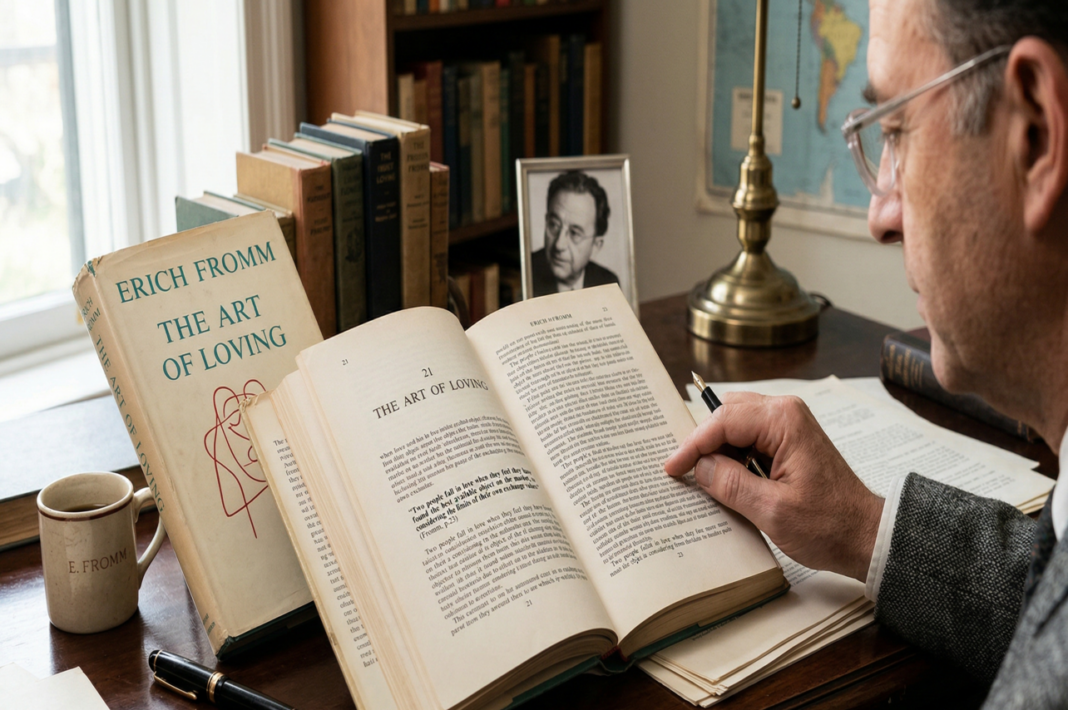

Before examining The Art of Loving, it would be beneficial to begin with a brief overview of Erich Fromm’s life in order to better understand his work. Born on March 23, 1900, in Frankfurt, Fromm was raised in the Jewish faith until the age of 26; afterward, he abandoned this belief and refused to affiliate himself with any religion. He studied at the Berlin Psychoanalytic Institute. Fromm emphasized that human behavior should be evaluated within the context of social environments rather than being seen merely as driven by instincts. He also stressed that psychology cannot be considered independently of sociology and economics.
“People are hungry for love; they watch countless love stories with happy or unhappy endings and listen to hundreds of trivial love songs. Yet, very few think that learning something about love is necessary” (Fromm, p.21).
From the perspective of existential needs, human beings have a need to connect with others through surrender, power, and love, with love being the healthiest form of communication. However, an important issue arises from the fact that love is not learned properly.
“Two people fall in love when they feel they have found the best available object on the market, considering the limits of their own exchange values” (Fromm, p.23).
Here, we observe the marketing orientation among character orientations, where personality is treated as a commodity that can be bought and sold. Fromm highlights how individuals may engage in superficial relationships while searching for love.
“There is certainty only about the past. The only thing certain about the future, apart from death in the distant future, is uncertainty” (Fromm, p.29).
Connecting life values and purpose solely to death reflects the necrophilous character orientation. This refers to individuals who dwell on the past and approach the future with coldness and distance. On the other hand, as a way of coping:
“Man is gifted with reason; he is life aware of itself, aware of himself, of others, of his past, and of the possibilities that await him in the future” (Fromm, p.29).
Here, Fromm emphasizes that humans differ from other beings through their capacity for reason, making rational interpretations about their past and future, thus reflecting a biophilous orientation.
“The feeling of separateness arouses anxiety; indeed, it is the source of all anxiety. To be separate means to be cut off from the use of human powers” (Fromm, p.30).
From the perspective of Karen Horney’s neurotic trends, particularly “moving away from people,” Fromm suggests that while individuals may strive for independence, human nature as inherently social makes this separation a source of anxiety.
“One belonged to a city-state, was a citizen of a great state, a member of a church. Even a poor Roman could proudly say civis romanus sum; Rome and the empire were his family, his home, his world” (Fromm, p.34).
This reflects the existential need for rootedness—the desire to belong to a family or group and to feel at home in the world.
“To love is an act of will; it can only be practiced in freedom and never as the result of compulsion” (Fromm, p.43).
Although Fromm discusses the tendency of individuals to escape from freedom, he evaluates this within the framework of positive freedom and love. He argues that love becomes concrete when it is practiced as an active commitment involving responsibility.
“Not he who has much is rich, but he who gives much” (Fromm, p.45).
The fear of losing possessions and the tendency to accumulate reflect the hoarding orientation. Fromm emphasizes that true wealth lies in giving and sharing, warning that the receptive orientation may impoverish one’s inner world.
“Until the age of eight and a half or ten, the problem for most children is almost exclusively that of being loved. At this stage, children cannot yet love; they respond gratefully and joyfully to being loved. At this point in development, a new factor emerges: the sense of producing love through one’s own activity” (Fromm, p.60).
Harry Stack Sullivan explained personality development through interpersonal relationships, emphasizing stages such as infancy, childhood, and adolescence. Social acceptance plays a crucial role in developing both loving and being loved. The emergence of producing love through one’s own efforts reflects the development of self-perception through relationships.
“The nature of fatherly love is that obedience is the main virtue, disobedience the main sin, and its punishment is the withdrawal of love” (Fromm, p.63).
According to Fromm’s concept of unhealthy family structures, in a symbiotic family, love is perceived as conditional and dependent on obedience. While maternal love is more unconditional and instinctual, paternal love is often conditional.
From the perspective of Karen Horney’s neurotic trends, particularly “moving toward people,” individuals may become dependent personalities, striving to gain love through self-sacrifice.
Another noteworthy point about Fromm’s life is that he grew up in a loving environment with strong paternal support. His father was deeply invested in his success, even expressing that he would commit suicide if Fromm failed his exams.
“If the father is authoritarian and strongly attached to the son, the latter becomes entirely devoted to law, order, and authority, and his ability to receive unconditional love remains underdeveloped” (Fromm, p.65).
This statement supports the idea that conditional love may lead to neurotic personality structures.
“Sexual love is an exclusive union of two persons, but in the person one loves, one loves all humanity and everything that lives” (Fromm, p.75).
Unlike Sigmund Freud, who explained love and attachment primarily through sexuality, Fromm emphasizes that love should be understood within a broader social and existential context.
“The most important condition for the achievement of love is the overcoming of one’s narcissism” (Fromm, p.137).
From the perspective of existential needs, particularly the need for relatedness, love requires care, responsibility, respect, and knowledge. Fromm highlights that overcoming narcissism is essential for achieving genuine love, emphasizing the transition from “I” to “we.”
References
Fromm, E. (2020). The art of loving. Say Publishing.
Pervin, L. A., & Cervone, D. (2016). Personality: Theory and research (13th ed.). Wiley.
Personality theories. (n.d.). Pegem Akademi Publishing.