



Hello, dear you, Today, there is a story I am eager to tell you, and some distinctions I want you to learn. But first, think about this: Can time, space, and emotions find a person simultaneously in their truest forms? Or what is that thing you call “the truest” really; is it what you assume, what you see, or the trace left in you by what you have heard from others? Perhaps time passes, space changes, and emotions silently transform. This trio, which initially appears wrong or even untrustworthy, takes on a different form as we get used to it, get to know it, and see it. And perhaps the issue is not the perfection of those parameters, but what you truly feel and experience within them.
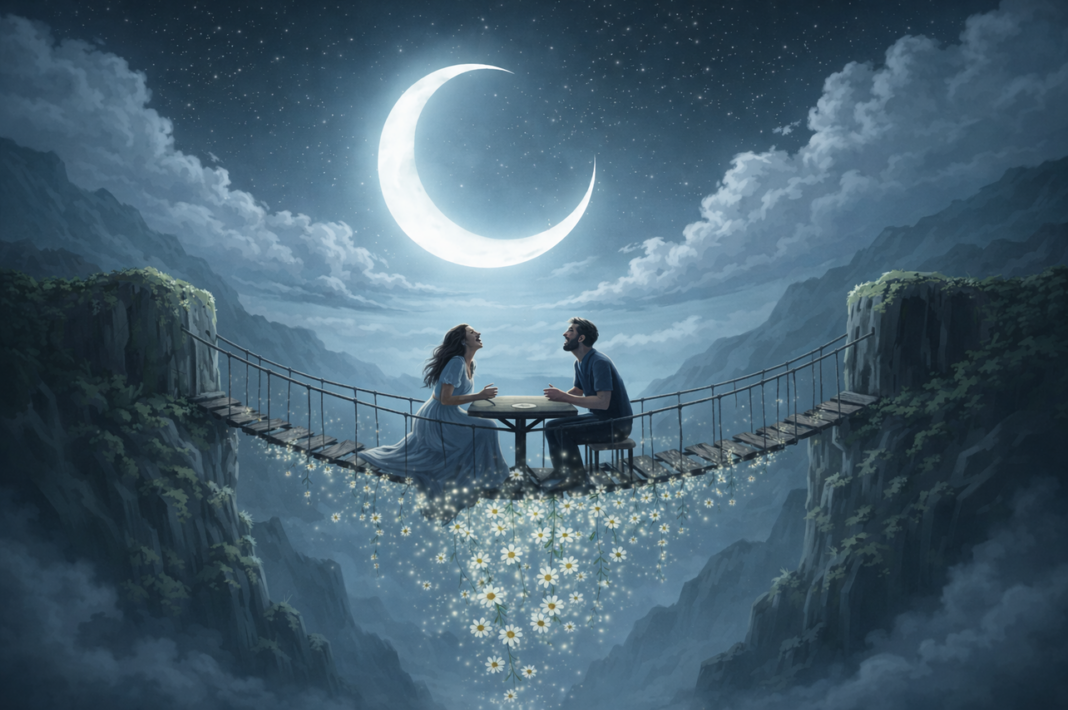
In ancient times, a valley is spoken of, known only by the wind. In this valley, there is a bridge made neither of stone nor wood; it appears when the fog descends, shines when the moon rises, and thins when doubt falls. Legend has it that this bridge stretches between the hearts of İki strangers. The law of the bridge is this: If two people step at the same time, the bridge becomes visible; but if they do not walk at the same hour every day for forty nights, the ropes unravel. Because the bridge loves duration. It would not surrender itself to anyone without duration.
One winter night, while the moon hung in the sky like a thin crescent, a woman and a man meet at the two ends of the valley. They do not know each other. They have no names yet. But neither of them turns back. The woman only says, “Forty nights.” The man does not answer and steps forward quietly. On the first night, the bridge is almost invisible. The wind makes the ropes tremble, the abyss reminds one of its depth. On the fifth night, steps are still cautious. On the tenth night, the abyss does not seem as terrifying as before. This is because they have grown accustomed to the repetition.
However, the sage of the valley explains the situation as follows: “You have been coming for ten nights; your eyes have grown accustomed not to the depth, but to each other’s silhouettes. The decrease in terror is not from courage, but from repetition.” Then he adds: “Getting used to something is memorizing the place of the darkness. Trust, however, is being able to close one’s eyes in that darkness. You haven’t believed yet that you won’t fall; you have only seen that you haven’t fallen every night. This is something else.” And as the wind wanders through the valley, the sage’s words echo: “Repetition thins the fear, but it does not build trust. Trust is the heart not hesitating while taking the same step. Getting used to someone is not trusting them.”
As the nights progress, a rhythm forms. On the fifteenth night, they talk; on the twentieth, they learn to be silent. When the hour comes on the twenty-fifth night, both are there. Is the bridge getting stronger, or have their steps simply become accustomed to the same time? On the thirtieth night, the man pauses for a moment. The woman continues to walk. The ropes stretch but do not break. On the thirty-fifth night, the woman is late; the man waits. Waiting is the silentest test of the bridge. Because trust is the consistency hidden within repetition. Being there at the same hour might be a habit; but the heart intending to stay there is something else.
On the fortieth night, there is a full moon. The fog has cleared, the bridge has become clearly visible. Fear is gone; but a question hangs in the air. Have these forty nights brought them closer, or have they merely accustomed them to being in the same place at the same time? The human mind warms up to what is repetitive; they call this familiarity. But trust grows not just in what is familiar, but in what is unshakable.
The tale says: Walking for forty nights creates a habit; but a single doubt reveals what the bridge is woven from. For trust is understood not through duration, but when it is tested. A shadow falling on someone’s step can make all the nights be weighed anew. And sometimes the bridge does not collapse. Only one person realizes they are looking with a belated doubt at a bridge that has never actually swayed. The wind of the valley still whispers the same question: Did you walk because you were used to it, or because you truly believed? None but the woman and the man know the answer. And some nights, what shakes a person the most is not the depth of the abyss, but the voice of belated doubt rising from their own heart.
The Compass Of The Nervous System: Consistency
When approaching someone, two things actually work simultaneously: the heart and the nervous system. The heart notices the excitement; the nervous system measures the risk. Therefore, before it is a romantic feeling, trust is a state of regulation. At every new encounter, the mind silently asks the same question: “Am I safe here?” This question is answered not with words, but with patterns. The rhythm of the answers, the tone of the voice, the harmony of words with behavior… it is all recorded.
An interesting situation arises when a fixed-term limit is set. In psychology, this is called the “framing effect.” An experience with a known duration appears more manageable to the mind. The thought of “It is not infinite” lowers the defenses. When defenses are lowered, contact becomes possible. That is, duration does not create trust; but it opens the space where trust can form.
Then the “exposure effect” comes into play. Meeting the same person again and again, sharing the same humor, messaging at the same hours… Familiarity produces warmth. What is familiar seems less threatening. But there is a critical threshold here: Familiarity is not a bond. It is only the ground for a potential bond. Habit also forms at this point. Thinking of that person when a certain hour arrives, your heart fluttering slightly when a notification comes… Yet this does not explain the depth of the feeling. You can get used to someone, but you may still not trust them.
Well, dear you, according to psychology, neither duration nor habit was enough to create trust. Because the primary determinant of trust is consistency. Indeed, Jung draws attention to the harmony between the face a person presents to the world—which we call the persona—and the truth they carry in their inner world. If someone’s actions do not align with the depths of their being, time does not close that crack; it only makes it more visible. Habit allows us to get used to the mask. But trust is born from the essence behind the mask remaining unchanged. A being with no distance between what they said yesterday and what they exhibit today, who maintains the same inner integrity while approaching or moving away… This is what calms the nervous system and convinces the heart.
This calming is the foundation of attachment. A person becomes themselves where they are not on guard. Because humans believe most in what is consistent; they lean on what is authentic. Time may pass, repetition may increase; but if there is no harmony between self and behavior, trust remains only an assumption. Therefore, the issue is not time itself. The issue is what your brain records during that time. Did the threat decrease? Did consistency increase? Did familiarity warm up? Yes, duration creates an undeniable ground, exposure produces familiarity, and habit creates a rhythm. But trust is built only when consistency is repeated.
The Final Door Opening To Fields Of Daisies
So, what happened in the end? What end can be predicted anyway? If you ask the author, the greatest uncertainty in this vast world is the “end.” But of course, the author has a few words to say.
Time drew a frame for these two strangers. It narrowed the uncertainty of duration. The thought of “It is not infinite” lowered the defenses. Thus, contact became possible. This framing gave the initial courage but did not yet give trust. Then, repetition came into play. The same hours, similar sentences, laughter rising together… As they were exposed, familiarity increased; naturally, this led to warmth and closeness. Habit created a rhythm, and the heart synchronized with that rhythm. But not everything familiar is trustworthy. Because the truth is that repetition is not what matters; humanity seeks consistency. Humans measure the distance between what was said yesterday and what is done today. They pay close attention to small changes in tone of voice, fluctuations in response times, and the difference between intent and behavior. This is where trust begins. Trust is not in repeated interest, but in unchanging interest; not in continuity, but in stability.
When you are used to someone, you are saddened by their absence. When you trust someone, however, you relax in their presence. That is the difference. While one is a preoccupation of the mind, the other offers you fields of daisies. Habit might have brought you to the same bridge every night. But if there is no trust, the end of that bridge never leads to fields of daisies.
Therefore, the real question is: Was it the passing time that kept you there, or the unchanging behavior? Or that answer you hide from everyone: did you just want to stay there? To live, to see, to feel… Perhaps the only thing keeping you there was your wanting. Don’t look at the screen like that, as if you don’t agree with me. Everything starts with your wanting or continues with your desire. In everything you think you cannot control, your traces are there most of all. Because a person cannot stay for long where they do not want to be; if they stay, they have accepted staying somewhere inside. And sometimes the most difficult confession is this: What keeps you is not duration or habit, but your desire and curiosity. So yes, you can just say “I wanted to.” The author gladly accepts this.
Let us come to the end. Ultimately, the two strangers realize this: A person does not go to the harbor they take refuge in merely for the sake of duration; they stay because they see their own storm calming in that harbor. Perhaps the greatest miracle of life is being able to pull oneself together in the consistency of another. And sometimes the most honest end is not hiding behind big sentences, but standing on the edge of the abyss and confessing this to oneself: “It wasn’t just about arriving; or time, wanting, or habit… It was about staying within the serenity brought by the stranger, wanting to trust them.”
At that moment, the bridge ceases to be invisible and transforms into an endless path opening to fields of daisies under their feet.