


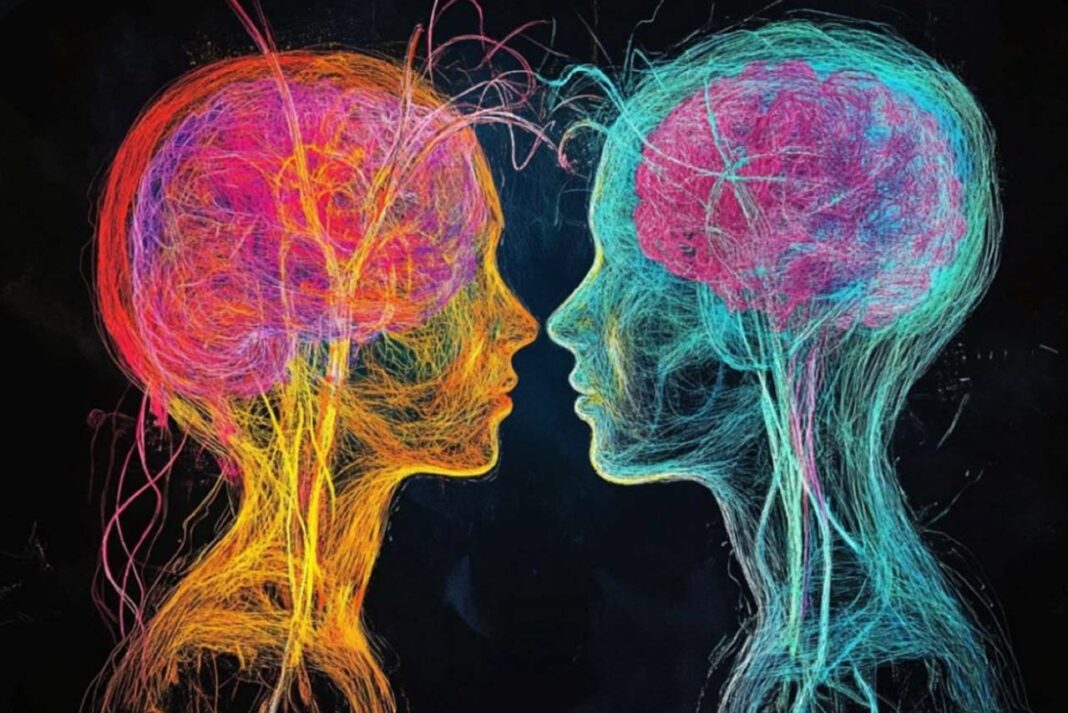

A new year, for many, is a time when old emotions are questioned just as much as new beginnings are embraced. We expect new things as much as we continue to carry expectations toward what is not yet truly past. The very act of questioning new beginnings reveals that old emotions are not, in fact, old. Love stands at the center of this inquiry. At times it appears as attachment, at times as a need, and at times as a savior upon which meaning is imposed.
Dear readers, if you are ready, you are about to encounter a text unlike the constructive and restorative pieces you may have read before. This essay does not sanctify love; it questions it, disassembles it, and attempts to redefine it.
Could we all be mistaken about this? Is love real as an independent emotion, or is it an illusion produced by the mind’s perception?
Love confronts us not only as an emotion, but also as a cultural, religious, philosophical, and literary concept. This diversity suggests that love is closely tied to the ways in which each era and culture assigns meaning. If love can be shaped according to time and culture, then especially in contemporary relational contexts, the scale of this transformation becomes even clearer. This leads to the possibility that love may be less an unchanging essence and more a product of the mind’s need to generate meaning.
Turning to the present, the meaning attributed to love in Franz Kafka’s Letters to Milena offers a striking example of this inquiry. In Letters to Milena, Kafka writes:
“If only the world would end tomorrow. Then I could take the next train, come to your door in Vienna and say: ‘Come with me, Milena. We will love each other without hesitation, without fear, without restrictions. Because tomorrow the world ends.’”
But what if we do not have time? Or what if time, as we understand it, is irrelevant? In these lines, Kafka suggests that love renders waiting and postponement meaningless. He implies that such notions are bound to the pressure of time, and that when this pressure disappears, love’s reality is revealed.
When we examine what is anticipated and invested in today, we see how love and other emotions evolve across periods. In Kafka’s love for Milena, the anxiety of time gives way to a sense of urgency born from the idea that “the world ends tomorrow.” Time—one of the most precious realities shaping our lives—loses its function under the thought of imminent ending.
From another perspective, Kafka emphasizes the inevitability and non-deferrable nature of his love for Milena. Yet his manner of expression also suggests that love may constitute a field of meaning constructed by the individual to cover an inner void.
Surely, each of us has people we love most and believe love us most. But is this love truly what we think it is, or is it a game played by perception? This familiar feeling is often the product of a familiar process of construction. We may direct it toward the living or the inanimate, the abstract or the concrete.
Love is one of the most widely accepted emotions in human life because it is familiar. Its familiarity—whether rooted in trauma or experience—also makes it one of the least questioned emotions. Its centrality invites deeper scrutiny and leads to the realization that it may not be absolute.
Perhaps the issue is not whether love exists, but what we choose to call love. The phrase “so-called love does not exist” does not deny its meaning; rather, it challenges the assumption that it is a fixed and immutable reality.
The Limits Of Perception And Synesthesia
This ambiguity surrounding love inevitably raises the question of how much we can trust human perception. Love seems to prove its existence by being felt, yet the source of that feeling is rarely examined.
Songs, poems, novels, and stories frequently embellish themselves with love. Often, love is the exaggerating dust sprinkled over poetry. At this point, we must ask whether love belongs to the past, or whether it continues to exist in every era as an illusion produced to fill an internal void.
Not everyone perceives or experiences the world in the same way. For some minds, the world is encountered beyond conventional sensory boundaries. Synesthesia is one of the most concrete examples of this difference.
Synesthesia is a neurological perception phenomenon in which one sensory stimulus involuntarily triggers another sensory experience. Synesthetic individuals may see sounds as colors or associate letters with specific tastes. Such experiences suggest that there is no single, fixed perception of the external world.
Synesthesia is neither a disease nor a perceptual disorder; it is an alternative organization of how the brain processes information. Perception becomes less a direct window into reality and more an interpretative field constructed by the mind.
If perception can be this permeable across senses, then it is equally possible that an abstract and bodily ambiguous experience such as love is also perceptually constructed. Just as one might perceive a sound as green, love may be meaning generated by the mind in accordance with its needs, past experiences, and expectations.
Here, Friedrich Nietzsche’s critical approach to love gains significance. Nietzsche does not treat love as a pure and absolute emotion; rather, he associates it with self-deception, power dynamics, and the search for meaning. He does not deny its existence, but insists that its origin and function must be questioned. For Nietzsche, love is one of the most convincing stories the mind tells itself in order to endure the void of existence.
Within this framework, love persists as an experience that lacks certainty yet is powerfully lived.
Just as a mind that tastes colors does not deny reality, to regard love as a perceptual illusion is not to deny the feeling itself, but to question its source.
The Reconstructed Concept Of Love
To say “love does not exist” is not to claim that it is absent. It is to emphasize that love cannot be regarded as a fixed, immutable, and objective emotion.
Thus, love may be less a felt reality than a believed experience. This does not render it worthless; on the contrary, it reveals the human mind’s capacity to survive and to create meaning. The aim of this text is not to dismantle love, but to leave it bare. In our daily lives, the urgency created by time often transforms this emotion into a state of immediacy. No one loves without reason; love always touches a condition, a need, or a void.
Human beings are inclined toward love by nature, a tendency linked to existence itself and to humanity’s interdependence. Yet this does not necessarily mean that love is an objective and self-evident reality. When a loved one is lost, what is often mourned is not the person alone, but the feeling of absence and the unrealized possibilities. The cry of “come back” expresses not love itself, but need.
Love is not a fixed object in the world; it is an experience formed within the perceiving mind. Color is not inherently taste, yet it can be lived as such. Love is not objective, yet its experience is undeniable.
I hope for tables at which our perceptions do not cast shadows over our realities—where we do not gather the sum of our emotions and inner voids, including our own, under the ornamented title of “love.”
If love exists—and whatever else exists alongside it—may we live it with awareness. May we continually remind ourselves of time as the only singular reality, and may we convince ourselves that light, in every perception, comes from the lens through which we see the world. I invite into our lives those whom we choose to actualize with beauty.
As long as we perceive reality clearly, we cannot confine or universally define the word “love” and the profound meanings beneath it. I wish for each of us a year spent not merely looking, but truly seeing.