


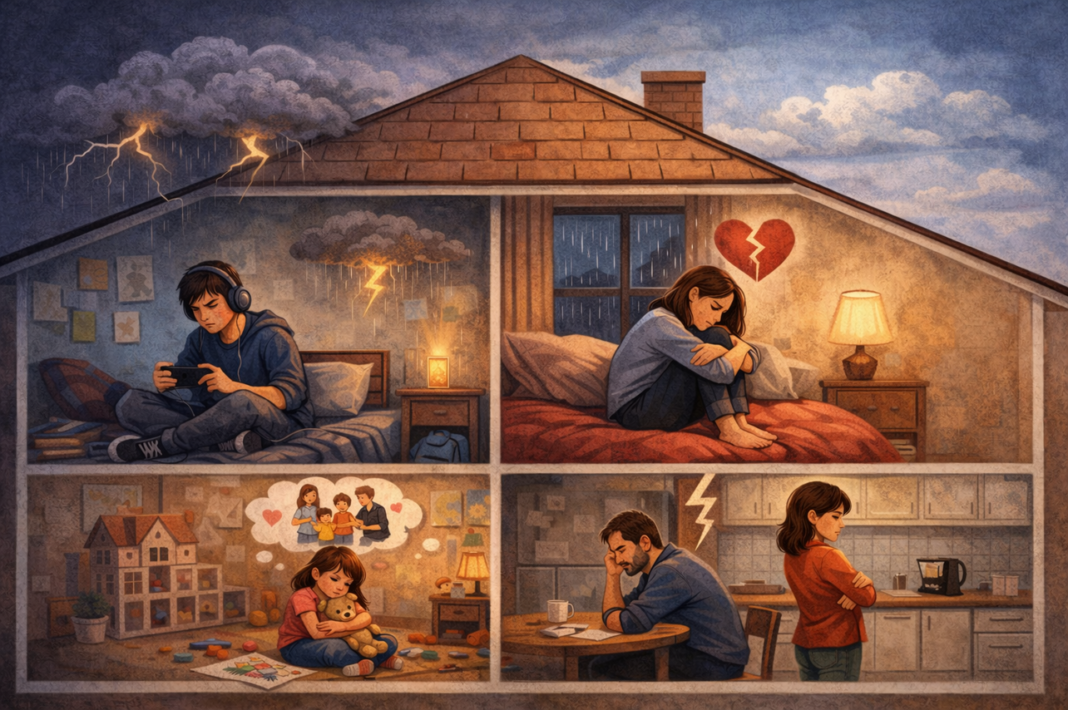

I now view the concept of family not merely as “people living together,” but as a living system constantly influencing each other. In this system, each individual is affected not only by their own behavior but also by the emotions, thoughts, and reactions of other members. For example, when a parent is stressed at home, the child may reflect this in their behavior even if they do not directly notice it. A parent’s fatigue may manifest as the child wanting more attention; tension between spouses may be reflected in the silence at home. The family is like an organism; if there is pain in one place, it affects the whole body. Therefore, it is necessary to see the family not as individual members, but as a network of relationships between them.
Each individual is both a carrier and a transformer of this system. The change of one paves the way for the change of others. That is why problems in a family are never just “one person’s problem.” For example, a child’s temper tantrums are often connected not only to the child’s emotional regulation skills but also to the relationship atmosphere at home. Approaching the family in this way allows for the development of an understanding, rather than a blaming, perspective. What we call family dynamics is precisely hidden in these invisible bonds.
A child’s behavior is often not solely their own; the parents’ communication style, stress levels, the balance between roles, and even intergenerational beliefs form the background of this behavior. For example, a child who is constantly expected to be a “good child” may learn to suppress their own needs, which can lead to difficulty setting boundaries later in life. Or someone who grew up in a family where conflicts were not discussed may avoid expressing their emotions in adulthood.
One of the most common family dynamics is the lack of clear roles or their unhealthy distribution. A child assuming the role of a parent, one spouse constantly bearing the burden, or unclear boundaries can create burnout, anger, and estrangement over time. For example, in some families, the older child takes on the role of mediator between the parents. This child is forced to take on responsibilities at an early age instead of experiencing their own childhood. This situation can create fatigue and resentment in the burden-bearing parent and feelings of inadequacy in the other. When roles become unhealthily rigid, flexibility is lost within the family.
In healthy families, however, roles are flexible but clear; boundaries exist but are drawn with love. Parents remain in their parent roles, while the child remains in their child role. Responsibilities are shared, but no one is expected to carry the burden alone. This balance contributes to the healthier development of family members, both individually and relationally.
Another important dynamic is the language of communication. Families may often be “talking” but “not being understood.” For example, when a parent tells their child, “Your room is always messy, you never take responsibility,” the child may perceive this as criticism and become defensive. However, what the parent really needs is perhaps order and support at home. Similarly, generalizing statements between spouses, such as “You never think about me,” push the other party into a defensive stance and damage the emotional bond.
Critical, judgmental, defensive, or avoidant communication styles wear down relationships instead of protecting them. Instead, language that expresses emotion, articulates need, and genuinely listens to the other person has a healing power in relationships. For example, instead of saying “You never understand me,” saying “I felt alone about this and needed to be understood” reduces the other person’s defensiveness. Communication, instead of escalating the problem, creates space for a solution. Over time, family members learn to understand each other instead of blaming one another. This leads to a more secure bond within the family.
The most promising aspect of family counseling is this: because a family is a system, even a small change within the system can lead to significant transformations. A slight difference in a parent’s attitude can affect a child’s behavior; a softening in a couple’s communication style can completely change the atmosphere of the home. For example, even if a constantly critical parent only softens their language slightly, more cooperation can be observed in the child. Or, if a couple who raise their voices during arguments try to stop and listen to each other, the intensity of conflicts may decrease. These small changes give family members the feeling that “change is possible.” Hope is one of the most powerful components of the therapeutic process. Families often come with the thought, “We are like this, we won’t change.”
While writing this, I realize as an individual: a family does not have to be perfect. But when it is aware, open to learning, and willing to heal together, it becomes one of the most powerful areas for transformation. No family is flawless. What matters is how mistakes are handled. For example, when a parent unintentionally acts harshly toward a child, even acknowledging the mistake and apologizing can have a restorative effect on the relationship. Or, when a couple dares to talk about a long-standing resentment, a new chapter can begin in their relationship. Family is a place where not only joys but also heartbreaks occur.