


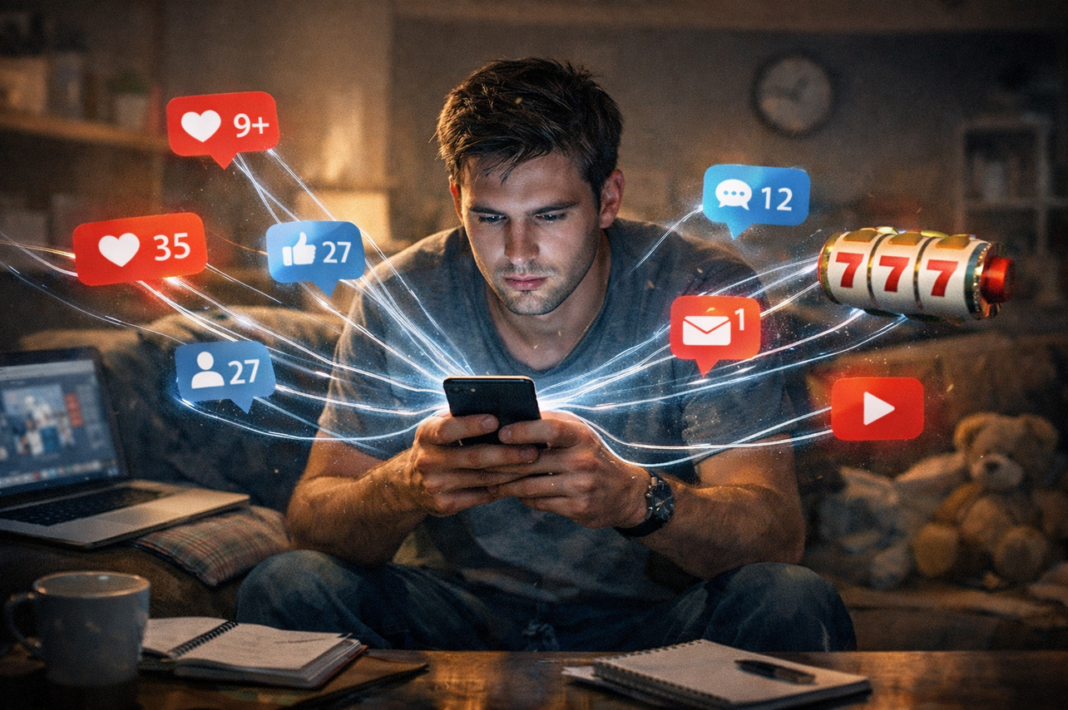

Today’s individuals live within rapidly shifting attention cycles brought about by constant connectivity. A person who picks up their phone “just to check something” often finds themselves trapped in a scrolling vortex that lasts for minutes. This behavior is no longer merely “distractibility”; in psychological literature, it is recognized as a much deeper and more systematic phenomenon known as impulsive technology use. Impulsivity has traditionally been associated with difficulty in planning, inability to delay gratification, and instantaneous action. However, digital platforms transform this impulsivity into a constantly triggered reflex. This reflex is shaped less by an individual’s conscious choices and more by the micro-rewards offered by technology.
The most critical aspect of impulsive use is that it gives the individual the illusion of being in control. For instance, a user may think, “I’m bored, let me take a look,” but in reality, the behavior is often triggered by an algorithmic cue. Red notification badges, sudden pop-up messages, rapid transition animations, and eye-catching alerts activate the brain’s “check now” impulse. Consequently, while individuals believe they are using technology, it is technology that is directing their behavior.
Why Does Technology Nudge Us? The Psychology Of Digital Design
The primary goal of digital platforms is to keep the user on the screen for as long as possible. To achieve this, a discipline called behavioral design is employed. This design targets the decision-making mechanisms of the human brain. For example, the greatest strength of feeds like TikTok, Instagram Reels, or YouTube Shorts is the “infinite scroll” technique. This technique eliminates natural stopping points, removing the user’s opportunity to think. Since there are no pauses—such as the content ending, reaching the bottom of a page, or seeing a loading screen—the brain remains in a constant “continue” mode.
Another strategy is the “variable ratio reinforcement system.” A user does not receive the same level of satisfaction every time they open an app; sometimes the content is highly engaging, sometimes it is not. This uncertainty is the digital version of the psychological mechanism found in slot machines. Driven by the anticipation that “the next one might be better,” the brain returns to the application repeatedly. Furthermore, the timing of notifications is not random; platforms calculate the hours you are most likely to engage and optimize notifications accordingly. Therefore, user behavior is often guided not by free intuition but by invisible design decisions. Digital environments automate behavior by targeting the most sensitive points of human psychology.
Neurobiological Attraction: Why The Brain’s Reward System Can’t Resist
At the heart of impulsive technology use lies the dopamine reward system. A new message, a like, a follow request, or the appearance of a recommended video creates an instantaneous spike in dopamine. Dopamine is not just a chemical of pleasure; it is also a cornerstone of the learning and anticipation system. Even after putting the screen away, the thought “I wonder if anything new happened?” is triggered by the anticipatory effect of dopamine.
The prefrontal cortex—our center for planning, decision-making, and impulse control—struggles to cope with digital stimuli. This is because social media and games appeal to the brain’s more primitive and faster-acting limbic system. Since this system favors immediate rewards, long-term goals or tasks requiring sustained attention are sidelined. This creates the urge to check the phone even during study sessions, report writing, or meetings.
Neuroimaging research shows that intensive screen use creates activation patterns in the brain similar to addictive behaviors. This does not mean everyone is an addict; however, in individuals with weak impulse control, the cycle becomes established more quickly. The reason the brain surrenders to this mechanism is that technology is fine-tuned enough to target individual vulnerabilities and attention gaps.
Daily Behaviors: Moments Where Control Slips Away
Impulsive technology use often goes unnoticed because it is subtly woven into daily routines. However, certain signs are prominent:
-
Repeatedly checking the phone even when there are no notifications.
-
Aimless switching between applications.
-
An automatic urge to refresh the feed.
-
Constant repetition of the phrase, “I’ll just check for a second.”
-
Turning to social media as an escape from real-life responsibilities.
-
Underestimating the time spent on the screen.
These signs indicate that the behavior has become an automatic reflex rather than a conscious choice.
Tangible Examples From Daily Life: Getting Lost In The Loop
A high school student takes a short break from studying for an exam to check their phone. They first look at messages, then move on to a video. When the video ends, the next one starts automatically, and the student loses track of time. As study hours become insufficient, feelings of guilt increase; this guilt, in turn, triggers further escape into the digital world. The cycle continues.
An employee cannot keep their phone away from the table even during a meeting. Even if no notification arrives, their fingers instinctively reach for the screen. This behavior results in both a loss of focus and damage to professional presence.
In another example, a parent looking at social media to relax in the evening inadvertently sidelines the time they would spend with their child. By the end of the day, the feeling of “I couldn’t engage with them” creates guilt, which leads back to digital escapism.
Finally, a single adult starts watching videos during dinner. Even though the meal is over, they cannot turn off the screen because the brain is still in a state of reward anticipation. Over time, this routine turns into a habit.
Conclusion: What Can Be Done To Manage Impulsivity?
It is not possible to completely eliminate impulsive technology use, as modern life makes digital interaction inevitable. However, it is possible to prevent this use from becoming automated. The first step is awareness. When a person begins to observe when, with what emotion, and why they reach for their phone, the first link in the chain is broken.
The second step involves environmental adjustments:
-
Turning off unnecessary notifications.
-
Physically distancing oneself from the phone.
-
Declaring certain times of the day as “screen-free.”
-
Keeping phones out of the bedroom.
-
Setting time limits on applications.
The third step is “micro-alternatives.” When the urge to open a screen arises, a 30-second pause, a short breathing exercise, or simply leaving the room to drink water can reset the dopamine cycle.
The gravitational pull of the digital world is strong, but the human mind is capable of managing this cycle through conscious regulation. Once impulsive use is recognized, technology stops managing us, and we begin to manage technology.
References
Alter, A. (2017). Irresistible: The Rise of Addictive Technology and the Business of Keeping Us Hooked. Penguin Press.
Kuss, D. J., & Griffiths, M. (2017). Social networking sites and addiction: Ten lessons learned. International Journal of Environmental Research and Public Health, 14(3), 311.
Meshi, D., Elizarova, A., Bender, A., & Verdejo-Garcia, A. (2020). Excessive social media users demonstrate impaired decision making. Journal of Behavioral Addictions, 9(4), 917–927.