


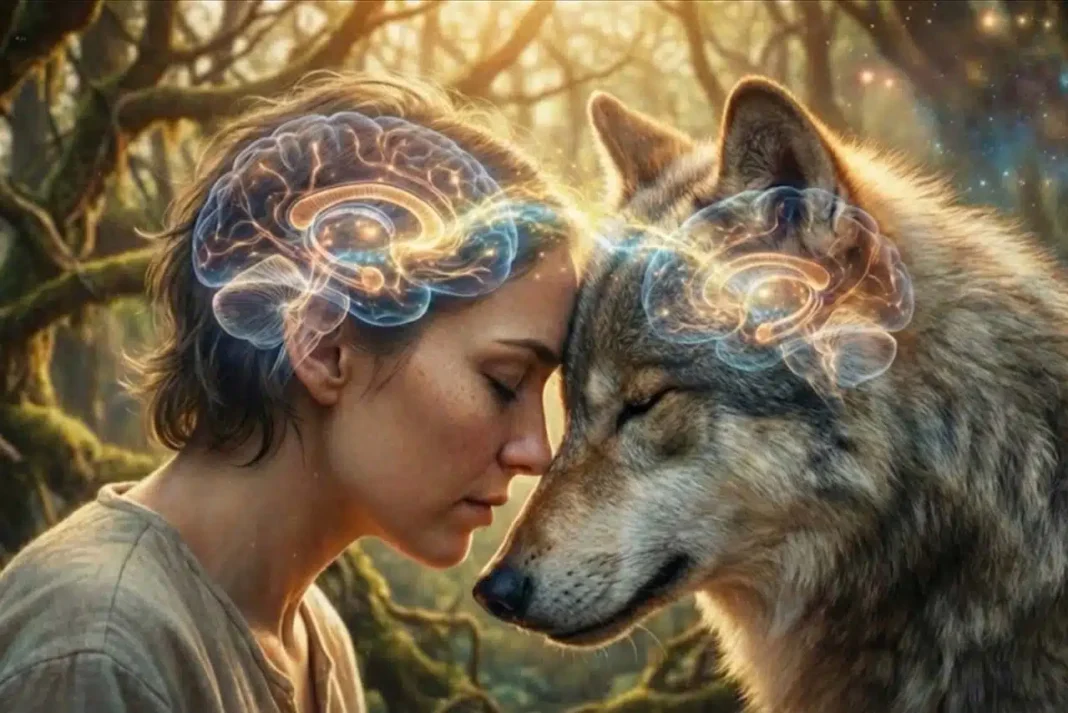

Throughout the history of philosophy and science, the concept of “human” has been placed on a special pedestal, comprised of all other living beings. Since Descartes’ labeling of non-human animals as “soulless automatons”, it has been scientifically marketed as a privilege reserved for Homo Sapiens. However, today, when we examine the indicators in this construct, a massive “Fallacy of Induction” emerges.
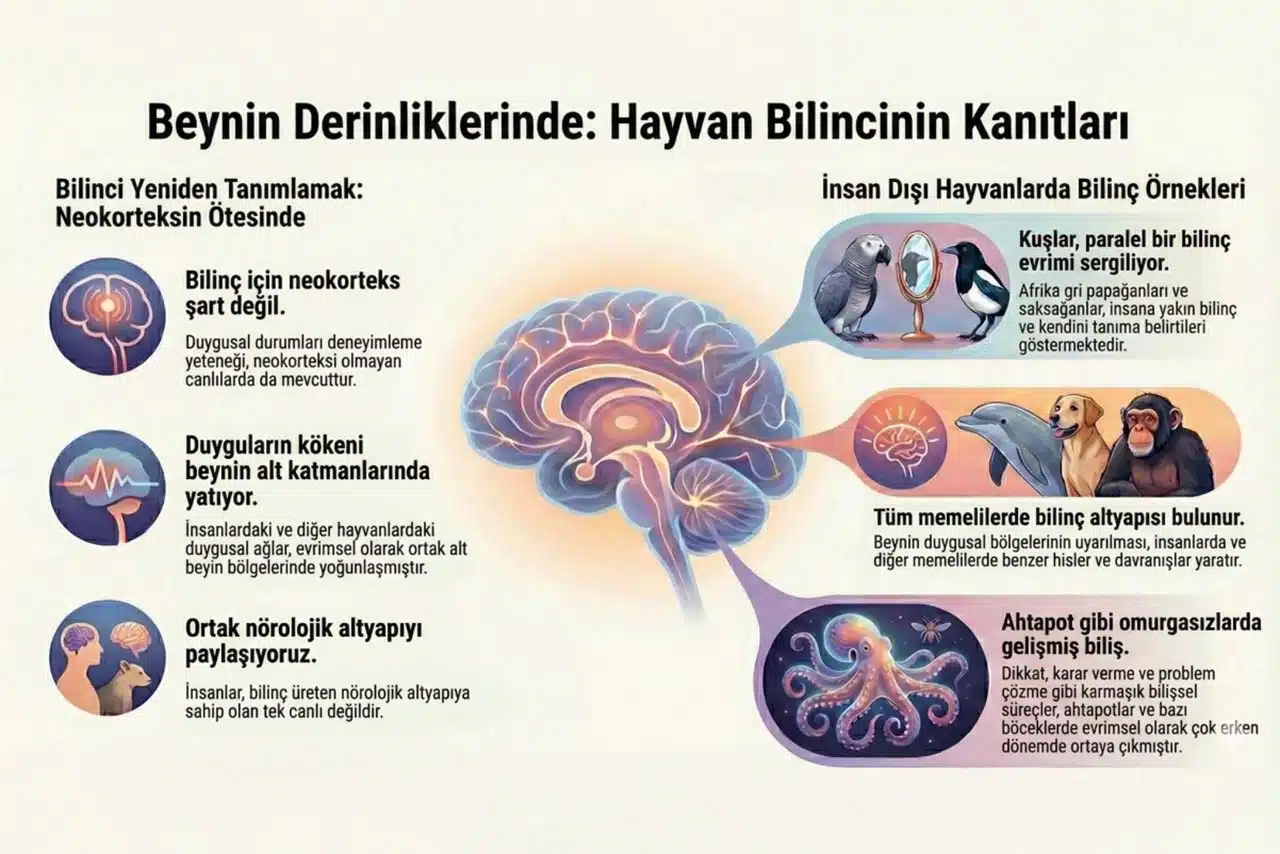
Yet, the final nail in the coffin of this fallacy was hammered into place in 2012 by leading scientists from various disciplines, including physicist Stephen Hawking and programmatic neuroscientist Philip Low. The signed “Cambridge Declaration on Consciousness” clearly states: “Non-human animals possess the neuroanatomical, neurochemical, and neurophysiological substructures of consciousness.” So, the standard consensus is clear, consciousness is not a human monopoly. This immense knowledge invites those who have confined themselves to themselves out of their synthetic prisons. In other words, it informs humans that they are not alone in this world, and that there are extremely unique potential friends to discover and meet.
There Are No Types Of Intelligence: De Waal And Convergent Evolution
The dominant culture makes the superficial generalization that “humans are intelligent, others are not”. Nevertheless, primatologist Frans de Waal, in their publication “Are We Smart Enough to Know How Smart Animals Are?”, contradicts this conceit: “Counting to ten may not be compatible with the purpose of life for a non-human animal. Humans, on the other hand, are not as successful at hiding 20,000 seeds in different places and finding most of them months later as if they had placed them manually”.
Defining intelligence solely as “thinking like a human” is a speciesist delusion. This distortion fundamentally harms everyone. Indeed, nature, the world, and the universe are a unified whole, encompassing all sentient and sentient beings within them. Unless we approach the problem as such, the problem cannot be solved. The principle of “Convergent Evolution” in evolutionary biology shows us that there is no single path to intelligence in nature. A crow’s problem-solving ability or an elephant’s capacity to grieve proves that consciousness is perfectly suited to diverse endowments. As biologist Lynn Margulis emphasizes, the true success of evolution is not “competition”, but “symbiosis”, where species benefit from each other’s intelligence.
Contact Across Species: Vasotocin And Limbic Resonance
The overemphasis on the concept of “human” leads us to many misconceptions. One of these is the misconception that the best communication can only be established “within a species” or with mammals. On the other hand, when the concept of “Limbic Resonance” in neuropsychiatric literature is expanded, it becomes clear that nervous systems possess the capacity for a nonverbal “synchronization of trust”.
This synchronization transcends biological barriers. Oxytocin is activated in the bond between a human and a cat, while vasotocin, the evolutionary ancestor of oxytocin, forms the bridge in the bond between a human and an iguana or bird. While the chemical messengers may differ, the frequency of “trust and safety” established remains the same. In this context, the understanding between beings of different species can sometimes be far deeper and more authentic than that between two humans speaking the same language. To understand, one does not need to be of the same species. All that is required is to resonate on the frequency of mutual compassion, respect, and trust.
The Myth Of The “Reptilian Within”: The Collapse Of Hierarchical Neuroscience
One of the greatest pillars of cultural arrogance was popularized by neuroscientist Paul MacLean. The hierarchical “Triune Brain” theory, now refuted by scientific data, views the lower layers of the brain as the “Reptilian Brain”. This way, this part is equated with automatic violence and perpetual instinct.
According to modern neuroscience, the situation is quite different. The Bird Brain Nomenclature Consortium (2004), led by physicist Georg Striedter and Professor Erich Jarvis, demonstrated that evolution has not superimposed itself on the brain. In other words, existing structures are transformed. Reptiles and birds also possess the pallium, the primary ancestor of the mammalian cortex. Therefore, these living beings also possess the ability to learn and make decisions. Geneticist Luis Puelles’ maps prove that emotional circuits are also genetically encoded in reptiles. To call an organism “reptilian-brained” to say that some people are “inner reptiles” or to attribute the violence they produce to their “inner reptile” is not a scientific observation, but a hierarchical justification of perpetration.
The anthropocentric misconception sees fish as merely “swimming reflexes”. However, neuroanatomy proves that fish also possess the pallium, the ancestor of the mammalian cortex, and that the experience of pain (nociception) begins in aquatic life. What a fish feels when hooked is not merely a mechanical tug; it is a neurochemical agony. As biologist Victoria Braithwaite emphasizes, consciousness did not begin on land; it awoke in the ocean.
Neuroarchaeology: Dismantling The “Human” Monolith
Regarding the archaeology of the brain, Jaak Panksepp, founder of Affective Neuroscience, demonstrated that deep within mammalian brains, care and play systems are shared. According to Panksepp, “other animals also have feelings, and these feelings share the same evolutionary roots as Sapiens”. But, the anthropocentric orientation has created a “human” monolith (a uniform structure) with judgments like “all humans are like this” or “all animals are like that”. Bjørnar Olsen, a pioneer of Symmetrical Archaeology, critiques this view in In Defense of Things. Accordingly, someone who wishes a gazelle to be deprived of its life for their own benefit should not be equated with someone who risks their life to save a gazelle. What needs to be criticized is not the biological categories, but the toxic cultural software that has permeated these categories.
This software, within the infinite diversity of life, only focuses on and magnifies violence, along with humankind. It markets it as if violence were an immutable law of nature, absolutely at the core and root of everything. Similarly, coding a cat as merely an “instinctive hunter” and ignoring their loving individuality is a speciesist denial. Yet, as seen in thousands of examples, there are enormous cats with sharp claws and teeth that bond with a mouse or a tiny bird, protecting it at the cost of their lives.
Conclusion: Frankl’s Call And Primary Existence
Some people’s greatest mistake is to seek meaning only within the confines of their “own species”. In other words, if we embrace Viktor Frankl’s concept of “Self-Transcendence” and move beyond it, we will be seeking answers in the right place. Accordingly, a person is only fulfilled when they transcend themselves and become aware of the “outside” world and the “other”. We extend beyond Frankl’s emphasis on humans to all sentient and feeling beings. This is a connected, compassionate, and pain-feeling cow, or neurodiverse human, with their own complex inner world. Scientific data, ethical philosophy, and psychology converge.
That’s why, healing begins with breaking out of one’s own mental (conceptual) prison and joining the great orchestra of life, where all sentient individuals are “primary” (unique and valuable), not merely as a listener but as a compassionate, respectful participant.
References
Avian Brain Nomenclature Consortium. (2005). Avian brains and a new understanding of vertebrate brain evolution. Nature Reviews Neuroscience, 6(2), 151-159.
Braithwaite, V. (2010). Do Fish Feel Pain? Oxford: Oxford University Press.
De Waal, F. (2016). Are We Smart Enough to Know How Smart Animals Are? New York: W. W. Norton & Company.
Frankl, V. E. (2006). Man’s Search for Meaning. Boston: Beacon Press.
Lewis, T., Amini, F., & Lannon, R. (2000). A General Theory of Love. New York: Random House.
Low, P., Panksepp, J., Reiss, D., Edelman, D., Van Swinderen, B., & Koch, C. (2012). The Cambridge Declaration on Consciousness. Cambridge, UK: Francis Crick Memorial Conference.
Margulis, L. (1998). Symbiotic Planet: A New Look at Evolution. New York: Basic Books.
Olsen, B. (2010). In Defense of Things: Archaeology and the Ontology of Objects. Lanham: AltaMira Press.
Panksepp, J., & Biven, L. (2012). The Archaeology of Mind: Neuroevolutionary Origins of Human Emotions. New York: W. W. Norton & Company.
Puelles, L., et al. (2000). Pallial and subpallial derivatives in the embryonic chick and mouse telencephalon. Journal of Comparative Neurology, 424(3), 409-438.
Striedter, G. F. (2005). Principles of Brain Evolution. Sunderland: Sinauer Associates.