


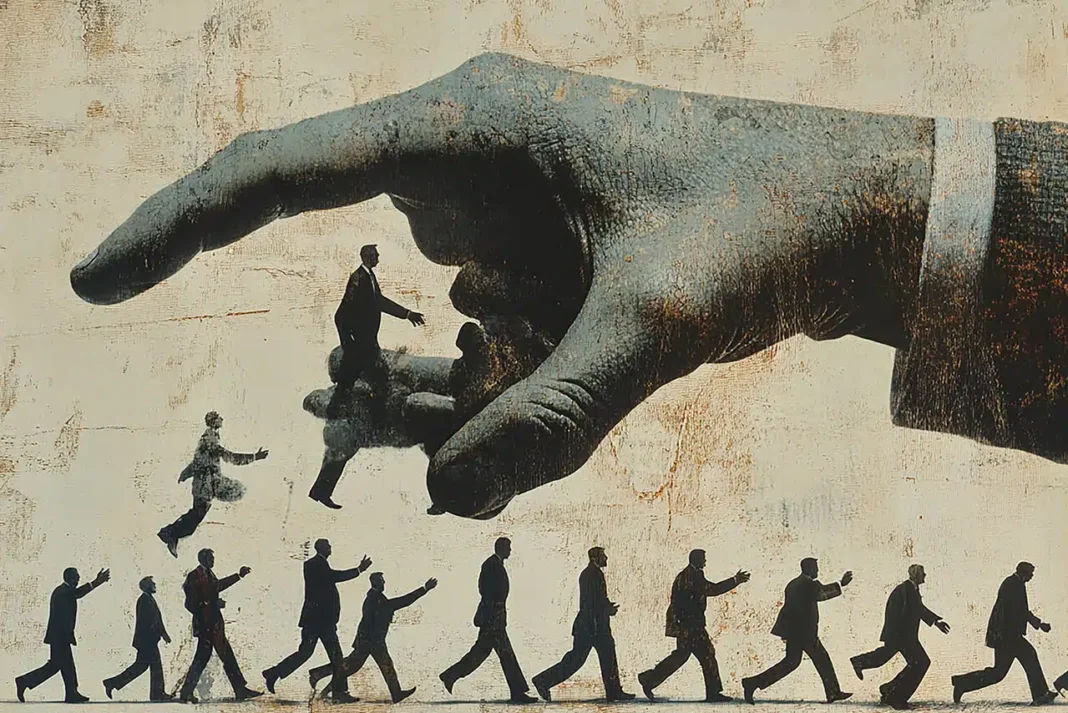

The human mind, by its very nature, strives to reduce uncertainty and make sense of the world. One of the most fundamental cognitive tendencies when faced with complex events is to reduce them to simpler and more comprehensible causes. This stems from the need to preserve limited cognitive resources: explaining an event through the complex interplay of coincidences requires far more mental energy, whereas attributing it to a single intent or actor offers a more economical and satisfying solution (Feldman, 2016). Even in everyday life, people establish invisible connections in random situations, construct a “cause–effect chain,” and in doing so maintain their sense of control.
This tendency becomes even stronger in periods marked by uncertainty and a sense of loss of control. Crises, disasters, or unpredictable social changes make it more difficult for the individual’s mind to tolerate “coincidence,” since uncertainty psychologically increases anxiety and threatens the need for security (Douglas, Sutton, & Cichocka, 2017). At such times, people tend to believe that there must be “great causes” behind great events (van Aaken, 2019). In the literature, this is defined as the “proportionality bias.” In other words, even events that could be explained by small and accidental factors are perceived as deliberate and planned actions, in order to provide cognitive relief.
The Cognitive Basis of Conspiracy Theories
This cognitive and emotional ground facilitates the emergence and spread of conspiracy theories. A mind unable to tolerate uncertainty invokes the planned moves of invisible actors to make sense of complex events. Thus, conspiracy theories are not merely a form of “misinformation,” but mental patterns that fulfill a psychological function. Psychology literature explains this phenomenon with various concepts. While the “proportionality bias” suggests that major events must be explained by major causes, the “intentionality bias” shows that even random developments are attributed to conscious intent.
Social identity theory explains the group-level dimension of this process: conspiracy theories sharpen the distinction between “us” and “them,” demonizing out-groups and strengthening in-group solidarity (Robertson, Pretus, Rathje, Harris, & Van Bavel, 2022). In societies where the “us versus them” distinction is strong, polarization begins, and with it come hostility, intolerance of differences, the hardening of prejudices against out-groups, and a reduction in empathic capacity. In this process, individuals tend to evaluate their own group in excessively positive terms, while evaluating out-groups in excessively negative terms. Such patterns of thought and behavior are so distorted that they would not be found in a healthy democracy.
Consequently, conspiracy theories not only create informational distortions, but also weaken social bonds, erode trust, and generate a constant sense of distrust. As these patterns persist, individuals’ anxiety levels rise, their motivation to cooperate with others diminishes, and a climate of chronic distrust emerges in society. In this sense, conspiracy theories are powerful determinants not only of individual psychology but also of social relations.
Conspiracies, Distrust, and the Rise of Authoritarianism
Conspiratorial discourses present alternative, often unverified narratives to official information, instilling citizens with a constant sense of suspicion and distrust. In democratic regimes, the source of legitimacy is not merely the casting of votes. Contrary to popular belief, democracy is not limited to this act alone. The impartiality of institutions, rule-based functioning, and faith in the rule of law are equally essential elements of democracy. The circulation of conspiracy theories constitutes a direct attack on these building blocks because narratives such as “great powers” and the “deep state” convey the message that institutions are incapable of combating these forces and that the public is no longer safe.
One of the most common narratives is that of the “deep state,” which rests on the claim that behind the visible face of the state, decisions are made by a hidden elite group. Similarly, the “great powers” narrative asserts that economic crises or political turmoil are always linked to the interventions of foreign states. On a global scale, the notion that organizations such as the Freemasons, the Illuminati, or the “globalists” rule the world comes to the fore. Narratives suggesting that the media manipulates the public, or that scientists and experts serve the interests of large corporations, are also frequently encountered. In addition, accusations that ethnic or religious minorities are “undermining the country from within” constitute another conspiratorial discourse that fuels social polarization.
All these narratives reduce complex social problems to simple, personified explanations, eroding trust in institutions and reinforcing the belief that a strong authority is needed, given that institutions are depicted as inadequate. As institutions are portrayed as “toys of hidden actors,” citizens begin to seek solutions not in legal procedures, but in personal authority figures. Thus, the focus of trust shifts from institutions to individuals. Political psychology explains this tendency with the concept of the “need for a strong leader”: individuals facing uncertainty, threat, and insecurity seek a singular, decisive authority to protect them. What is striking here is that the need for security often outweighs the need for freedom. For the human mind, the feeling of insecurity is perceived as an existential threat; hence, individuals may even be willing to sacrifice some of their democratic rights in exchange for security.
As might be expected, this situation does not necessarily lead to mass revolt; on the contrary, the search for a “strong hand to protect us” intensifies. Citizens turn toward a figure who is firm, decisive, and uncompromising, one who they believe can rescue them from chaos and uncertainty. This explains why authoritarianism can so easily gain legitimacy in the social arena. In other words, the authoritarian demand that emerges in an environment where institutional trust is eroded is not an irrational choice, but rather a psychological outcome of the primacy of security over freedom.
It should also be remembered that rebellion is not always the dominant option. In many contexts, the erosion of trust in institutions does not result in mass protest but instead feeds a tendency toward authoritarianism. Among the reasons for this are the dominance of the need for security over the desire for freedom, the limited organizational capacity of civil society, and the historical or cultural perception of strong leadership as more legitimate. Under these conditions, even when societies believe that institutions are corrupt, they are more likely to expect the existing order to be restored through personal authority rather than to demand a radical break.
In summary, with the strengthening of conspiracies and the triggering of distrust, citizens begin to evaluate decisions not through legal processes or collective mechanisms, but through the intentions of individual actors. This means that political trust shifts from institutions to individuals. As distrust in institutions increases, the masses seek solutions not in independent and accountable mechanisms, but in strong leaders perceived as decisive and anchored in personal authority.
Thus, conspiracy theories do more than create informational disorder; they also feed on the public’s damaged sense of trust, weaken the legitimacy of democratic representation, personalize the functioning of the political system, and pave the way for authoritarianism. From this perspective, the political function of conspiracy theories is not only to reinforce social prejudices, but also to undermine the trust contract on which democratic institutions are based, rendering politics more fragile and more personalized.
References
-
Douglas, K. M., Sutton, R. M., & Cichocka, A. (2017). The psychology of conspiracy theories. Current Directions in Psychological Science, 26(6), 538-542.
-
Feldman, J. (2016). The simplicity principle in perception and cognition. Wiley Interdisciplinary Reviews: Cognitive Science, 7(5), 330-340.
-
Robertson, C. E., Pretus, C., Rathje, S., Harris, E. A., & Van Bavel, J. J. (2022). How social identity shapes conspiratorial belief. Current Opinion in Psychology, 47, 101423.
-
van Aaken, A. (2019). The Decision Architecture of Proportionality Analyses: Cognitive Biases and Heuristics. Available at SSRN 3364553.