


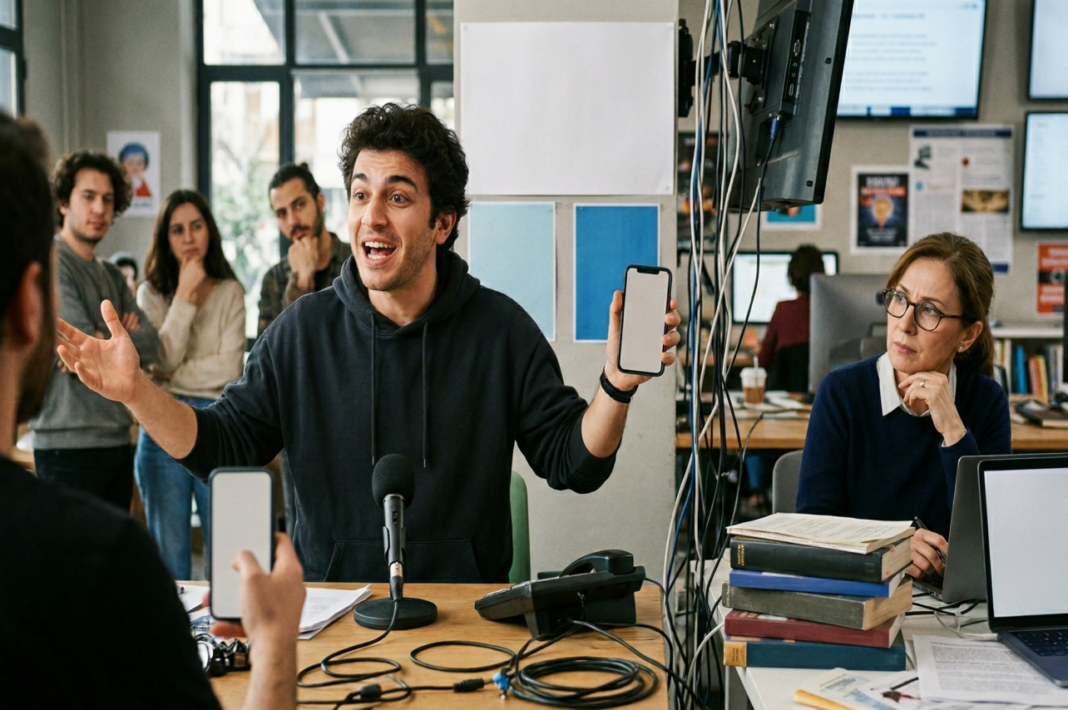

In today’s world, having deep knowledge about a subject no longer seems to be a prerequisite for speaking about it. Short videos, superficial content, and rapidly consumed information can easily create the illusion of “knowing.” However, this feeling is often misleading. The gap between actually knowing and merely believing that one knows has become increasingly blurred, especially in the digital age. This ambiguity not only leads individuals to possess inaccurate information but also encourages them to express it with a high level of confidence.
To understand this phenomenon, it is essential to consider a key concept in psychology: the Dunning–Kruger Effect. First introduced by David Dunning and Justin Kruger, this effect describes the tendency of individuals with low levels of knowledge or competence in a domain to overestimate their own abilities. More strikingly, these individuals often lack the cognitive capacity to recognize their own inaccuracies. In other words, they are not only wrong; they are unaware that they are wrong.
The Role Of Metacognition In Self-Assessment
At this point, the concept of metacognition becomes relevant. Metacognition refers to an individual’s ability to evaluate their own thinking processes. In the Dunning–Kruger Effect, the issue is not merely a lack of knowledge, but also the inability to recognize that lack. This leads individuals to perceive themselves as more competent than they actually are and makes them less receptive to critical feedback. As a result, the learning process is hindered, since individuals do not feel the need to learn about something they believe they already understand.
The manifestations of this effect are easily observable in everyday life. Particularly on social media platforms, individuals often make definitive claims based on limited information and defend these claims with strong confidence. This is not only an individual issue but also a broader societal problem related to misinformation. When inaccurate or incomplete information is presented with confidence, it can become more persuasive. At this point, it is important to remember a simple truth: Real knowledge does not create noise; it speaks through consistency and evidence.
The Contrast Between Expertise and Overconfidence
On the other hand, individuals with higher levels of knowledge tend to communicate more cautiously. This is because they are better able to grasp the complexity and limitations of a subject. As knowledge increases, so does awareness of what remains unknown. This awareness often leads to more nuanced and less definitive statements. Paradoxically, this can cause less knowledgeable individuals to appear more assertive and dominant, as confidence is often fueled not by knowledge itself, but by the lack of it.
The place of the Dunning–Kruger Effect in psychology is well-established. It is categorized under cognitive biases and is recognized as one of the systematic errors the human mind tends to make. It has been widely referenced in research on self-assessment, decision-making, and social judgment. Therefore, it is not merely a popular internet concept, but a scientifically supported phenomenon grounded in experimental research.
Societal Implications and The Path To Cognitive Awareness
The societal implications of this effect should not be overlooked. While the democratization of information—where everyone can produce and share content—has many benefits, it has also blurred the distinction between expertise and opinion. In an environment where everyone can speak, it becomes increasingly difficult to distinguish well-informed perspectives from superficial commentary. This can influence how individuals, especially younger generations, relate to knowledge, as visibility is often mistaken for accuracy.
Breaking this cycle begins with acknowledging the limits of one’s knowledge. Being able to say “I don’t know” is not a sign of weakness, but rather an indication of strong cognitive awareness. Additionally, developing critical thinking skills, consulting diverse and reliable sources, and avoiding hasty judgments can contribute to a healthier understanding of information. In this regard, academic literacy serves as an important protective factor.
In conclusion, the Dunning–Kruger Effect offers a compelling insight into how the human mind can overlook its own limitations. The confidence that stems from limited knowledge can lead individuals not only to erroneous judgments but also to a mindset that resists learning. True knowledge, however, is often quiet; it does not assert itself loudly, but expresses itself through consistency and evidence. Therefore, striving to understand more deeply rather than speaking more frequently may be one of the most valuable cognitive skills in the modern age.
References
-
Kruger, J., & Dunning, D. (1999). Unskilled and unaware of it: How difficulties in recognizing one’s own incompetence lead to inflated self-assessments. Journal of Personality and Social Psychology, 77(6), 1121–1134.
-
Dunning, D. (2011). The Dunning–Kruger effect: On being ignorant of one’s own ignorance. Advances in Experimental Social Psychology, 44, 247–296.
-
Kahneman, D. (2011). Thinking, Fast and Slow. New York: Farrar, Straus and Giroux.
-
Bjork, R. A., Dunlosky, J., & Kornell, N. (2013). Self-regulated learning: Beliefs, techniques, and illusions. Annual Review of Psychology, 64, 417–444.