


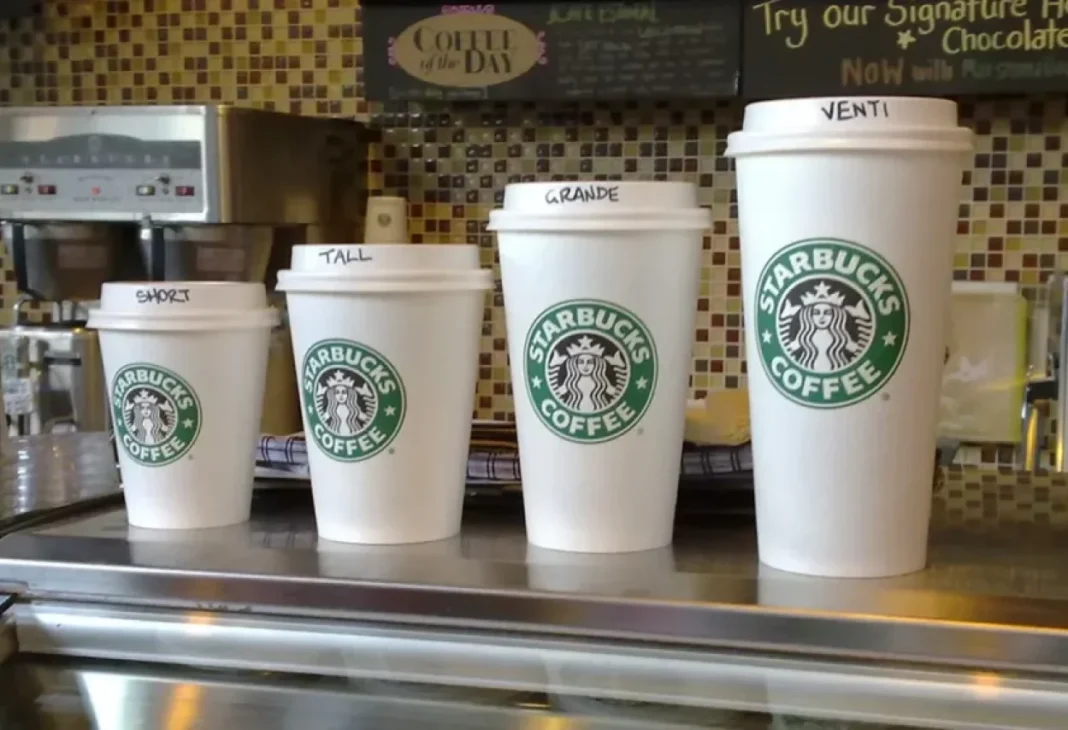

Is the decision we make over a cup of coffee or a slice of pizza really just about hunger? Or, without noticing, are we putting on a small display of power with the size of the cup we set down on the table? The same question could be asked of a car, a house, even a handbag, but in its purest form, it catches us at the register, several times a day.
We like to think most of our decisions are rational. We walk up to the counter, weigh how hungry we are, glance at our budget, and assume we choose accordingly. In reality, mechanisms running just beneath our awareness, signals we never register, have often made the decision for us already. The physical size of the things we consume is one of these invisible cues.
Picture the scene. It is your turn at the coffee counter. Small, medium, extra large. Your budget covers all three, and your actual thirst would be perfectly satisfied by the medium. And yet your hand reaches, almost on its own, for the biggest cup. Is that about the volume of the drink, or about the message you send everyone around you the moment that oversized cup lands on the table?
Marketers had a hunch about this for a long time before anyone tested it. The people who did were David DuBois of HEC Paris along with Derek Rucker and Adam Galinsky of Northwestern University. Their first experiment was simple: participants were shown profiles of fictional people who preferred different sizes of coffee, pizza, or soda, and asked to rate each person’s social status and power on a scale of one to seven. People who chose small sizes scored an average of 3.03. People who chose large or extra large scored 4.98.
Stop for a second. No concrete information had entered the picture, no title, no income. The physical size of a cup or a plate alone was enough to move a stranger up the social hierarchy in an observer’s mind. Size, on its own, without a single word of explanation, had become a signal of power.
Social psychology has an old explanation for why this works so easily. According to the theory of symbolic self-completion, proposed by Robert Wicklund and Peter Gollwitzer in 1982, when a person feels a deficit along some identity dimension they value, they try to close that gap with symbols borrowed from the outside world. Someone without a degree brings up their title at every opportunity; someone who feels powerless reaches for objects they believe represent power. The size of the cup in your hand performs exactly that function.
The researchers did not stop there. They went further, into the consumer’s inner life. One group was asked to write about a memory of being controlled by someone else, of feeling helpless. The other group was asked to recall a moment of being in charge, of directing someone else. Both groups were then offered menus with different sizes, at identical prices. The group primed to feel powerless chose the largest size far more often than the group primed to feel powerful, regardless of what it cost.
The most telling part came from another experiment by the same team. Participants first read a fabricated news item: one group was told that 63 percent of America’s most influential people were physically fit, the other group was told the same 63 percent were overweight. Everyone then chose from five different sizes of chocolate bars. The group primed to associate status with fitness chose the smaller bar. The group primed to associate status with abundance chose the larger one. In other words, the issue was never size itself; it was whatever size happened to represent in that moment. The mind learns which language status is currently speaking and behaves accordingly.
Consumer psychology has a name for the broader pattern: compensatory consumption, the attempt to close a felt loss of control and power with visible, large, external objects. Physical size functions as a kind of psychological prosthetic, filling a gap in the mind.
So why does the mind bind size to power so unshakably? The roots run through both evolutionary biology and childhood. In nature, almost every creature that feels threatened or wants to establish dominance tries to make its body look bigger than it is. Birds puff their feathers. Cats arch their backs and raise their fur. Predators square their shoulders and expand their territory. Size is nature’s oldest language of dominance, and shrinking is the universal gesture of submission. Dacher Keltner and colleagues, working out of Dartmouth, developed what they call the approach-inhibition theory of power, which points to a similar pattern: bodies that feel powerful tend to take up space, while bodies that feel powerless tend to contract. And the first lesson we absorb in childhood is much the same: what is big, a parent, an adult, a tall building, sets the rules, while what is small is dependent. That coding never disappears in adulthood; it just changes costume. When we feel exposed or vulnerable, we reach for objects that loom larger in our hands, retreating to that old shelter where big equals safe.
The moment this instinct got noticed and turned into a business model is fairly recent, and it starts in movie theaters. In the 1960s, David Wallerstein, who ran concessions for a Chicago theater chain, could not get audiences to buy a second box of popcorn or a second soda. Price cuts, two-for-one deals, nothing worked. People stopped at one. Wallerstein’s conclusion was simple: buying a second one carried the risk of looking greedy. But the same people had no hesitation buying one much larger box up front. When he brought the idea to McDonald’s, founder Ray Kroc was skeptical at first, until the data from the floor convinced him: customers were turning fry bags upside down, chasing the last grains of salt at the bottom. The large size was born, and the supersize culture that followed spread across the entire fast food industry. What Wallerstein had actually discovered was more than a sales trick. He had found a psychologically comfortable way to take more without feeling ashamed of it.
What is strange is that real power now speaks the opposite language. The sociologist Thorstein Veblen wrote in 1899 about how the upper class displayed its power through conspicuous consumption, back then through luxury estates and gold. Today that same impulse has trickled down to the most ordinary object, a cup. But research on brand visibility by Young Jee Han, João Nunes, and Xavier Drèze at Columbia points to an interesting break in the pattern. The researchers sort consumers into four types: patricians, whose wealth is established and whose choices go unnoticed on purpose; parvenus, newly wealthy and eager to be seen; poseurs, who chase visible logos to look wealthy despite lacking the means; and the broad mass of people with no interest in buying status at all. Those with real, established power are not chasing size or an oversized logo. In what has come to be called quiet luxury, the elite favor minimal, understated choices, while people anxious about climbing the hierarchy, or feeling powerless within it, chase the largest size, the most visible volume. The signal, it turns out, gives away not the power itself but how new and how fragile it is.
Perhaps the most striking place this finding reaches is public health. Higher rates of obesity in lower socioeconomic environments are usually explained by access to cheap, calorie-dense fast food. But there is a psychological layer underneath that gets overlooked. The offer to upgrade to a large size for just a little more carries an almost irresistible symbolic pull for someone who is economically constrained and feels powerless socially. They get to feel they acquired more for barely any extra money, and they get a small, immediate sense of control from holding the biggest option available. And this is rarely a one-off moment. For someone who feels they have lost control across many parts of daily life, it can become a recurring, small but accumulating ritual of compensation. The extra calories consumed end up, more often than not, as a byproduct of a systemic feeling of powerlessness rather than physiological hunger, and the cycle can deepen further once weight gain invites its own social judgment.
Next time someone at the register asks if you would like to make that large, pause for a second. Does your body actually want that volume, or is it the exhaustion of the day, a feeling of being undervalued, of being powerless, that is pushing you toward the oversized cup?
The mind usually rationalizes a decision long after the body and the subconscious have already made it. Maybe real power lies not in the size of the cup you set on the table, but in being able to notice you never needed it.
Kaynakça
- DuBois, D., Rucker, D. D., & Galinsky, A. D. (2012). Super size me: Product size as a signal of status. Journal of Consumer Research, 38(6), 1047–1062. https://doi.org/10.1086/661835
- Rucker, D. D., & Galinsky, A. D. (2008). Desire to acquire: Powerlessness and compensatory consumption. Journal of Consumer Research, 35(2), 257–267. https://doi.org/10.1086/588569
- Han, Y. J., Nunes, J. C., & Drèze, X. (2010). Signaling status with luxury goods: The role of brand prominence. Journal of Marketing, 74(4), 15–30. https://doi.org/10.1509/jmkg.74.4.15
- Wicklund, R. A., & Gollwitzer, P. M. (1982). Symbolic self-completion. Lawrence Erlbaum Associates.
- Keltner, D., Gruenfeld, D. H., & Anderson, C. (2003). Power, approach, and inhibition. Psychological Review, 110(2), 265–284. https://doi.org/10.1037/0033-295X.110.2.265 Veblen, T. (1899). The theory of the leisure class: An economic study of institutions. Macmillan.
- Love, J. F. (1986). McDonald's: Behind the arches. Bantam Books.