



Introduction
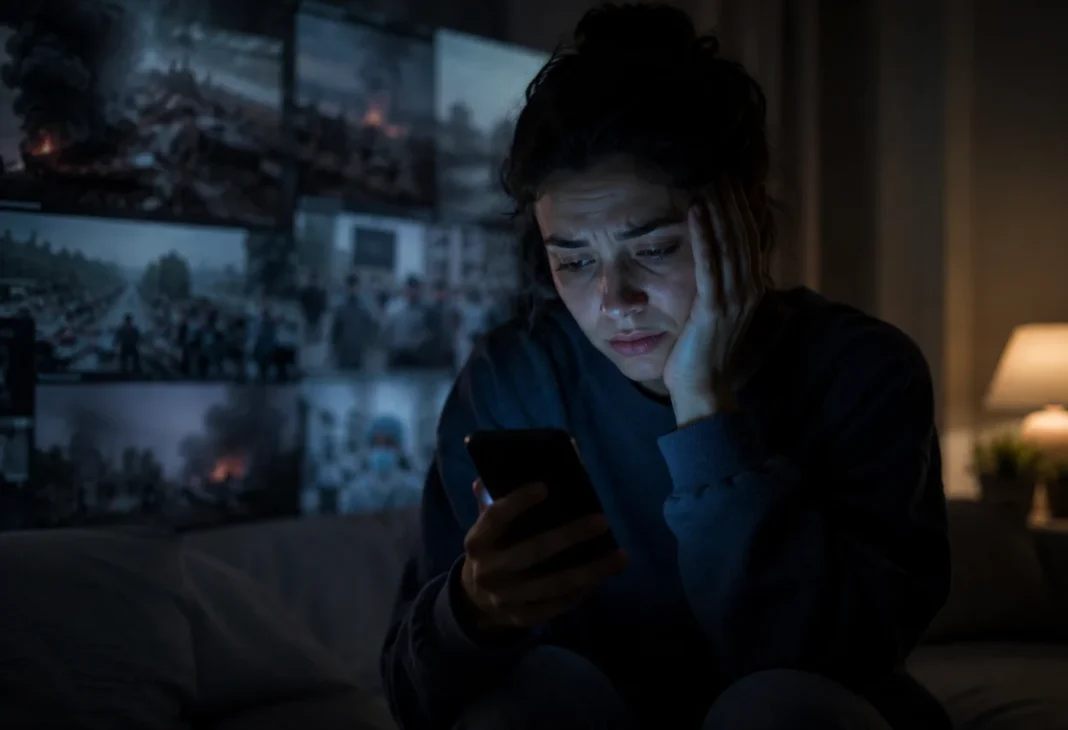
As smartphones and social media have become integral parts of daily life, access to information has never been easier. However, this convenience also brings certain psychological risks. In recent years, particularly amid global events such as the COVID-19 pandemic, wars, natural disasters, and economic uncertainty, the phenomenon known as doomscrolling has become increasingly prevalent. Doomscrolling refers to the tendency to continuously and compulsively consume negative news and distressing information online. Even when individuals recognize that the content is increasing their anxiety, they often continue scrolling through endless streams of alarming updates. While this behavior may appear to satisfy a need for information in the short term, it can have detrimental effects on psychological well-being over time.
Main Discussion
One of the primary mechanisms underlying doomscrolling is the human brain’s natural sensitivity to threats. In psychological literature, this tendency is referred to as the negativity bias, which describes the inclination to notice, process, and remember negative information more strongly than positive information (Rozin & Royzman, 2001). From an evolutionary perspective, this bias may have enhanced survival by helping individuals detect potential dangers. In today’s digital environment, however, constant exposure to negative information can contribute to heightened stress and emotional distress.
During periods of uncertainty, people naturally seek information to better understand their surroundings and anticipate future events. Consequently, following negative news may initially create a sense of control. Research suggests, however, that excessive news consumption often produces the opposite effect. The more negative content individuals consume, the greater their perception of threat becomes, leading to increased levels of anxiety and distress (Bendau et al., 2021).
The structure of social media platforms further reinforces this behavior. Algorithms are designed to maximize user engagement and keep individuals on the platform for extended periods. Emotionally charged content tends to generate more interaction and is therefore prioritized within users’ feeds. As a result, individuals may find themselves trapped in a cycle of consuming increasingly negative information, often without conscious awareness.
Doomscrolling not only contributes to anxiety but can also affect sleep quality and overall mental health. Individuals who consume distressing content late at night may experience difficulty falling asleep, mental fatigue, and elevated stress levels. A study by Soroya and colleagues (2021) found that excessive information seeking through social media can lead to information overload, which in turn increases anxiety and psychological distress. Interestingly, the same relationship was not observed for traditional media sources, highlighting the unique role of social media in facilitating doomscrolling behavior.
The relationship between doomscrolling and anxiety appears to be bidirectional. Individuals who are already prone to anxiety tend to be more sensitive to potential threats and may therefore be more likely to seek out negative news. At the same time, repeated exposure to distressing information can further intensify anxiety symptoms. This creates a self-perpetuating cycle: anxiety drives increased news consumption, while increased news consumption amplifies anxiety.
It is also important to recognize that doomscrolling is not solely motivated by a desire for information. For some individuals, it reflects an attempt to cope with uncertainty and regain a sense of security. The fear of missing important developments can make it difficult to disengage from digital platforms. Yet the human mind is not designed to remain in a constant state of alertness. Continuous exposure to negative news can deplete psychological resources and contribute to feelings of exhaustion and burnout.
Conclusion
Although easy access to information offers many advantages, it is important not to overlook the impact of excessive negative news consumption on mental health. Doomscrolling may appear to be a strategy for staying informed and maintaining a sense of control, but in many cases, it becomes a cycle that increases anxiety and stress.
Establishing boundaries around news consumption, relying on trustworthy information sources, reducing social media use before bedtime, and making space for offline activities throughout the day may help mitigate the negative effects of doomscrolling. In an increasingly digital world, staying informed is valuable, but protecting our psychological well-being is equally important.
Kaynakça
- References
- Bendau, A., Petzold, M. B., Pyrkosch, L., Mascarell Maricic, L., Betzler, F., Rogoll, J., Große, J., Ströhle, A., & Plag, J. (2021). Associations between COVID-19 related media consumption and symptoms of anxiety, depression and COVID-19 related fear in the general population in Germany. European Archives of Psychiatry and Clinical Neuroscience, 271(2), 283–291.
- Rozin, P., & Royzman, E. B. (2001). Negativity bias, negativity dominance, and contagion. Personality and Social Psychology Review, 5(4), 296–320.
- Soroya, S. H., Farooq, A., Mahmood, K., Isoaho, J., & Zara, S. E. (2021). From information seeking to information avoidance: Understanding the health information behavior during a global health crisis. Information Processing & Management, 58(2), 102440.