


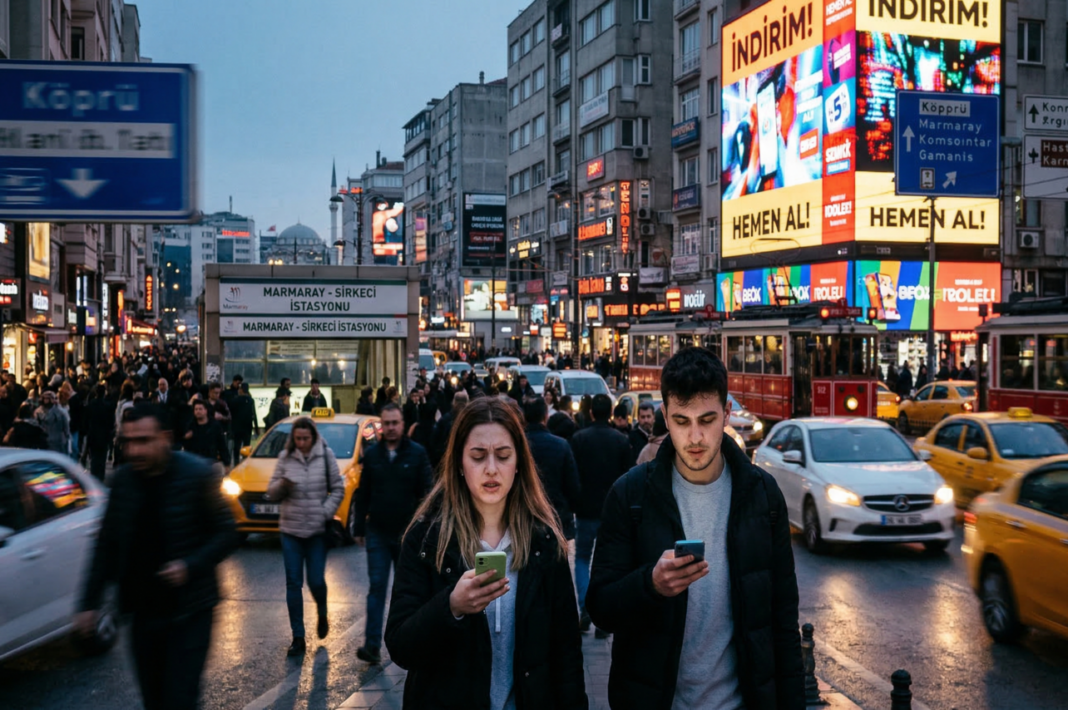

Living in a metropolis has become a challenge that tests us all in various ways. It is not merely a matter of physical exhaustion; rather, urban life is a silent endurance test for the Prefrontal Cortex (PFC). Throughout the day, we are bombarded by stimuli: the incessant blaring of horns, the visual pollution of subway advertisements, the overwhelming crowds of the Marmaray—Istanbul’s transit lifeline—and even the harsh white light of our phones upon waking. This sensory onslaught does more than just fatigue the PFC; it gradually erodes our attention span. But how exactly does this neural siege affect our cognitive health?
Attention Mechanisms and Neural Fatigue
From a neuropsychological perspective, the urban environment ruthlessly exploits what we call “top-down” attention mechanisms. Research highlighted by Marc Berman (2008) proves that these random and intense urban stimuli force the PFC into a constant state of hyper-arousal. (Berman et al., 2008) Our brains expend immense neural energy deciding which stimulus is a vital warning—like a vehicle speeding toward us—and which is irrelevant data, such as a shop window display. This is the fundamental neuropsychological cause of the “brain fog” we feel upon arriving at school or work. The mental exhaustion we experience at the end of the day is not metaphorical; it is the literal overloading of the PFC’s Cognitive Capacity.
The impact of city life extends beyond attention; it reaches into our emotional balance. This fatigue, coupled with the amygdala sensitivity pointed out by Lederbogen and colleagues, explains why the urban environment makes us emotionally “fragile.” Their 2011 study published in Nature demonstrated that urban living has direct effects on the amygdala—the brain’s stress processor—and the Anterior Cingulate Cortex (ACC). (Lederbogen et al., 2011) By weakening the PFC’s calming control over the amygdala, city life leaves individuals more emotionally reactive and intolerant.
Digital Noise and Cognitive Overload
When the external pressure of the city meets the digital noise that is now inseparable from modern life, our cognitive load reaches uncontrollable levels. Research shows how constant exposure to digital stimuli step-by-step weakens the brain’s capacity for deep information processing. (Ward, 2013) Before our PFC can even reach full capacity for the day, the data stream we dive into upon waking traps our minds in a “high-alert” mode. This consumes our cognitive reserves within seconds of our most productive hours.
Consequently, our brains retreat into a “cognitive economy” model, where instead of truly meaning-making and synthesizing information, we focus solely on “where and how to access” it. (Sparrow et al., 2011) This digital tempo, synchronized with metropolitan chaos, bypasses the PFC’s rational control mechanisms. This neural fatigue not only makes us more forgetful but also leaves us more vulnerable and reactive to the stresses of urban life.
Conclusion: Mental Restoration and “Soft Fascination”
Neuropsychology reminds us: our minds did not evolve for concrete blocks and endless digital noise. The way to survive this “neural siege” is, paradoxically, hidden in nature. According to “Attention Restoration Theory,” moving the PFC from “directed attention” mode into the “soft fascination” offered by nature is a biological necessity, not a luxury. (Kaplan, 1995) Walking for even half an hour in a park, sipping tea by the shore to the sound of seagulls and waves, or simply watching the rhythmic complexity of leaves while escaping the Marmaray crowds provides our fatigued PFC with the Cognitive Resilience it needs.
Protecting our cognitive health is not just about working harder; it is about managing this neural fatigue. While the gray labyrinth of the city constantly alters our balance, creating “green spaces” for our PFC to breathe is still within our hands. Because when our executive functions tire, we lose more than just our attention; we lose our empathy, our patience, and our creativity to the skyline.
REFERENCES
-
Berman, M. G., Jonides, J., & Kaplan, S. (2008). The cognitive benefits of interacting with nature. Psychological Science, 19(12), 1207-1212.
-
Kaplan, S. (1995). The restorative benefits of nature: Toward an integrative framework. Journal of Environmental Psychology, 15(3), 169-182.
-
Lederbogen, F., et al. (2011). City living and urban upbringing affect neural social stress processing in humans. Nature, 474(7352), 498-501.
-
Sparrow, B., et al. (2011). Google effects on memory: Cognitive consequences of having information at our fingertips. Science, 333(6043), 776-778.
-
Ward, A. F. (2013). One with the cloud: Why people mistake the internet’s knowledge for their own. Scientific American.