


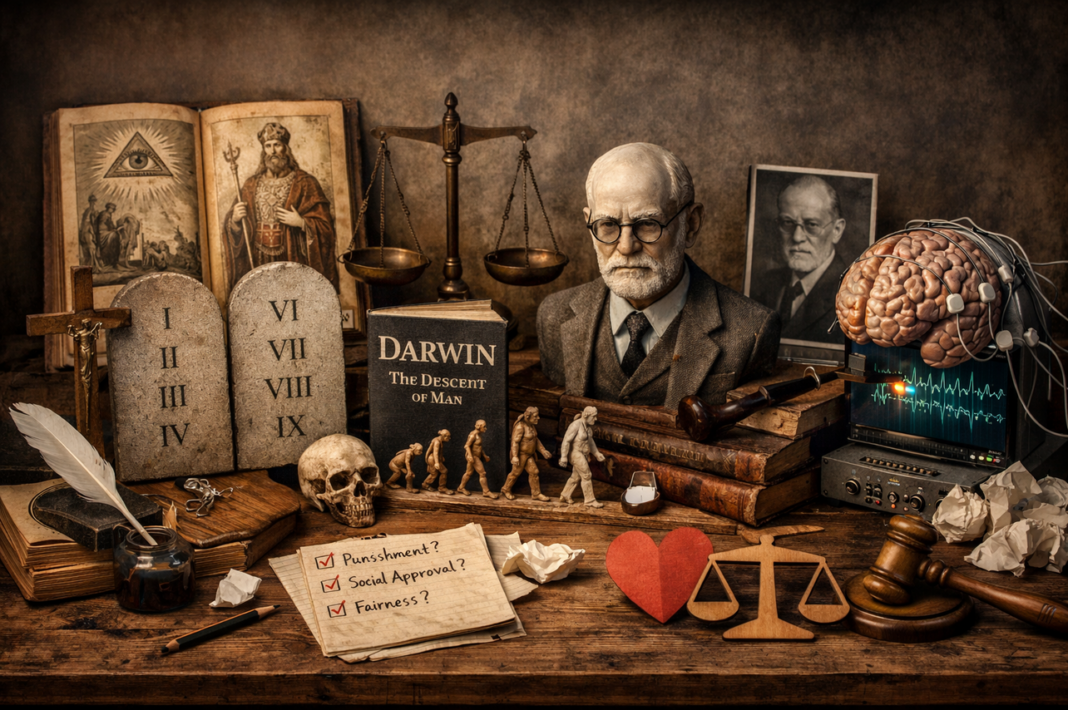

Let’s take a moment and travel back in time. Imagine you are living in the Middle Ages and you have just “borrowed” your neighbor’s chicken. A sense of unease creeps in—a tightness in your chest. Where does this feeling come from? Most likely, your answer would be simple: “God saw it.” Or, in a slightly more secular version: “Something bad is going to happen to me.”
For a long time, morality worked exactly like this. Right and wrong were not matters debated within the individual mind; they were rules announced from the outside. They came from tablets, sacred texts, royal decrees. Morality was less about psychology and more about a cosmic order.
Then a major shift occurred. About 150 years ago, people began asking an unsettling question:
“But what if this feeling of guilt doesn’t come from God—what if it comes from me?”
That was the moment morality entered the playground of psychology.
Darwin And The Evolutionary Story Of Conscience
The first major turning point in this story came with Charles Darwin. In The Descent of Man, Darwin essentially argued that conscience is not only morally meaningful—it is biologically sensible.
According to him, morality was not a law that fell from the sky, but a survival program continuously updated by natural selection.
Imagine one tribe in which everyone is selfish, no one shares, and people abandon one another in times of danger. Now imagine another tribe where individuals cooperate, punish cheaters, and protect the group. For Darwin, the second group was not “moral” because its members were better people, but because morality allowed them to survive longer.
At this point, morality ceased to be sacred and became functional. Conscience was no longer the voice of the soul, but an effective evolutionary strategy. In this sense, moral psychology begins with adaptation rather than revelation.
Freud And Inner Conflict
By the early twentieth century, Freud entered the scene and began to probe morality more deeply. For him, evolution was not the whole story—childhood mattered just as much.
Freud’s genius lay in relocating morality from external authority to the inner world of the mind. What he called the superego was essentially the internalized voice of parents and society. Even without a scolding teacher or a threatening god hovering above us, there was now someone inside constantly whispering:
“You shouldn’t have done that.”
“That was inappropriate.”
“Will you really be able to sleep tonight?”
With Freud, guilt stopped being a divine punishment and became a psychological inner debate. Morality no longer descended from the heavens—it came from the family home. The superego became the new moral authority.
The Cognitive Revolution: Is Morality Learned?
By the 1950s, things became even more interesting. Psychologists began to realize that people are not born moral—they become moral.
Lawrence Kohlberg proposed that moral reasoning develops in stages. First:
“Will I be punished?”
Then:
“What will others think?”
And finally:
“Is this fair? Does it respect human dignity?”
This perspective treated morality less as a matter of character and more as a mental capacity. Someone who behaves immorally may not be evil, but simply has not completed the stages of moral reasoning. Here, morality becomes a developmental achievement rather than a fixed trait.
Modern Moral Psychology: We Feel First, Then We Explain
Modern moral psychology approached moral behavior from a completely different angle. While earlier theories emphasized intelligence and reasoning, contemporary researchers began asking: “Who ever said we were that rational?”
According to Jonathan Haidt, when we make moral judgments, we feel first and think later. We say “ugh” before we can explain why we said it. Reason, more often than not, acts not as a judge but as a skilled defense attorney.
Brain imaging studies support this view. When we witness an injustice, emotional regions of the brain activate almost immediately, while areas associated with reasoning lag behind.
In short, we feel first—and then we generate justifications. From this perspective, conscience is not purely rational deliberation but a rapid emotional response followed by narrative construction.
So, Has This Made Us Less Moral?
Quite the opposite. Viewing morality through a psychological lens has made us more understanding. Instead of labeling someone a “bad person,” we now ask: “Why does this person feel and think this way?” We talk about rehabilitation alongside punishment, empathy alongside judgment.
Of course, the philosophical question remains open: if morality is rooted in our feelings, does an absolute moral truth still exist? Psychology does not answer this question—but it does show us how morality works.
And perhaps that is where genuine morality begins: not in memorizing rules, but in recognizing how easily our inner compass can falter.