



Introduction: On Conscience in the Wake of a Novel
Literature is one of the most powerful ways to understand the human inner world. Some novels do more than tell a story; they lead individuals to question their conscience, their sense of justice, and their relationship with society. Go Set a Watchman, in this respect, is not merely a story of childhood but also a narrative of the development of conscience.
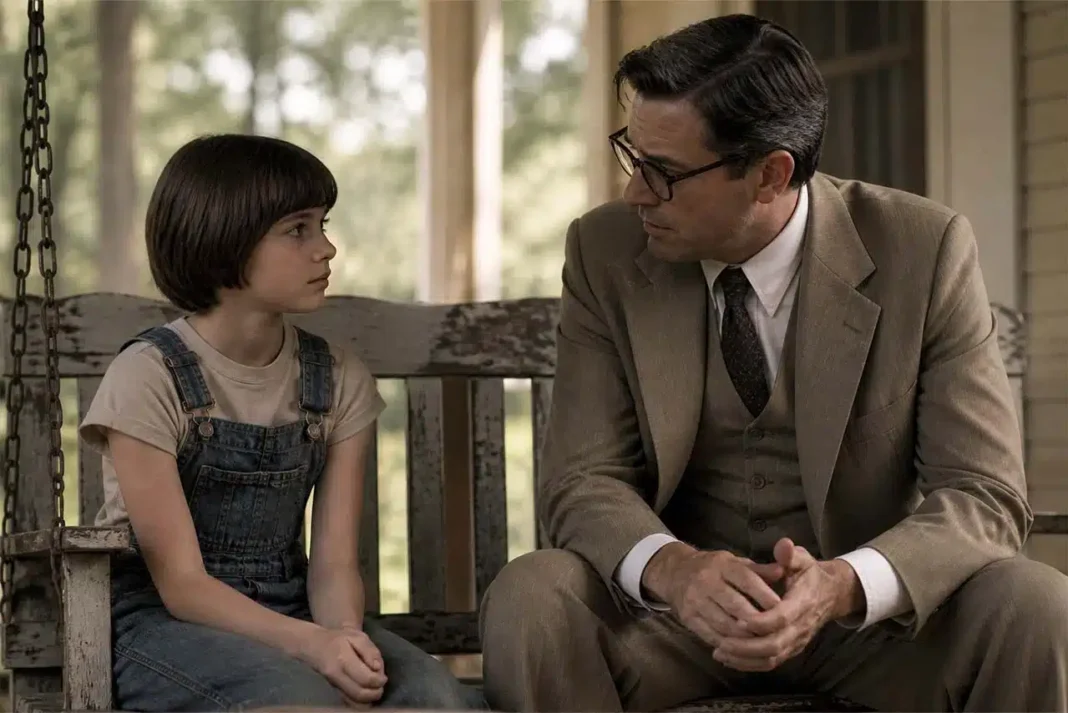
This work can also be considered, in a sense, a continuation of the author’s earlier novel To Kill a Mockingbird; it deepens Scout’s intellectual and emotional transformation from childhood to young adulthood through a different period of her life. Especially in the final chapter of the novel, the conversation between Scout and her uncle represents a turning point—a moment when a child experiences the concepts of justice, responsibility, and conscience for the first time in a profound way.
In this article, drawing on that dialogue, I will explore the process of taking responsibility for one’s own conscience and the psychological cost of growing up.
The Collapse of Idealization: The First Fracture of Growing Up
Growing up often begins not with gaining new knowledge, but with the shaking of our old beliefs. When the people, values, and truths we once trusted begin to crack in unexpected ways, a quiet yet deep fracture occurs within us.
In the final chapter of Go Set a Watchman, the conversation between Scout and her uncle reflects the psychological imprint of precisely such a moment. This scene is not merely a family disagreement; it is a symbolic portrayal of the individual being left alone with their own conscience.
Scout’s disappointment is, in fact, the most painful threshold of entering adulthood: realizing that role models can also be flawed.
The Collapse of Childhood Ideals: Confronting a Trusted Figure
Since childhood, Scout has seen her father as the embodiment of justice, honesty, and conscience. For her, Atticus is not only a father but also a moral compass. However, toward the end of the novel, when Scout hears some of her father’s views, she experiences a deep internal conflict.
In psychology, this conflict is defined as the breakdown of idealization. Scout’s inner reaction is strikingly clear:
“Is that really you saying this, Father?”
This question expresses not only surprise but also a disturbance in identity. In childhood, parents are often perceived as the representatives of absolute truth. When this perception collapses, the individual experiences a crisis not so much in the external world as within their own inner world.
The Construction f Conscience: From External Voices to an Inner Voice
The conversation between Scout and her uncle is a symbolic example of the transition from external authority to internal guidance. At first, Scout expects others to tell her what is right. Yet as the conversation unfolds, she begins to realize that the answer lies not outside, but within herself.
In psychology, this process is called internalization. In other words, individuals gradually transform the values they learn from others into a part of their own identity.
The most lasting legacy her uncle leaves Scout is not a ready-made answer, but a way of thinking. One sentence he shares with her captures the essence of this process:
“One day, everyone must become the guardian of their own conscience.”
This statement emphasizes the necessity of forming a moral identity independent of external authorities. During childhood, right and wrong are mostly determined through parental guidance. In adulthood, however, individuals must internalize that guidance.
Psychologically, this process is known as moral autonomy—choosing what is right not simply because an authority says so, but because it aligns with one’s own values.
And perhaps the strongest psychological message of this dialogue is this:
Conscience is not something we are given; it is a capacity we build over time.
Caught Between Loyalty and Justice: The Psychology of Inner Conflict
One of the deepest psychological tensions Scout experiences is being torn between her loyalty to her family and her own sense of justice. This situation represents a form of inner conflict frequently observed in developmental psychology.
On one side stands the father she loves and respects.
On the other stand the values she believes to be right.
The uneasiness Scout feels during her conversation with her uncle is, in fact, a test of loyalty. In childhood, loyalty is often unconditional. As we grow older, however, loyalty becomes a concept that can be questioned.
At this point, her uncle opens an important psychological space for her:
Loving someone does not mean you must agree with every idea they hold.
Redefining The Father Figure: Flawed Yet Human
The greatest transformation Scout experiences is not rejecting her father entirely, but beginning to accept him with his imperfections. This is a significant indicator of emotional maturity.
True adulthood begins when we stop idealizing our parents and start seeing them as human beings.
Scout’s inner process reveals itself in the following question:
“Can I still love him, even if I do not agree with him?”
This question forms the foundation of psychological flexibility in relationships. People do not have to think the same way as those they love. A healthy bond is measured not by agreement, but by the ability to sustain emotional connection despite differences.
The Responsibility of Conscience: The True Cost of Growing Up
The most important message Scout receives from her uncle is that freedom also brings responsibility. Becoming the guardian of your own conscience carries the risk of standing alone. At times, individuals may have to stand against the majority—even against their own families.
In psychology, this situation is described as a value conflict. On one hand, individuals feel the need to belong; on the other, they want to protect their own truths. This tension is an inevitable part of growing up.
The pain Scout experiences reflects a simple truth:
Growing up means learning to distinguish your own truths from those of others.
Being Alone With Conscience: The Quiet Loneliness of Growing Up
The conversation between Scout and her uncle initiates not only an external discussion, but also an irreversible realization within her inner world. As people grow, they do not notice that answers to their questions disappear; rather, they realize that the answers begin to carry weight within themselves.
There is no longer a single voice declaring what is right; instead, there is a consciousness that must choose among many voices. What Scout experiences is exactly this: a transition from following a path pointed out by a guide to becoming a conscience that must determine its own direction.
The most difficult part of this transition is loneliness. Because individuals who begin to build their own conscience must sometimes risk living without the approval of others.
As the quiet words her uncle leaves behind echo in Scout’s mind, they teach her an important truth: Not everyone will understand you, but you cannot escape confronting yourself.
That is why growing up is not only a process of maturation; it is also the burden of carrying an inner responsibility.
Conclusion
Scout’s story reminds us of this: People grow the most when they are left alone with their own conscience. And perhaps the most painful cost of growing up is precisely this:
No one makes decisions for you anymore; you become the guardian of your own conscience.