


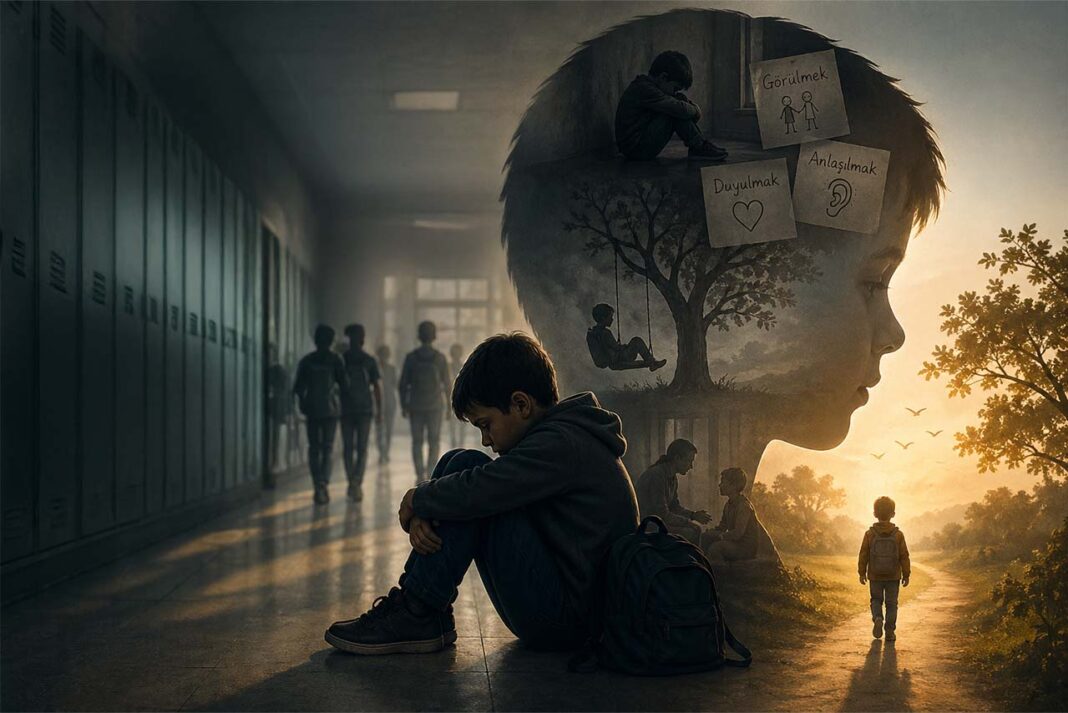

When we walk through a school corridor, we are often met with a familiar scene: students rushing by, overlapping sounds, and an ordinary flow of daily school life. Yet within this visible movement, there is another reality that often goes unnoticed: children who remain unseen, unheard, or emotionally on the margins. This invisibility does not emerge from a single setting, but from the intersection of multiple relational and developmental contexts in a child’s life.
In recent years, certain events occurring within school environments and their strong impact on public awareness have once again raised fundamental questions about childhood development. At first glance, these events may appear sudden and unexpected; however, they are often the result of complex developmental processes that cannot be reduced to a single cause. For this reason, focusing solely on behavior or outcome risks overlooking the emotional and environmental dynamics that shape them.
A child’s behavior is too complex to be reduced to a single moment and too multilayered to be explained by a single cause. This complexity requires us to consider both individual developmental processes and the broader social environment in which the child exists. Childhood experiences are shaped through the interaction of family, school, and peer relationships; therefore, no behavior can be meaningfully understood in isolation.
The Formation of the Inner World
From a developmental perspective, childhood is one of the most sensitive stages in which self-concept begins to take shape. Experiences during this period are not merely remembered events; over time, they become internalized emotional schemas that structure how the individual relates to themselves and others. The school environment is one of the key spaces where these schemas are formed, as it exposes children to experiences of acceptance, exclusion, understanding, or misunderstanding.
The experiences accumulated in a child’s life are often not directly observable. Small but repeated experiences such as not being acknowledged, having emotions dismissed, or consistently remaining in the background may appear insignificant on their own. However, over time, these repetitions form a deeper emotional structure. This structure shapes not only behavior but also the child’s core beliefs about themselves.
Behavior as a Language
Children are not always able to express what they experience directly. Due to developmental limitations, emotions are often communicated through behavior rather than verbal expression. Silence, withdrawal, intense reactions, or excessive compliance should therefore not be interpreted in isolation. Each of these may represent an attempt to give meaning to an internal emotional experience.
At this point, an important question arises: “Why is the child behaving this way?” While this question is a starting point, it often remains on the surface. A deeper and more explanatory question is: “What experiences has this child gone through that led to this behavior?” This perspective shifts the focus from individual reaction to developmental process, allowing for a more holistic understanding.
From Reaction to Understanding
Asking this question does not only represent a cognitive shift but also a transformation in perspective. The aim is no longer to suppress behavior, but to understand the conditions that give rise to it. In this sense, behavior is not the problem itself, but the visible outcome of a longer and more complex relational process.
School is one of the environments where this process unfolds; however, it is not the sole determining factor. Family dynamics, peer relationships, and broader environmental influences are also integral parts of this system. Therefore, understanding child behavior requires considering the entire network of interactions rather than focusing on a single context.
The Invisible Impact of Being Unseen
When a child repeatedly experiences themselves as unseen, unheard, or misunderstood, this perception may gradually shape their self-concept. This transformation often occurs silently. Although it may not be easily visible from the outside, it deeply influences how the child relates to themselves and the world around them.
The dismissal or minimization of emotional experiences may also strengthen a child’s tendency to withdraw inward. Over time, the individual may learn that expressing emotions does not lead to a response. This learning process is not limited to childhood; it may extend into later stages of life.
Sometimes, this extension appears in adulthood as well. A person may appear externally functional while carrying an unexplainable sense of inner emptiness. Such experiences are often not the result of a single event, but rather the cumulative effect of many small and repeated relational moments that went unnoticed.
Seeing Before Hearing
Ultimately, child behavior is not the result of a single cause but the convergence of multiple visible and invisible interactions. Therefore, the most fundamental question is this: Are we truly seeing, or are we merely looking? And to what extent are we able to interpret what we see in a holistic way?
Because most often, meaningful change does not begin with major interventions, but with small and timely moments of recognition.
And every child, in their silence, is already saying something. Sometimes not through words, not even through behavior—but simply through their presence.
Understanding them often requires not only hearing, but first, truly seeing.
And some children do not speak. But the traces they leave behind say everything.