


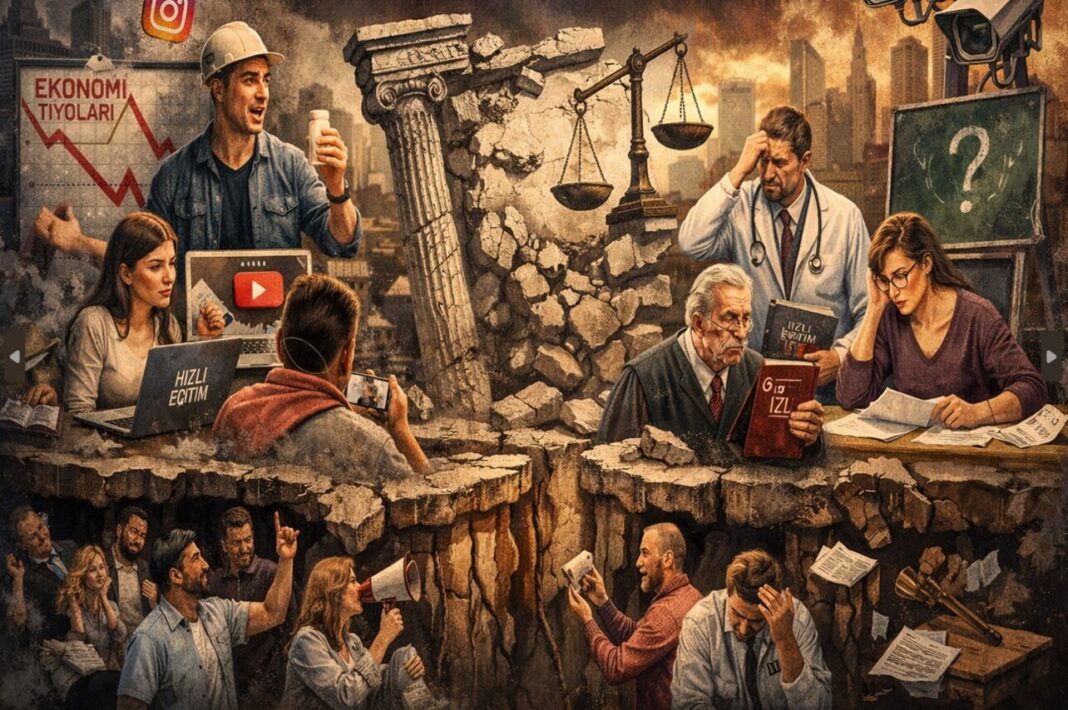

One of the most invisible yet most destructive problems of modern societies is individuals not doing their own work and meddling outside their areas of expertise. This phenomenon is not just an individual behavioral pattern; it is a crisis that permeates the entire social fabric. In the age of social media, everyone expresses opinions on every subject, devaluing the concept of expertise and eroding the meritocracy system. In this article, the phenomenon of “not doing one’s own job” will be examined from an academic perspective; its sociological, cultural, and epistemological dimensions will be discussed.
Devaluation Of Expertise and Merit Crisis
Expertise is a fundamental principle in how modern societies function. As emphasized in Max Weber’s theory of bureaucracy, rational-legal authority is built on expertise and merit. However, today this principle is gradually wearing away. Not doing one’s own work essentially dismisses someone else’s labor and expertise. This attitude demolishes the concept of merit and erodes trust in society.
-
In the field of health: For years of e-learning, superficial information obtained from internet searches is preferred over the training of doctors. For example: the mentality that ignores a doctor’s years of training with a Google search.
-
In the field of education: Teachers’ pedagogical accumulation is being attempted to be replaced with a few online videos. Or the university department studied is not about teaching, leading to the teaching by non-qualified individuals. For example: A person studying civil engineering working as a paid teacher in rural or urban schools. It clearly states the meritlessness in the Provincial Directorates of National Education in cities and the influence peddling (TORPİL) openly.
-
In the field of law: Amateur and false comments circulating in forums replacing professional lawyers.
These situations lead to the demoralization of expertise and the undermining of social trust. The merit crisis affects not only individual errors but also the functioning of institutions.
Social Media and The Culture Of Being The Expert Of Everything
Social media has allowed everyone to speak on any topic. There are millions who are turned into “experts” in economics, health, politics, philosophy, and more. This illusion increases information pollution and paralyzes collective intelligence. Social media has democratized access to information; however, this democratization has blurred the boundaries between information and opinion. In a way that can be explained by Pierre Bourdieu’s concept of “symbolic capital,” visibility and follower counts on social media have displaced expertise.
-
Engineers commenting on economics.
-
Influencers giving health advice.
-
Students who express opinions on law.
This culture is increasing information pollution and causing an epistemological chaos. In society, the correct distinction between true information and false information is becoming impossible, leading to wrong guidance and social conflict.
Sociological Consequences Of Not Doing One’s Own Job
“Not doing one’s own job” is not only an individual choice but a form of societal decay.
-
Misdirected guidance: Individuals who act on the words of unqualified experts make faulty decisions.
-
Loss of social trust: Respect for experts decreases, trust in institutions is shaken, and the rate of unmeritocracy increases.
-
Arguments culture: Everyone, knowing or not knowing, having a say on every topic, instead of deepening discussions, superficializes them.
These results cripple the rational functioning of society and weaken collective intelligence.
Respect For Expertise and Digital Literacy
Two fundamental solutions to curb societal decay emerge:
1. Rebuilding the Culture of Respect for Expertise
-
Strengthening the principle of merit at the institutional level and taking measures against the favoritism “torpil” within organizations.
-
Raising social awareness against the discrediting of experts.
2. Enhancing Digital Literacy
-
Teaching the difference between information and opinion.
-
Critical filtering of content circulating on social media.
These two steps are essential for modern societies to regain trust.
Institutional Merit and Epistemic Authority
The phenomenon of “not doing one’s own job” may appear at first glance as an individual behavior, but it actually represents a structural pathology of modern societies. This behavior stems not from the individual’s self-confidence but from a weakening of social responsibility consciousness. The tendency to express opinions outside one’s area of expertise, to interfere in others’ work, and to violate the boundaries of competence leads to the disruption of the information ecology, the erosion of epistemic authority, and the erosion of institutional trust. In this context, the illusion that “everyone knows everything” is one of the most dangerous epistemological crises of the digital age.
The democratization of access to information does not eliminate the responsibility for information production. On the contrary, the obligation of evaluating information in the correct context and relating it to expertise increases for the individual who has access to information. However, today this obligation is neglected; visibility on social media platforms replaces expertise. Pierre Bourdieu’s concept of “symbolic capital” plays a critical role here: the number of followers, algorithmic interaction, and digital popularity override the authority of knowledge.
Conclusion
This situation threatens not only individuals but also the functioning of institutions. The weakening of the principle of merit undermines efficiency in public services and leads to a crisis of trust in fundamental areas such as education, health, and law. As Michel Foucault stated in the context of the knowledge-power relationship, the production and distribution of knowledge are directly linked to power relations. Therefore, delegitimizing expertise harms not only information but also power structures.
Real progress is possible through individuals deepening in their own areas of expertise. For society to function healthily, everyone doing their own job is not only an ethical responsibility but also an epistemological necessity. Respect for expertise, digital literacy, and the principles of institutional merit must be reestablished, otherwise modern societies will not escape this quiet rot.