


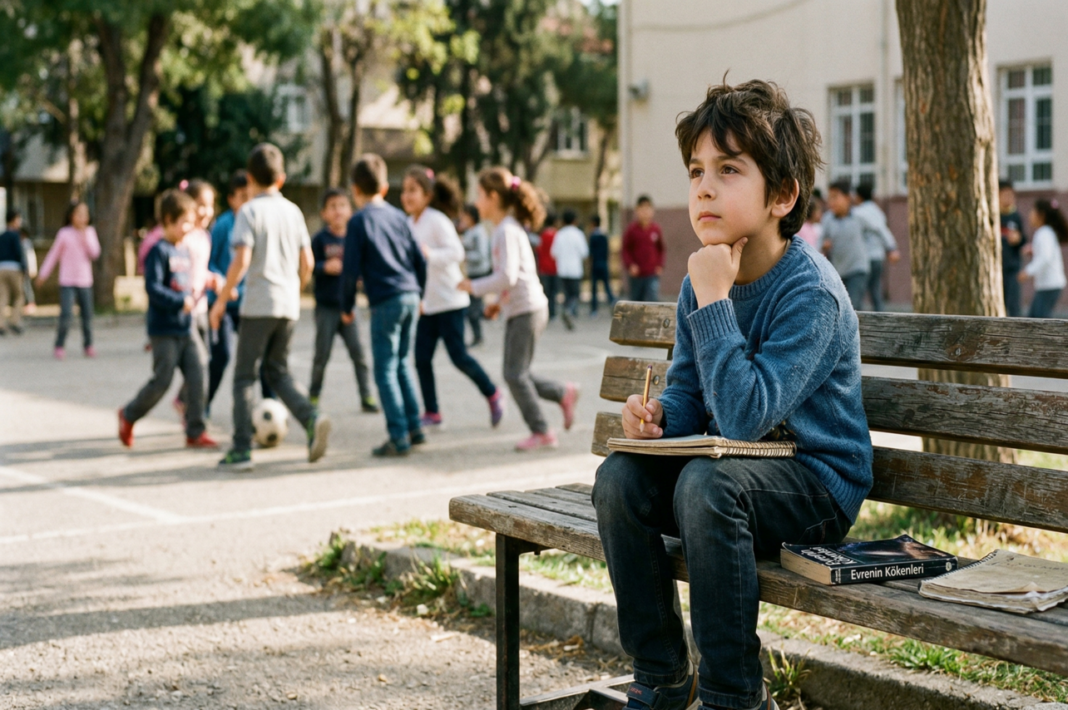

Imagine a child. Only eight years old, yet asking questions that even adults struggle to answer. Wondering why the universe exists, reflecting on the concept of death, and questioning whether justice truly exists. Yet the same child sometimes prefers to sit alone in the schoolyard.
The world of gifted children often unfolds between these two realities. On the one hand, there is advanced cognitive capacity; on the other, an emotional and social structure that is still developing. In psychological literature, this situation is referred to as asynchronous development. In other words, different domains of development do not progress at the same pace.
The Cognitive and Emotional Imbalance
The intellectual development of gifted children often progresses well beyond their chronological age. These children can solve complex problems, develop abstract thinking skills at an early age, and interpret the world around them with a depth that differs from their peers. However, emotional and social development does not always advance at the same rate. This situation can create a form of developmental imbalance between cognitive capacity and emotional experience.
For example, a nine-year-old child may ask philosophical questions, yet at the same time be highly sensitive to rejection in peer relationships. For this reason, gifted children may sometimes feel as if they live in two different worlds: intellectually ahead, yet emotionally still within the experiences of childhood.
Social Challenges and Peer Relationships
Research indicates that gifted children may occasionally experience loneliness in peer relationships. This is often because their interests and ways of thinking differ from those of their peers (Gross, 2004). Many gifted children may feel that they are not fully understood within their own age group.
The Intensity Of Emotional Overexcitability
This difference is not limited to the cognitive domain. The emotional experiences of gifted children can also be quite intense. According to the theory proposed by the Polish psychiatrist Kazimierz Dabrowski, gifted individuals may demonstrate higher levels of emotional overexcitability. This may cause emotional responses to events to be experienced more strongly and deeply.
For this reason, gifted children often develop a strong sense of empathy. When they witness the suffering of an animal or encounter injustice, they may feel it very deeply. Their early reflections on environmental issues, wars, or humanity can also be part of this emotional sensitivity.
Misunderstood Sensitivity In Development
However, this intensity may sometimes be misunderstood by their surroundings. The child may be described as “overly sensitive” or “overthinking.” Yet, in many cases, this characteristic is part of the developmental profile of gifted individuals.
Educational systems often focus primarily on the academic performance of gifted children. They are expected to learn faster or solve more complex problems. However, this approach frequently overlooks the emotional and social needs of gifted children.
The Need For Holistic Understanding
A gifted child is not simply a student with a high IQ score. They are also individuals who perceive the world with greater intensity and depth. For this reason, emotional support is just as important as academic support in their developmental processes.
Understanding the development of gifted children requires moving beyond viewing them merely as “successful students.” In their world, curiosity, intense emotions, existential questions, and sometimes loneliness can coexist.
Perhaps that is why the greatest need of gifted children is not more information, but more understanding.
References
-
Dabrowski, K. (1972). Psychoneurosis is not an illness: Neuroses and psychoneuroses from the perspective of positive disintegration. London: Gryf.
-
Gross, M. U. M. (2004). Exceptionally gifted children (2nd ed.). Routledge.
-
Neihart, M., Reis, S., Robinson, N., & Moon, S. (2016). The social and emotional development of gifted children: What do we know? Prufrock Press.
-
Silverman, L. K. (2013). Giftedness 101. Springer Publishing Company.
-
Winner, E. (1996). Gifted children: Myths and realities. Basic Books.