
Supportive Learning Environments: A Brief Overview From A Neuroarchitectural and Pedagogical Perspective

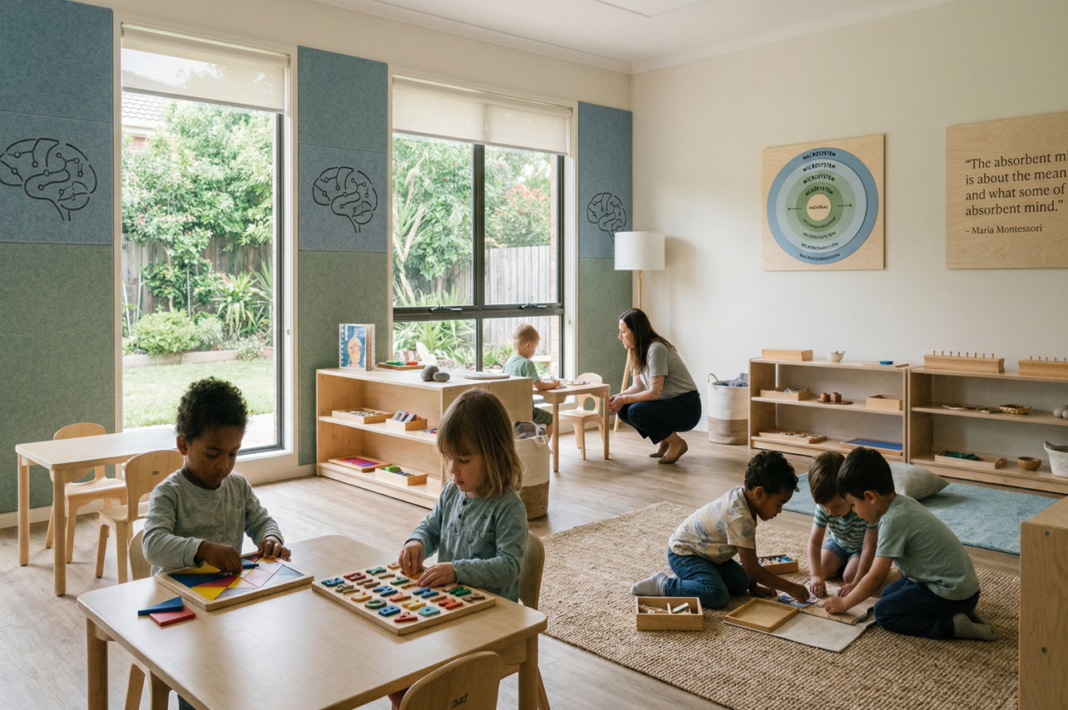
The early years of every individual’s life represent an extremely critical period during which cognitive, emotional, and behavioral structures are shaped for the later stages of life. This brief span of time represents not merely a chronological phase, but the most dynamic stage of mental and physical development—an essential period of foundational construction.
One of the historical figures who first recognized the importance of this formative process on a scientific basis was the physician and educator Maria Montessori. In her work, we observe a fundamental assertion: the early years of life constitute a decisive threshold for the formation of an individual’s personality, self-confidence, and character.
The Concept Of The Absorbent Mind
Montessori’s observations regarding the functioning of the child’s mind have also received significant recognition within contemporary neuroscience circles. Her discoveries reveal that mental development in early childhood consists of two principal phases: the Unconscious Absorbent Mind and the Conscious Absorbent Mind. According to this theoretical framework, the child absorbs all stimuli from the environment in which development takes place, much like a “sponge,” incorporating them into the structure of the mind. Montessori further emphasized that during this period the capacity for learning internalizes environmental stimuli directly, thereby attributing strategic importance to the physical habitat.
At this point, it becomes evident how vital it is to design the most appropriate spatial parameters for children. The profound interaction that a child establishes with the surrounding environment demonstrates that spatial design is not merely an aesthetic preference but rather a form of developmental engineering.
Constructing The Physical Climate Of Cognitive Development
From Maria Montessori’s pioneering approaches to today’s interdisciplinary research findings, a compelling truth emerges: the design of the physical classroom environment plays a crucial role in the formation of cognitive processes and attention mechanisms during early childhood. To illustrate this process more concretely, one might consider the journey of a sapling in the soil. Just as sunlight, water, and soil quality are essential for a sapling to grow, love, security, and quality education are equally indispensable for a child’s healthy development. Yet it must be remembered that even the most fertile seed cannot reach its full potential in an unsuitable climate.
“When the child begins to move, his absorbent mind has already taken in the environment. Before he starts to move, an unconscious psychic development has already taken place. As he starts to move, he begins to become conscious. If you watch a small child of three, he is always playing with something. That means he is elaborating with his hands, putting into his consciousness, what his unconscious mind had taken in before. It is by this experience in the environment in the guise of playing that he goes over the things and the impressions that he has taken into his unconscious mind. It is by means of work that he becomes conscious and constructs Man. He is directed by a marvellously grand mysterious power which little by little he incarnates and thus he becomes a Man. He becomes a man by means of his hands, by means of his experience, first through play, then through work.” — Maria Montessori, The Absorbent Mind, 1949, p. 37.
The views presented below have been reinterpreted from a contemporary learning-environment perspective, drawing inspiration from the works of Montessori and Bronfenbrenner, as well as the study ‘Early Childhood Classroom Design: Integrating Montessori Principles with Neuroeducational Research’ conducted by Foster (Johns Hopkins University).
The Bioecological Model Of Human Development
One of the key theoretical approaches developed in the last quarter of the twentieth century to understand the developmental process is Urie Bronfenbrenner’s bioecological model of human development. This theory posits that a child’s development results from a multilayered and dynamic network, extending from the microsystems—immediate interaction settings such as family and school—to the macrosystems, which encompass the cultural codes and societal norms of the broader society.
Bronfenbrenner’s framework moves beyond a unidimensional view of development, positioning the child as the central figure at the intersection of interrelated biopsychosocial systems.
A closer look at this model reveals:
-
Microsystem: The primary environmental layer where developmental experiences occur most intensively, including the child’s direct interactions with family, school, and peers.
-
Macrosystem: The overarching environmental context encompassing societal values, belief systems, and social norms.
This explanatory framework, along with a wealth of subsequent research, demonstrates that a child’s development is influenced not only by social relationships but also closely shaped by the physical environment in which the child exists.
How Is A Child’s Development Shaped By Its Environmental Ecosystem?
The Determining Role Of The Physical Environment In Child Development
When child development is examined from a holistic perspective, an increasing body of scientific research indicates that Attention Deficit Hyperactivity Disorder (ADHD) has become one of the most frequently diagnosed conditions among young children. Moreover, studies demonstrate that the physical design of early childhood classrooms has a critical impact on children’s attention, cognitive functions, and learning processes. This finding necessitates that the design of educational environments considers not only children with normative development but also those exhibiting diverse developmental trajectories.
In this context, teachers carry significant responsibilities. However, current research shows that various constraining factors often cause classroom environments to become limiting rather than supportive of children’s development. There are multiple reasons for this; foremost among them is the need to approach each child as a unique individual, valuing their distinctiveness. Every child has a different learning capacity and perceptual level, and therefore educational environments must be designed to accommodate these differences.
Student well-being should be a fundamental criterion in the design of physical spaces, and the design should revolve around this principle. Factors such as lighting, acoustics, spatial arrangement, ambient temperature, and the comfort of materials used are critically important in ensuring this well-being. In classrooms with young children, visual stimuli—such as posters, pictures, or previous students’ work—should not overcrowd the environment, and the classroom should generally be kept simple and uncluttered. Additionally, tactile toys and educational materials should be provided for active use by students; items used solely for decorative or figurative purposes can negatively affect both classroom organization and the learning process.
There are numerous critical factors to consider in the design of physical learning environments, all of which must be met to the highest standards. To enhance the quality of education and build a healthy future, priority should be given to the following considerations:
In this context, space is not merely a physical area for play; rather, it is a living and active component of the learning process that directly shapes a child’s sensory, emotional, and cognitive world.
Future Perspectives In Neuroarchitectural Design
Teachers should design classroom environments in accordance with the principle that every child is unique and special. Classroom organization should not be dictated by social media trends or traditional conventions; rather, learning environments must be structured to support the developmental needs of children.
As engineers, we can reimagine the design of learning environments in line with neuroarchitectural principles, guided by evidence-based strategies and data-driven analyses. Elements such as lighting, acoustics, spatial arrangement, and tactile features can each be planned to optimize students’ attention, motivation, and learning performance.
One of the most valuable steps we can take for our future is to move beyond treating children’s spatial experiences as mere subjective observations, and instead make them analyzable through interdisciplinary data. This new perspective—at the intersection of engineering, architectural design, and neuroscience—transforms learning environments from mere physical structures into optimized systems that actively support cognitive development.
Ultimately, when we recognize the child not as a passive figure influenced solely by the environment but as a dynamic agent in continuous dialogue with the systems around them, the responsibility of design transcends mere aesthetics. Within this ecological cycle, extending from the microsystem to the macrosystem, every spatial intervention optimized through scientific evidence contributes not only to today’s learning environments but also to the construction of tomorrow’s cognitive architecture.