


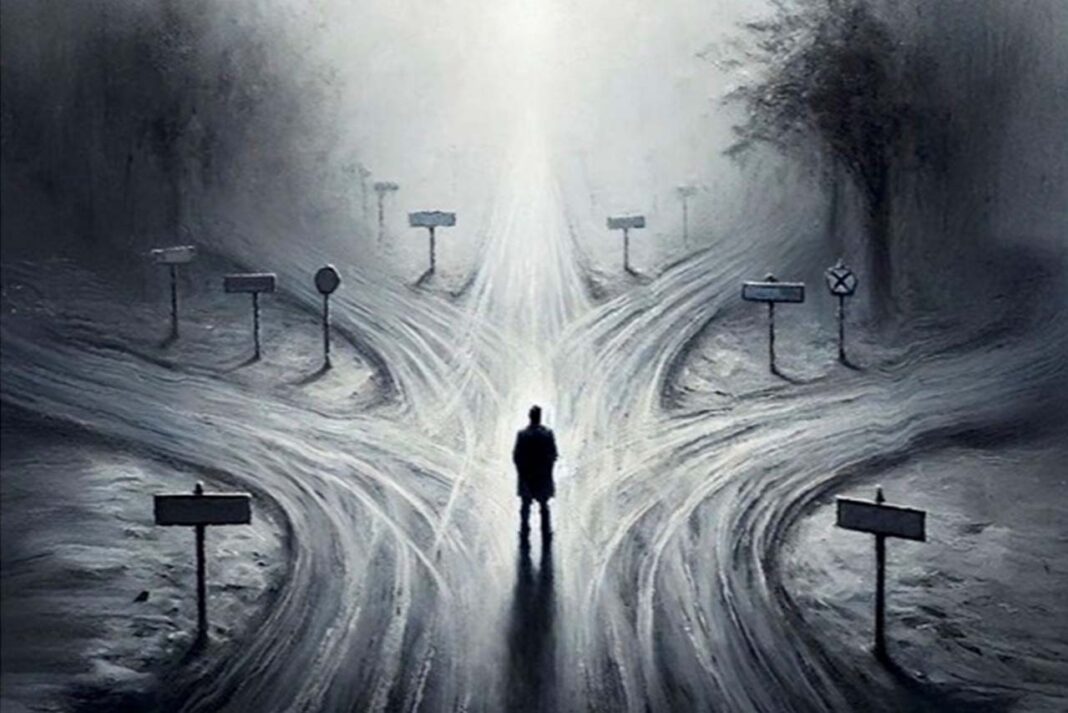

While living, life constantly confronts us with a fork in the road, often without us even realizing it. Choosing one adds a new one; this situation thus branches out and multiplies. These crossroads we choose act as “extras” shaping our current lives. When we start doing something without realizing it, we have actually chosen a direction. We are inside a simulation; a simulation of the life we will build in the future…
In other words, every step we take, every preference we have, shapes us and brings us to today. It is impossible to think of today independent of yesterday; however, the importance of the now, of this very moment, is inevitable when building our tomorrow. Yet, precisely at this point, there is an important issue we must pay attention to: responsibility. Life should not consist solely of making choices. If we can choose a path, we have chosen it along with all its roughness. With everything it brings to us and takes away from us; that is, every decision is also a responsibility.
Actually, being aware of this responsibility allows us to take the ropes of life into our own hands, just as it enables us to embrace the grief of what our choices have taken away from us. Being able to embrace those rough patches is another way of showing that our choices belong only to us. Regardless of the consequences, we become free when we do not ignore the reality that we are the ones responsible for our own decisions.
What we describe here as becoming free is not a feeling of relief as is assumed; on the contrary, it brings with it a deep-rooted anxiety that we must embrace. Because there are no longer external factors to blame. There is no excuse to hide behind. We are left entirely alone with reality itself, in its starkest form.
Because when a human begins to live a life where they embrace their own wounds, deficiencies, and incompleteness with compassion, no blow from the outside can truly destroy them. No one can hurt a person with those flaws anymore if that person counts their own flaws as a part of their existence. This internal acceptance and awareness deeply affect our bond with the other as well. Because someone who tries to complete their own deficiencies not with the compassion of another but with their own self-consciousness does not view the person across from them as a savior. They know that the only savior for their own life is undoubtedly themselves, and they act accordingly.
Precisely at this point, the relationship we establish with the other evolves from a need-fulfillment session into the companionship of two whole human beings. When we stop seeing the person across from us as a “patch” to fill the voids inside us, the possibility of loving them as they are, with their own reality, increases.
However, this movement is not as powerful a progression as it is thought to be. It also harbors losses within it. Because every choice made with free will is also a sharp renunciation. When we decide to enter through one door, our chance to pass through all the other doors we left behind is gone. The “unbearable weight of choices” is exactly those doors we leave behind. It is mourning the “other lives” that were never lived and never will be.
People delay making decisions to escape this grief or hide behind the excuse of “I didn’t choose, everyone does it this way” by following the footsteps of others. In other words, to escape the weight of being an individual and the ache of being oneself, they attempt to weave their way through the ready-made paths society lays before them, which are already tested and accepted as safe.
This could be the story of someone consuming their years in a profession their soul never desired, signing their name to a marriage their heart did not fully approve of just because their circle whispered “it is time,” or mixing into crowds they do not feel they belong to just because “everyone is there.”
Of course, we all get tired from time to time and choose to get lost in that crowd or take shelter in a safe harbor; this is a natural reflex of being human. But what I am mainly referring to is whether these escapes are a temporary rest or a permanent surrender. Because some compromises we make from our own truth with the desire for momentary approval do not resemble simple mistakes forgotten over time. On the contrary, they penetrate the depths of our soul and turn into a “self-betrayal” wound whose ache we will feel for a lifetime.
This wound eventually imprisons us behind a mask that makes us look perfect. That is when, from the outside, everything looks fine. A smooth life, exactly as it should be, is flowing. However, a deep alienation reigns inside. That person is rotting away like a ship that has never set sail to its own sea for the sake of staying in the safe harbor. Actually, the life they live is technically theirs, but their soul has gone no further than being a loyal actor in a script written by others.
Amidst the noise of life, someone will always speak, lay their own maps before you saying, “this is the right way.” This is also one of those crossroads we mentioned. Now, one of the critical questions you need to ask yourself at that junction is: Will you use these maps as a compass to reference while drawing your own route, or will you see them as a “convenience” just to get rid of the trouble of thinking and the burden of choice?
Even noticing this distinction and being able to ask that question is actually a courage in itself. If you use the experience of others to determine the direction of your own ship, this is wisdom. But if you surrender the ship to their hands just not to struggle with the waves alone, the place you arrive will not be the harbor of your dreams, but only the destination someone else intended.
Yet, a human being is not the work of coincidences, but of their bold choices.
References
İçöz, F. J. (2021). Kendin olmanın dayanılmaz hafifliği. Doğan Novus.