



Growing Up Online
Adolescence is a developmental period marked by heightened emotional sensitivity, increasing social awareness, and a strong need for belonging. Peer relationships become central to identity formation, emotional regulation, and self-worth. In recent years, social media has become one of the primary environments in which adolescents seek connection, validation, and self-expression. Although digital platforms offer constant opportunities for interaction, their widespread use has coincided with rising levels of loneliness, anxiety, and emotional disconnection among young people.
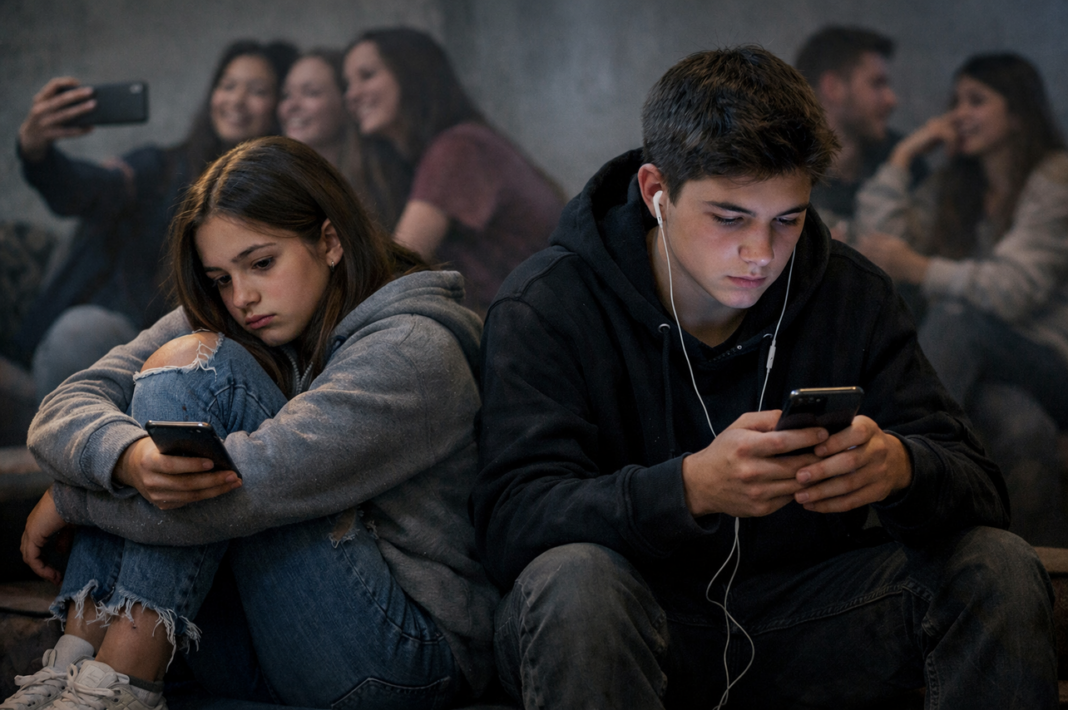
Adolescents I work with are rarely socially disconnected in a literal sense; instead, they often feel emotionally unseen while remaining constantly online. This contrast highlights an important distinction between social activity and emotional connection. Adolescents may appear socially engaged while experiencing a lack of emotional depth, responsiveness, and understanding within their relationships.
Connection Without Closeness
Online communication enables adolescents to stay in frequent contact with peers, yet these interactions often remain superficial. Messages, likes, and reactions provide visibility but do not necessarily foster emotional reciprocity. As a result, adolescents may feel present but unsupported, connected yet alone.
Digital environments also shape how adolescents evaluate themselves. Constant exposure to peers’ curated lives can intensify social comparison, fostering feelings of inadequacy, exclusion, and self-doubt. Unlike offline comparison, which is situational and time-limited, digital comparison is continuous and difficult to escape. Over time, this dynamic can erode emotional security and contribute to withdrawal.
Why Adolescents Are Especially Vulnerable
Adolescence is characterized by ongoing brain development, particularly in regions involved in emotional regulation, impulse control, and reward processing. During this stage, adolescents are especially sensitive to social feedback and external validation. Social media platforms, built around immediate reinforcement and continuous evaluation, are therefore particularly compelling.
Rather than reflecting pathology, adolescents’ heightened emotional responses to digital environments often reflect developmental vulnerability. Mood fluctuations, anxiety, and reliance on external feedback may intensify when emotionally demanding platforms intersect with still-maturing regulatory capacities. Social media does not create this vulnerability, but it can amplify it.
Feeling Lonely In Crowded Spaces
Despite unprecedented levels of online interaction, many adolescents report feeling emotionally isolated. Digital spaces may be crowded with communication yet lacking in emotional safety, attunement, or mutual understanding. Adolescents often describe being visible to many people without feeling genuinely known.
In clinical conversations, adolescents often describe online spaces as crowded but emotionally empty, where presence is constant but understanding is scarce. This experience reflects a mismatch between quantity of interaction and quality of connection. Emotional isolation emerges not from being alone, but from being unseen.
Sharing Feelings Without Being Held
Social media offers adolescents new ways to express emotions publicly, yet emotional expression does not always lead to emotional support. Adolescents may share distress in search of validation or connection, but responses are often brief, delayed, or misaligned with their emotional needs.
Without attuned responses, emotional expression can become performative rather than reparative. Over time, adolescents may externalize distress without processing it internally, limiting opportunities to develop reflective coping strategies and emotional regulation skills.
Different Paths To The Same Loneliness
The emotional impact of social media is not uniform across adolescents. Girls tend to experience greater emotional strain related to appearance-based comparison, relational monitoring, and perceived social evaluation. These pressures are associated with increased anxiety, depressive symptoms, and body dissatisfaction.
Boys may experience emotional isolation in less visible ways. Distress often appears as irritability, withdrawal, or disengagement rather than verbalized loneliness. These gendered patterns can obscure emotional suffering and contribute to delayed recognition and intervention.
When Loneliness Goes Unnoticed
Emotionally isolated adolescents frequently remain undetected by parents, educators, and clinicians. High levels of digital engagement can create the illusion of social fulfillment, masking internal experiences of loneliness and disconnection.
One of the most concerning clinical patterns is how adolescent loneliness is dismissed as a normal consequence of screen use rather than recognized as a psychological warning sign. When emotional isolation remains unaddressed, it can increase vulnerability to anxiety disorders, depressive disorders, self-harm, and suicidal ideation. Early recognition requires attention not only to observable behavior, but also to adolescents’ subjective emotional experiences.
Restoring Meaningful Connection
Addressing adolescent emotional isolation requires moving beyond simplistic narratives that portray social media as either harmful or harmless. More effective approaches emphasize relationship quality, emotional responsiveness, and meaningful connection. Preventive and school-based interventions that support emotional literacy, peer empathy, and relational safety show promise in reducing risk and enhancing resilience.
Prevention should not aim to eliminate screens, but to restore depth, responsiveness, and emotional safety in adolescents’ relational worlds. Clinicians and caregivers benefit from exploring how adolescents experience their online interactions, focusing on emotional meaning rather than usage frequency alone.
Seeing Adolescents Beyond The Screen
Social media plays a complex role in adolescent development. Its psychological impact depends less on how often adolescents are online and more on how emotionally supported they feel within their relationships. For many adolescents, constant connection without emotional attunement deepens loneliness rather than alleviating it.
Ultimately, the most important question is not how connected adolescents appear, but how deeply they feel seen.
References
Allen, K. A., Kern, M. L., Vella-Brodrick, D., Hattie, J., & Waters, L. (2022). What schools need to know about fostering belonging: A meta-analysis. Educational Psychology Review, 34(1), 1–34. https://doi.org/10.1007/s10648-021-09662-7
Blakemore, S. J., & Mills, K. L. (2014). Is adolescence a sensitive period for sociocultural processing? Annual Review of Psychology, 65, 187–207. https://doi.org/10.1146/annurev-psych-010213-115202
Chaplin, T. M. (2015). Gender and emotion expression: A developmental contextual perspective. Emotion Review, 7(1), 14–21. https://doi.org/10.1177/1754073914544408
Keles, B., McCrae, N., & Grealish, A. (2020). The influence of social media on depression, anxiety, and psychological distress in adolescents: A systematic review. International Journal of Adolescence and Youth, 25(1), 79–93. https://doi.org/10.1080/02673843.2019.1590851
Kelly, Y., Zilanawala, A., Booker, C., & Sacker, A. (2019). Social media use and adolescent mental health: Findings from the UK Millennium Cohort Study. EClinicalMedicine, 6, 59–68. https://doi.org/10.1016/j.eclinm.2018.12.005
Loades, M. E., Chatburn, E., Higson-Sweeney, N., et al. (2020). Rapid systematic review: The impact of social isolation and loneliness on the mental health of children and adolescents. Journal of the American Academy of Child & Adolescent Psychiatry, 59(11), 1218–1239. https://doi.org/10.1016/j.jaac.2020.05.009
Montag, C., Lachmann, B., Herrlich, M., & Zweig, K. (2019). Addictive features of social media platforms: A review of behavioral mechanisms. Behavioral Sciences, 9(4), 44. https://doi.org/10.3390/bs9040044
Nesi, J., Choukas-Bradley, S., & Prinstein, M. J. (2021). Transformation of adolescent peer relations in the social media context. Journal of Research on Adolescence, 31(1), 79–99. https://doi.org/10.1111/jora.12586
Odgers, C. L., & Jensen, M. R. (2020). Annual research review: Adolescent mental health in the digital age—Facts, fears, and future directions. Journal of Child Psychology and Psychiatry, 61(3), 336–348. https://doi.org/10.1111/jcpp.13190
Twenge, J. M., Haidt, J., Joiner, T. E., & Campbell, W. K. (2023). Worldwide increases in adolescent depression and anxiety following the widespread adoption of social media. Journal of Adolescence, 96, 213–227. https://doi.org/10.1016/j.adolescence.2022.11.006