


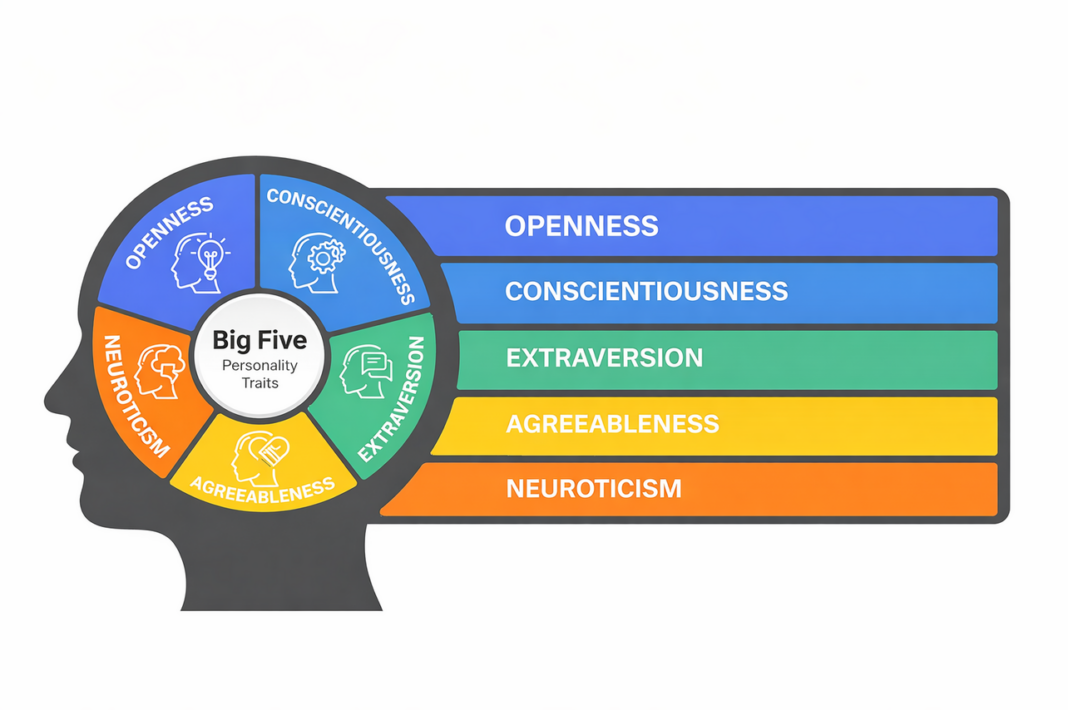

Personality is the fundamental determinant of human behavior and individual differences. What makes some of us outgoing, others cautious or creative? These questions have long been central in psychology. In recent years, one of the most robust answers to these questions has been the Big Five Personality Model (Five-Factor Model / OCEAN). This model approaches personality through five core dimensions, providing a widely used framework in both academic and applied psychology.
From Personality Types To Dimensions: Why This Model Is The “Gold Standard” In Psychology
In the past, personality was often explained through types. People were categorized as “introverted” or “extroverted,” “thinking” or “feeling.” However, this approach proved insufficient for understanding the complex, context-dependent nature of human behavior. Most people fall somewhere between the extremes, exhibiting different behaviors depending on the situation.
The Five-Factor Model evaluates personality in a dimensional framework, rather than forcing individuals into rigid “either–or” categories. Each dimension exists on a continuum from low to high, allowing the complexity of personality to be studied in a scientific and measurable way.
The Five Factors: Universal Dimensions Of Personality
The Five-Factor Model examines personality across five primary dimensions:
Extraversion
Reflects social interaction, energy, and communication levels. High extraversion is associated with sociability and assertiveness, while low levels indicate introversion and quietness.
Agreeableness
Encompasses empathy, cooperation, and friendliness toward others. High agreeableness is linked to trust and social harmony.
Conscientiousness
Represents organization, planning, and sense of duty. This dimension is strongly related to academic and occupational success.
Neuroticism (Emotional Stability)
Measures susceptibility to anxiety, stress, and negative emotions. High neuroticism indicates emotional variability, while low levels reflect emotional resilience.
Openness To Experience
Covers creativity, curiosity, and openness to new ideas. It reflects intellectual flexibility and an exploratory approach to learning.
These dimensions have been consistently validated across cultures, supporting the model’s universal applicability.
Scientific Basis And Reliability
The scientific strength of the Five-Factor Model stems from its empirical foundation. The model was developed using lexical studies of personality descriptors and factor analysis. In particular, the work of Paul Costa and Robert McCrae demonstrated that the model could be reliably measured and validated.
Scales such as NEO-PI-R and NEO-PI-3 are widely used in research and applied psychology. These assessments produce consistent results across repeated measurements, reinforcing the model’s reliability and validity.
Clinical And Applied Uses
While the Five-Factor Model was not originally designed for clinical diagnosis, it is used as a complementary tool in psychiatry and clinical psychology. Dimensional approaches to personality disorders align closely with modern perspectives on psychopathology.
Additionally, the model is widely applied in psychological counseling, career planning, organizational psychology, and academic research. By objectively identifying an individual’s strengths and areas for growth, it enhances self-awareness and can improve quality of life.
Comparison With Popular Personality Tests
Recent years have seen the rise of popular online personality tests (e.g., 16Personalities / MBTI), which attract broad audiences but lack the scientific validity and reliability of the Big Five. The power of the Big Five lies not in entertaining labels, but in its ability to capture the complex, measurable reality of human personality—one of the main reasons it is preferred in academic and clinical settings.
In contrast, tests such as the MMPI, commonly used by psychologists and psychiatrists, assess mental health concerns such as depression, anxiety, or personality disorders. The Five-Factor Model, however, focuses on normal personality structure, highlighting strengths and growth areas without diagnosing psychological disorders.
In short:
-
MMPI: “Does this person have psychopathology?”
-
Big Five Personality Test: “Who is this person, and how do they behave across different dimensions?”
Why Taking A Big Five Test Matters
Taking a Big Five test is not merely a fun exercise—it is a meaningful first step in personal development. For example:
-
Knowing your level of extraversion can help you develop strategies for social interactions.
-
Understanding your conscientiousness can improve planning in academic and professional goals.
By translating personality traits into actionable insight, the model supports intentional growth.
Conclusion
The Five-Factor Model examines personality without reducing it to simplistic categories, offering a measurable, scientifically grounded, and universal framework. It has become an indispensable model in both academic psychology and applied settings.
For anyone seeking to understand personality, the Big Five provides a strong starting point. It helps individuals recognize their strengths, identify areas for growth, and navigate life more consciously. Understanding your own personality also enhances understanding of others—making the Big Five a guide for anyone curious about the complexity of human behavior.
Taking a Big Five test is not just an enjoyable experience; it is an important first step in a journey of personal growth. Observe your results, recognize your strengths, and develop awareness of areas for improvement.
References
Costa, P. T., & McCrae, R. R. (1992). Revised NEO Personality Inventory (NEO-PI-R) and NEO Five-Factor Inventory (NEO-FFI) professional manual. Psychological Assessment Resources.
Gosling, S. D., Rentfrow, P. J., & Swann, W. B., Jr. (2003). A very brief measure of the Big Five personality domains. Journal of Research in Personality, 37(6), 504–528. https://doi.org/10.1016/S0092-6566(03)00046-1
McCrae, R. R., & Costa, P. T., Jr. (2008). The five-factor theory of personality. In O. P. John, R. W. Robins, & L. A. Pervin (Eds.), Handbook of personality: Theory and research (3rd ed., pp. 159–181). Guilford Press.