


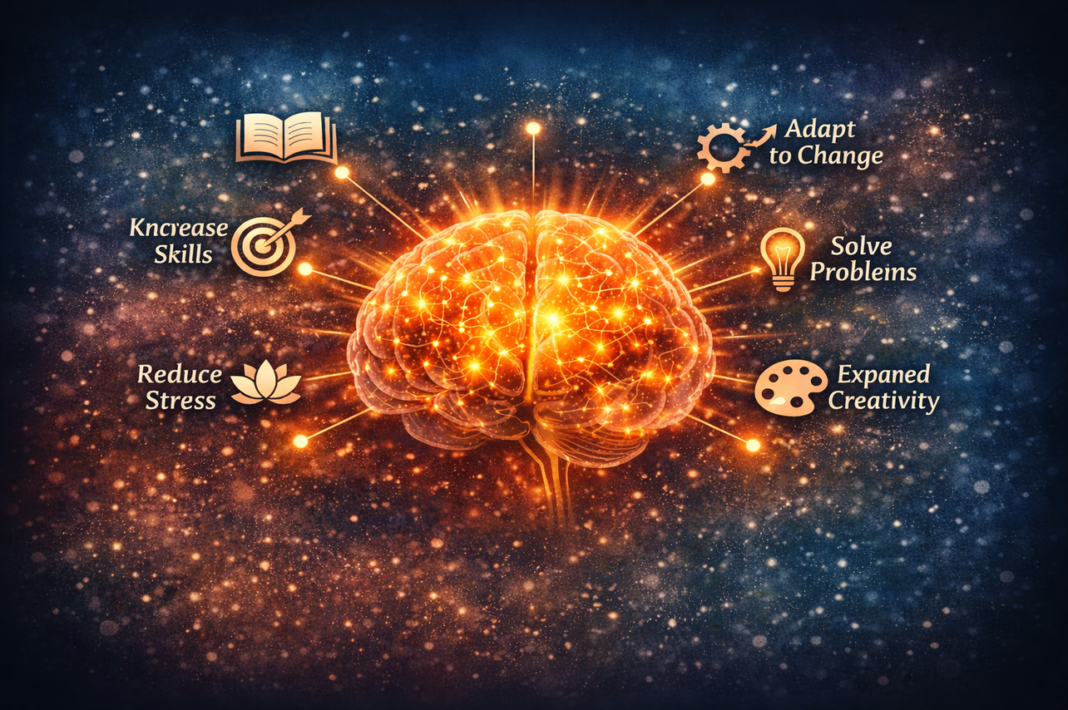

At its most fundamental level, learning is the process through which an individual mentally processes new knowledge and skills acquired through experience, observation, or interaction. Each learning experience forms new synaptic connections in the brain. Today, extensive research is being conducted on the neurobiological changes that occur in the brain after learning.
The Neurobiology Of Skill Acquisition
A study examining the restorative and developmental effects of learning on the brain asked 18 professional and 18 amateur archers to shoot arrows while their brain activity was measured using fMRI. The results showed that amateur archers exhibited higher levels of brain activity compared to professionals. When performing a newly learned movement, the brain initially requires significant activation. As the movement is repeated, it becomes autonomous. This means that when a behavior is repeated, the brain expends less energy to execute it.
Cognitive Shifts During Practice
Scientists at Cornell University analyzed findings from previous studies in which participants were given new tasks and their learning processes were monitored to better understand how the brain changes during learning. The results indicated that when learning new information or performing a task for the first time, areas of the brain associated with attention are highly active. However, as practice and repetition continue, activity in these attention-related areas decreases. At the same time, regions associated with imagination and reflective thinking become more active. Therefore, when individuals perform a behavior they have repeated many times, they may simultaneously recall past experiences or think about the future.
Psychological And Social Benefits
Research shows that the fundamental positive psychological effects of learning include:
-
Increases self-confidence and self-efficacy
-
Reduces stress and anxiety
-
Lowers the risk of depression
-
Enhances cognitive flexibility
As a result, learning strengthens social bonds and fosters a sense of belonging within groups. Sharing and interaction increase, and feelings of loneliness decrease. However, if learning is not managed well, individuals may initially feel more discomfort than before learning. For example, after learning something new, a person may realize how little they previously knew, or may feel anxious about needing to act differently or step outside their comfort zone. Therefore, learning must be managed gradually and intentionally.
Knowledge Production Versus Consumption
Learning is not merely understanding; it is being able to recall. The act of trying to remember challenges the mind, and this struggle is one of the most fundamental indicators of learning. If everything feels too easy, you are probably consuming information rather than truly learning. It is essential to distinguish between information consumption and knowledge production.
Holistic Impact On Well-Being
Learning affects the individual holistically—biologically, psychologically, and socially—enhancing overall well-being. It sharpens the mind, balances emotions, and improves emotional awareness and regulation. A learning individual becomes better at setting boundaries, saying “no” more clearly, and is less susceptible to manipulation.
As knowledge increases, decision-making improves. Fewer mistakes are made. Risks and opportunities are identified earlier, allowing the individual to stay several steps ahead. As uncertainty decreases, self-confidence grows, because one of humanity’s greatest fears is not knowing.
Adaptation And Professional Growth
With learning, problem-solving speed increases. We analyze more effectively, generate better solutions, and significantly reduce the likelihood of repeating the same mistakes. As you create more value, your income potential increases—and creating value begins with learning. Learning enables adaptation to change. What is true today may be false tomorrow. Through learning, change can be managed rather than feared.
Cognitive Strength And Independence
As learning continues, memory and mental strength improve. Attention, recall, and cognitive flexibility increase. Communication skills develop; one becomes more articulate, persuasive, and clear. As you learn, curiosity expands. Increased curiosity reduces monotony and opens the door to a more vibrant life. A learning individual becomes more independent, solving problems with less external assistance and progressively increasing their capacity to shape their own path. Sometimes learning means disrupting comfort in order to gain freedom—and freedom is the greatest comfort of all.
References
-
https://www.sciencenewsforstudents.org/article/learning-rewires-brain
-
Gallicchio, G., Cooke, A., Ring, C., “Practice makes efficient: Cortical alpha oscillations are associated with improved golf putting performance.”, Sport, Exercise, and Performance Psychology, Cilt 6, Sayı 1, s. 89-102, 2017.
-
Johnson, M. H., Munakata, Y., Gilmore, R. O., “Experience and Brain Development”, Brain Development and Cognition: A reader, Second Edition, s. 186-216, 1993.